Derogatory remarks against Hinduism, Hindu organisation, and leaders made by retired High Court judge
 Bidar, Karnataka, India
  7 December, 2025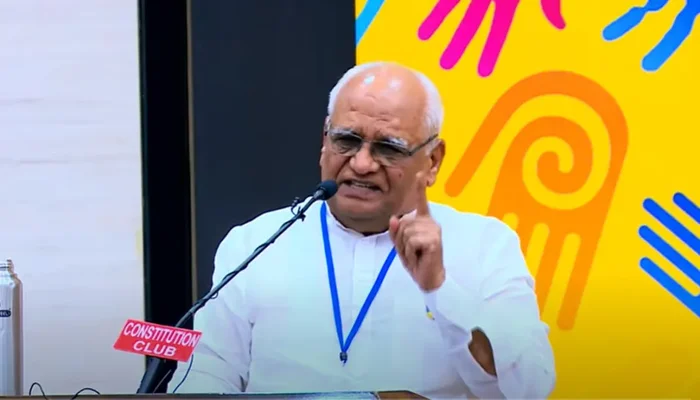
Case Summary
Hindu religious sentiments were insulted by retired Bombay High Court judge B.G. Kolse Patil, who claimed Hinduism is not a religion, but a Persian derogatory term. He also had a history of making anti-Hindu speeches, including making offensive remarks against Brahmins and Veer Sarvarkar. According to reports, on 8 December 2025, while speaking at the Sufi saints’ conference in Basavakalyan, Bidar district, an event organised by Salim Ahmed (Member of Legislative Council), he began targeting Hinduism. He claimed that Hinduism was not a religion but merely a Persian word manipulated by Brahmins to “enslave society". He further accused the Rashtriya Swayamsevak Sangh (RSS), a Hindu organisation, of being responsible for every riot in India, including the 1984 Sikh riots, insisting that Indians were too frightened to speak against the organisation. His remarks drew strong public outrage and reflected a consistent pattern of targeting Hindu identity, Brahmins, and the RSS through inflammatory statements. He continuously portrayed Brahmins as “cowards,” repeated his claim that “Hindu” is a derogatory term, and encouraged the audience, particularly Muslim religious leaders, to attack Hindu identity in public discourse. Kolse Patil had repeatedly used public platforms to attack Hindus and Hinduism, while portraying himself as an activist. For example, in 2016, he claimed that Hindutva was merely a deceptive façade for what he called Brahmanism, and insisted that India’s progress depended on the defeat of the RSS. To further vilify RSS, he regularly portrayed it to have links with Pakistan's ISI, claiming that it received foreign funding, and hinting at plots to destabilise India. Furthermore, during the Citizenship Amendment Act, he ran a misinformation campaign where he claimed that the CAA law was crafted only to protect Hindus, and said that Muslims were being thrown into “detention centres.” During this time, at a Jamaat-e-Islami Hind rally in January 2020, he was recorded urging the Muslim crowd to “hit the streets,” stating that they must decide whether they wanted to “rot and die” or “fight and die." He was also previously booked by the Pune police for defamatory remarks about Veer Savarkar, a Hindu religious icon, including fabrications that Savarkar was convicted for rape in England and that he opposed India’s freedom struggle. These statements were designed to vilify a respected figure in the independence movement and contributed to a broader pattern of attempting to delegitimise Hindu historical and cultural narratives.
Why it is Hate Crime ?
The primary category selected in this case is- Hate Speech against Hindus. The subcategory selected is- Anti-Hindu slurs, mocking faith. Anti-Hindu slurs and the deliberate mocking of the Hindu faith owing to religious animosity involve the usage of derogatory terms, stereotypes, or offensive references to religious practices, symbols, or figures. One of the common anti-Hindu slurs used against Hindus is “cow-worshipper” and “cow piss drinker”. The intention of using this term is to demean and mock Hindus as a group and their religious beliefs since Hindus consider the cow holy. Additionally, some symbols and the slurs attached to them have a historical context that exacerbates the insult, hate, stereotyping, dehumanisation and oppression against Hindus. Cow worship has been used for centuries to denigrate Hindus, insult their faith and oppress Hindus specifically as a religious group. There has been overwhelming documentation about how cow slaughter has been used to persecute Hindus with cow meat being thrown in temples and places of worship. There has also been overwhelming documentation where cow meat (beef) has been force-fed to Hindus to either forcefully convert them to Islam or denigrate their faith. Apart from cow worship, the Swastika – which holds deep religious significance for the Hindus – has also been misinterpreted and distorted to use as a slur against Hindus. Similarly, the worship of the Shivling has been used by supremacist ideologies and religions to denigrate Hindus owing to religious animosity. Such slurs and denigration stem out of inherent animosity and hate towards Hindus and their faith, therefore, it is categorised as hate speech targeted at Hindus specifically owing to their religious identity. The other sub-category selected here is - Mocking/denigrating Hindu leaders. Hate speech is defined as any speech, gesture, conduct, writing, or display that is prejudicial against a specific individual and/or group of people, which is leading to or may lead to violence, prejudicial action or hate against that individual and/or group. Religious leaders are often seen as representatives of the community, especially, the community’s religious faith and beliefs. Mocking or denigrating a religious leader specifically owing to his religious identity and/or the religious rituals he observes can be considered hate speech because the motivating factor of the speech is animosity and/or dislike for what he represents – the religious beliefs and faith of the community. It is important to note that mere insulting words against an individual do not constitute hate speech. It is entirely possible that insulting words are used for an individual, however, the specific speech is not the result of religious hate and/or animosity towards the professed faith of the religious leader, but the individual himself. For the speech to be considered hate speech, the speech itself or the motivating factor behind the speech has to be religious in nature. Such speech which denigrates Hindu religious leaders specifically owing to animosity towards the faith they profess and the community faith they represent will be treated as hate speech under this category. This case has been added to the tracker because Hindu religious sentiments were insulted by Retired Bombay High Court judge B.G. Kolse Patil, who claimed Hinduism is not a religion, but a Persian derogatory term. Firstly, Kolse Patil publicly claimed that Hinduism was not a religion and described the word “Hindu” as a Persian derogatory term. He also claimed that Brahmins had created and manipulated that label to “enslave society.” These statements directly attacked the existence of an entire religious community by denying that Hindus even have a religion or identity. The idea that “Hindu” is only a Persian slur is factually wrong. Historically, the term came from the Sanskrit word “Sindhu,” and over centuries it became the recognised name for the broad civilisational and religious traditions now called Hinduism, or Sanatana Dharma. By twisting this history into a narrative that Hindu identity doesn’t exist, but rather it was a Persian slur, he tried to delegitimise Hindu identity itself, turning a whole community into something fake or invented. When any individual denies the existence of a religion, it is not a debate; it is a targeted humiliation meant to demean and strip away its social and cultural recognition, thereby insulting the sentiments of its followers. This is an old strategy that Hinduphobia repeatedly uses: the attempt to erase the Hindu as a recognisable civilisational category, to reduce Hindus to fragmented caste units, and to deny the legitimacy of Hindu self-definition. Such statements have structural meaning. They delegitimise Hindu existence itself. They deny the right of Hindus to define themselves as a collective. This is a core feature of contemporary Hinduphobic rhetoric. Secondly, this was not a one-off incident or a one-off remark. Kolse Patil repeatedly attacked Hindus as a group, insulted Brahmins as “cowards,” and openly encouraged Muslim religious leaders to challenge and “attack” Hindu identity in public spaces. This went far beyond political disagreement. His speech targeted a specific religious identity, Hinduism, with the intention to degrade, shame, and provoke hostility. The pattern of calling Hindu identity fake, Brahmins manipulative, and Hindu organisations criminal leads to a climate where contempt for Hindus becomes normal and acceptable, resulting in hostility against them. Thirdly, he further claimed that the RSS was behind “every riot in India,” even the 1984 Sikh massacre, and repeatedly hinted that the RSS was working with Pakistan’s ISI. While presented as political criticism, these statements were designed to smear an organisation that unequivocally works for the Hindu cause. It is important to note that the RSS is a Hindu organisation founded on the ideology of Hindutva, which is a political, cultural, and civilisational movement aimed at protecting Hinduism from anti-Hindu forces such as Islamist fundamentalism, Khalistani extremism, aggressive Christian proselytisation, and left-liberal or Marxist ecosystems that promote anti-Hindu narratives. The ideology of Hindutva is not one of violence or suppression of minorities as most anti-Hindu groups portray it. It stands for unity, strength, and self-defence. It inspires Hindus across caste, class, and gender lines to unite in preserving their faith, dignity, and religious identity. Therefore, attacking the RSS in such sweeping, conspiratorial terms is a common tactic used to demonise the wider Hindu community by making Hindu self-organisation seem dangerous or illegitimate. His statements demonised the efforts of Hindu organisations working to preserve and uplift their community and turned Hindutva, a vision of unity and resilience, into a subject of disdain. Effectively, he was portraying Hindus as a threat by portraying their organisation as having links to Pakistan and riots in the country. By calling for the defeat of RSS, he attempted to suppress Hindu political and cultural expression, violating the principles of freedom of expression and association. His remarks risked spreading animosity and discrimination, potentially inciting hostility against Hindus by painting them as a source of law and order disturbances. Fourth, during the CAA protests, Kolse Patil spread the false claim that the law existed only to protect Hindus and that Muslims would be thrown into “detention centres.” As a former judge, he very well knew these claims were misleading, yet he still used them to stoke fear. He went further by telling Muslim crowds to “hit the streets” and choose whether they wanted to “rot and die” or “fight and die.” Combining false accusations with calls for street action deliberately risked inflaming communal tensions. This was not activism; it was dangerous incitement against Hindus based on misinformation, which resulted in hostility and violence towards them. Fifth, Kolse Patil was previously booked for making false allegations against Veer Savarkar, a Hindu religious icon, that he was convicted of rape in England and that he opposed India’s freedom struggle. These claims were not supported by evidence but were meant to disgrace one of the most important Hindu icons. Targeted false accusations against prominent religious or historical figures were a common tactic used by many leftists to delegitimise a community’s heroes and to erode the moral authority that those figures held among believers. Savarkar was (and is) a polarising but central figure for many Hindus; the deliberate spread of demonstrably false or defamatory charges about him was thus part of a pattern that sought to strip Hindu icons of legitimacy and to normalise public contempt for Hindu historical memory. In conclusion, Kolse Patil’s statements were not isolated comments but part of a long-standing pattern of hostility towards Hindu identity, Hindu organisations, and Hindu icons. By denying Hinduism, spreading falsehoods, inciting crowds, and repeatedly insulting Hindu figures, he engaged in direct ideological aggression against an entire religious community. This incident, therefore, fully meets the criteria of a hate-driven, anti-Hindu act and is accordingly documented in the Hinduphobia Tracker.


Case Status
Unknown


Perpetrators Details
Perpetrators
Others
Perpetrators Range
One Person
Perpetrators Gender
male
 Sources




