Hindu temple attacked, sacred idols desecrated by Sikh man in Ludhiana, Punjab
 Ludhiana, Punjab, India
  30 November, 2025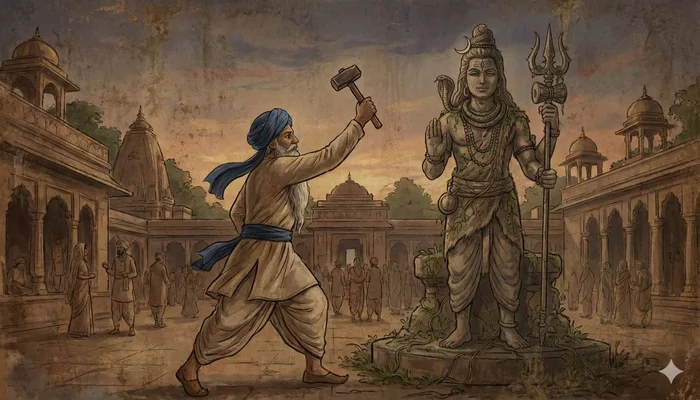
Case Summary
A Shiv temple in Dugri, Ludhiana, Punjab, was vandalised on 1st December 2025. The incident occurred when a Sikh man, identified as Surender Puri, claiming to be there to pay respects, entered the temple of Lord Bhole Nath and engaged in inappropriate behaviour. After the incident, people present at the temple immediately apprehended the suspect and handed him over to the police. According to a devotee, Surender Puri, the accused entered the temple under the pretence of offering prayers. He stood before the deity with his eyes closed and waited for other devotees to leave. During the brief period he was in the temple—approximately 10 to 15 minutes—the accused took the opportunity to vandalise the sacred murtis. CCTV footage from the temple confirmed these actions. The Hindu devotee further added that the accused tried to spoil the Hindu-Sikh brotherhood. The accused, who wore a turban and had a beard, first broke a rudraksha mala. He then proceeded to break another mala that was used for adorning the Shiva idol. In a further act of disrespect, the accused drank the ritualistic water from a conch shell placed before the deity. His actions did not stop there; he attempted to break the horns of the statue of Nandi, a sacred symbol in Hindu worship. However, before he could damage it further, people noticed and intervened, preventing more harm. The police, upon investigation, learned that the accused had a personal dispute with his wife, who had left him. Authorities suggested that this domestic issue may have affected his mental state. However, they emphasised that the investigation into his actions is ongoing. The accused was arrested and charged under Section 298 of the Indian Penal Code. The local police have stated that he will be presented in court soon. The incident has sparked significant anger within the local Hindu community, and many people have called for strict action against the accused. The authorities are continuing to investigate the case.
Why it is Hate Crime ?
This case has been added to the tracker under the primary category: Attack on Hindu religious representations. The first subcategory selected is: Desecration of Hindu religious symbol. Icons and symbols, or a religious representation of a spiritual ideal, are widely revered in Hinduism. Iconography is of vital significance in the Hindu milieu. It helps connect people’s spiritual beliefs with the real world. Iconography within the Hindu faith takes several forms. Murtis are of most significance to Hindus, to which daily rituals, prayers and offerings are done. Besides the murtis, there are several other symbols which have deep significance in the Hindu faith – the Om and Swastika, for example. Since these Hindu religious symbols hold paramount importance in Hinduism, any desecration of symbols, icons, murtis, religious representations and manifestations, is driven by animosity towards the faith itself, which manifests itself through these murtis, icons and symbols. Therefore, any desecration of these Hindu religious symbols and representations is considered a religiously motivated hate crime under this category. The second subcategory selected is: Attack on the temple. In Hinduism, a temple is the abode of the Deity. The Deity in the Temple is consecrated, thereby making it a real, breathing entity. Hindus believe that not just the Deity but the temple premises itself are sacred to Hindus since Hindus hold the faith that the entire Temple space is an amalgamation of the divine energy of the deity. Given the central significance of Temples in Hindu Dharma, any attack against a Hindu Temple or its peripheral premises is an attack on the faith itself and is born out of animosity towards the faith, of which the Temple is a central tenet. Any manner of attack against a Temple and/or its premises would therefore be considered a religiously motivated hate crime. The incident at the Shiva temple in Dugri, Ludhiana, constituted a clear case of an anti-Hindu hate crime. The Sikh perpetrator desecrated sacred idols inside the temple. In Hinduism, idols (Murtis) are not mere symbols or decorations; they are living representations and manifestations of the divine. Hindus believe that the divine presence resides within these murtis, and therefore, they are central objects of daily worship and devotion. Any act of attacking or desecrating idols is thus not a random act of vandalism but a deliberate attack on the Hindu faith and its most sacred expressions. This act showcased deep-rooted religious animosity harboured by the perpetrators against the Hindu community, its beliefs, and its places of worship, making it a religiously motivated crime. The desecration of the idols also amounted to an attack on the temple itself. The idols form the spiritual core of a temple; they are the sacred essence around which the temple is built. To defile or destroy them is to attack the very sanctity and existence of the temple as a religious institution. This act was, therefore, not an isolated instance of vandalism but a targeted desecration of a Hindu temple, reinforcing the communal motivation behind the crime. Given that this incident fulfilled the core parameters of a religiously motivated hate crime — targeting a Hindu place of worship and desecrating sacred objects central to the Hindu faith — it has been documented and added to the Hinduphobia Tracker’s hate crime database. It is important to mention here that the police suggested that a domestic issue may have affected the accused's mental state. The police and the media, in many such cases, where the crime has been committed against the Hindu faith by a non-Hindu perpetrator, deny that the crime committed was in any way motivated by a religious bias and attribute it to the perpetrator’s mental health. The police also often say that the crime was committed because the accused was mentally unstable, because they wish to ensure that, owing to the crime already committed, there is no further flare-up in the area. In fact, there are many cases where this strategy has been used by the media to downplay such incidents where the crime was committed by a non-Hindu perpetrator, for example, the attack on the Gorakhnath temple or the incident in Telangana where two Muslim women wearing a burqa tried to damage temple and church idols. The use of the "mental illness" trope to justify crimes targeting Hindu temples or idols by non-Hindu perpetrators raises critical questions. If perpetrators are indeed mentally unstable, why do they specifically target Hindu idols and places of worship, leaving mosques and gurudwaras untouched? This selective focus suggests that such acts are not driven by mental health issues but by religious animosity. The repeated use of this narrative to downplay crimes against Hindus reflects a strategic effort to whitewash religious hatred, obscuring the true motivations and intentions behind the attacks.


Case Status
Arrested


Perpetrators Details
Perpetrators
Sikh Extremists
Perpetrators Range
One Person
Perpetrators Gender
male
 Sources




