Hindu villagers, including women, targeted and offered inducements for religious conversion by Christian man
 Shahjahanpur, Uttar Pradesh, India
  29 November, 2025
Case Summary
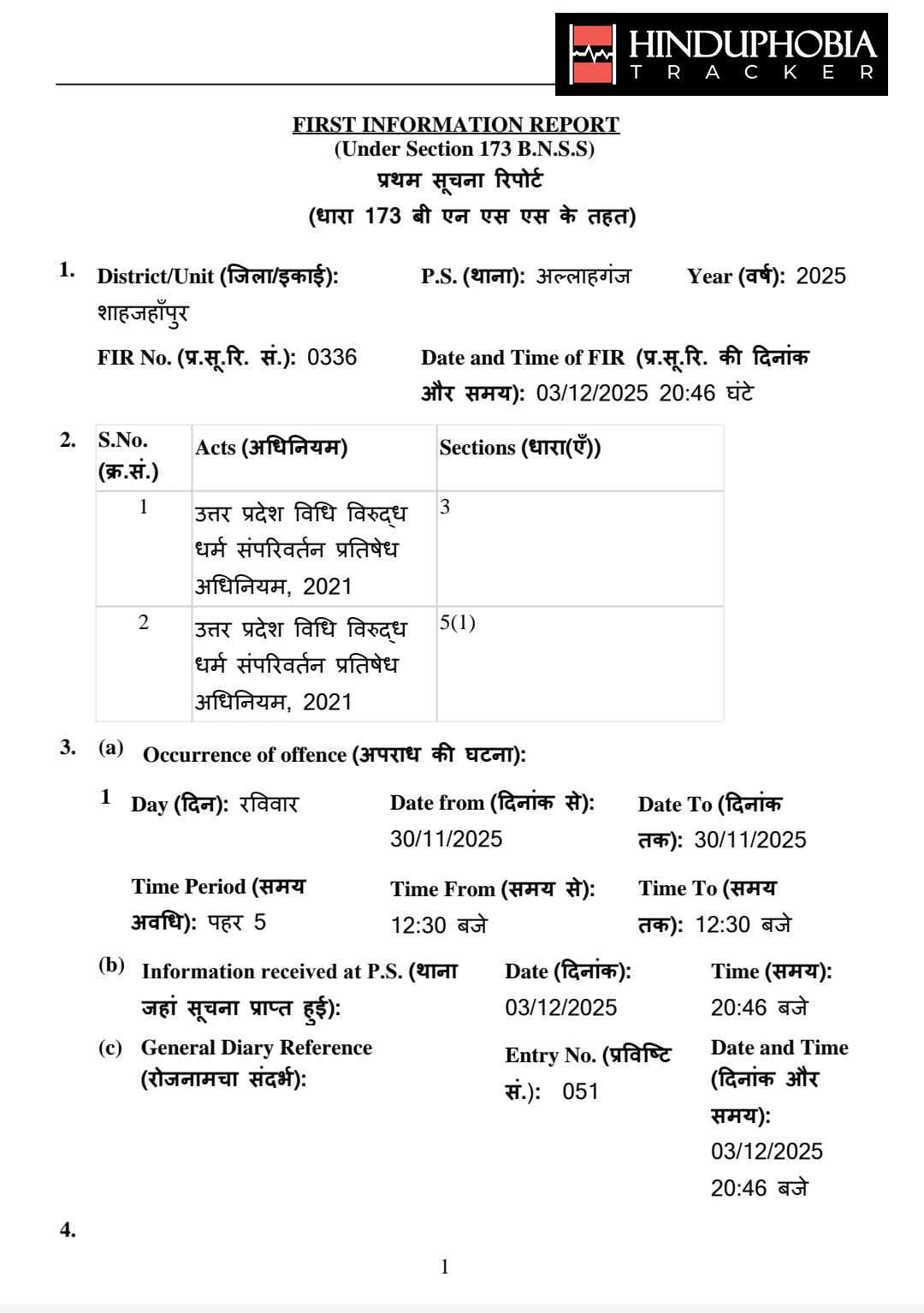
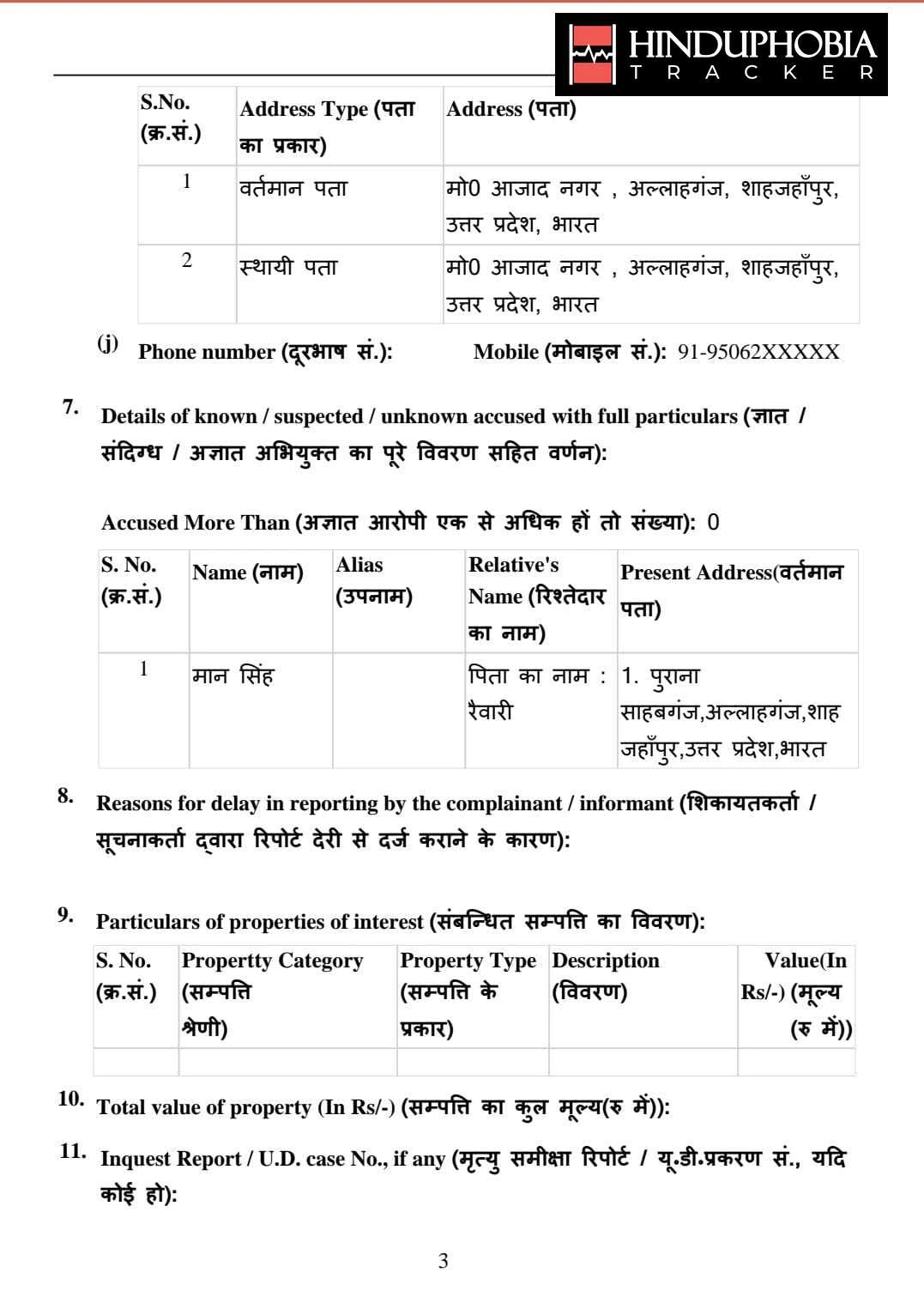
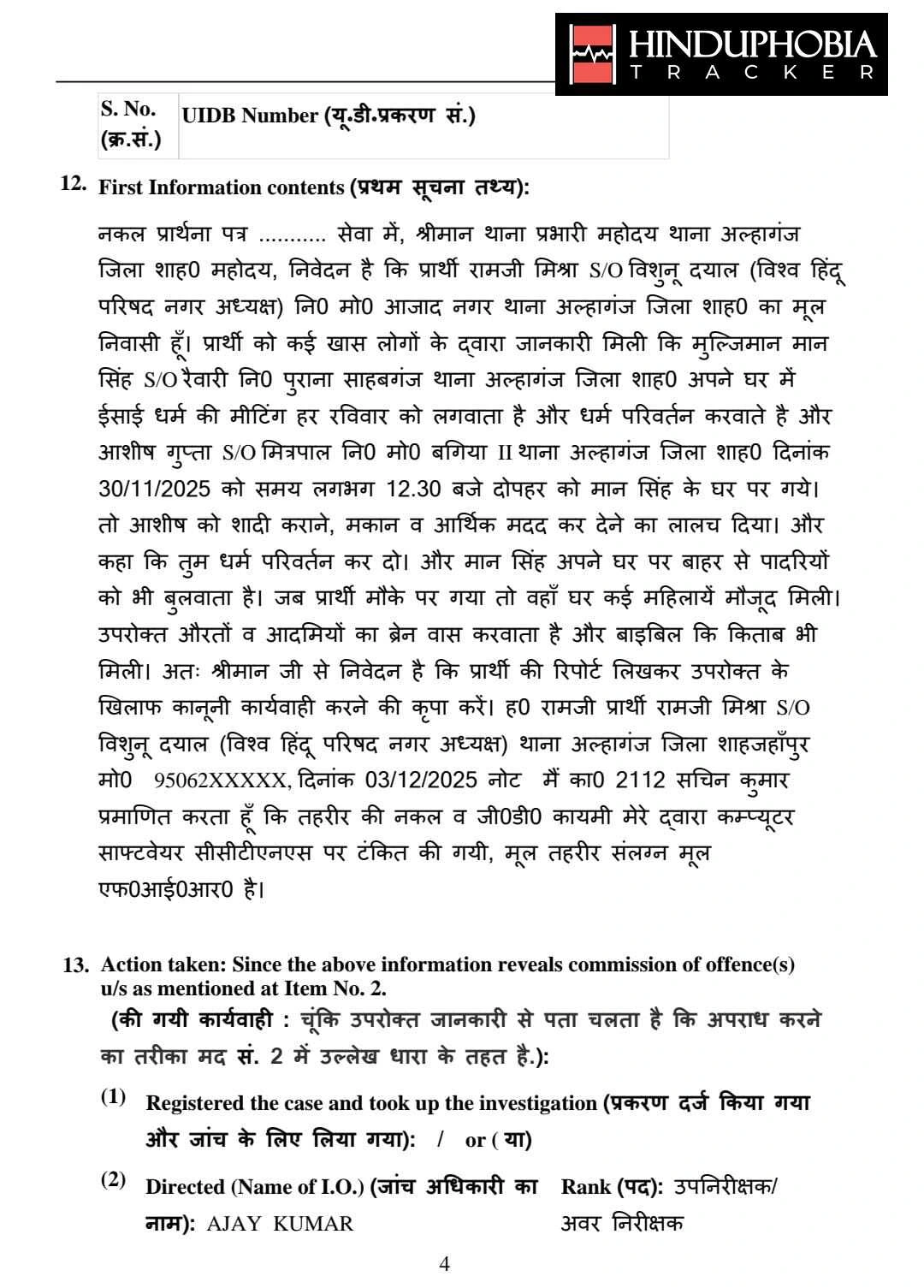
In the Alhaganj area of Shahjahanpur, Uttar Pradesh, Hindu villagers, including women, were targeted for conversion under the guise of a prayer meeting by a Christian man named Man Singh. Man Singh also offered inducements to a Hindu man named Ashish Gupta for religious conversion. The Hinduphobia Tracker accessed the FIR filed by the Hindu activist and Vishwa Hindu Parishad city president Ramji Mishra. He revealed that the Christian accused, Man Singh, had been conducting Christian religious meetings at his residence every Sunday, where he persuaded Hindu villagers to convert to Christianity. The accused used to invite pastors to his home to aid him in conversions. On 30 November 2025, a Hindu man named Ashish Gupta from Mohalla Bagiya was lured to Man Singh’s house. During the meeting, the accused attempted to convert Ashish, by offering various inducements. The accused promised Ashish of arranging his marriage, constructing a house, and providing financial assistance if he converted. When Mishra reached the location, he found multiple women inside, along with religious material including a Bible. He stated that the accused had been brainwashing people for religious conversion. Based on this information, an FIR was registered at the Alhaganj police station, and the police began a detailed investigation. Station House Officer Om Prakash stated that appropriate legal action would follow after investigation.
Case Images
Why it is Hate Crime ?
The primary category selected in this case is- Predatory Proselytisation. The subcategory selected is- Conversion/ attempts to convert by inducement. Predatory Proselytisation is not just limited to threat, harassment, force and violence, but it also has contours of stealth. In several cases, the Hindu victim is exploited to convert, with non-Hindus taking advantage of their poverty. In such cases, the Hindu victim who is suffering financially is offered monetary benefits, including lucrative offers for jobs, health treatment, education, etc, to induce the victim into changing his/her religion. In such cases, the religious identity of the victim and the aim to disenfranchise him from his faith form the heart of the crime. Also, taking advantage of and exploiting an individual’s economic vulnerabilities is widely acknowledged as exploitation, forms of which are often penalised by law. Such cases therefore are considered religiously motivated hate crimes since the victim’s religious identity forms the very heart of the crime itself. The other sub-category selected here is - Proselytisation by grooming, brainwashing, manipulation or subtle indoctrination. The tertiary category selected is- Pattern of targeting Hindus. Religious brainwashing essentially means the often subtle and forcible indoctrination to induce someone to give up their religious beliefs to accept contrasting regimented ideas. Religious grooming or brainwashing also involves propaganda and manipulation. It involves the systematic effort, driven by religious malice and indoctrination, to persuade “non-believers’ to accept allegiance, command, or doctrine to and of a contrasting faith. Cases of such grooming or brainwashing are far more nuanced than direct threats, coercion, inducement and violence. In such cases, it is often seen that there is repeated, subtle and continual manipulation of the victim to induce disaffection towards their own faith and acceptance of the contrasting faith of the perpetrator. While subtle indoctrination is widely acknowledged as predatory, an element which is often understated in such conversions or the attempts of such conversion is the role of loyalty and trust which might develop between the perpetrator and the victim. Fiduciary relationships are often abused to affect such religious conversion. For example, an educator transmitting religious doctrine of a competing faith to a Hindu student. The Hindu student is likely to accept what the teacher is transmitting owing to existence of the fiduciary relationship. The exploitation of the fiduciary relationship to religiously indoctrinate victims would also be included in this category. Since the underlying animosity towards the victim’s faith forms the basis of predatory proselytisation, such cases are considered religiously motivated hate crimes. This case has been added to the tracker because the Hindu villagers, including women, were targeted for conversion under the guise of a prayer meeting by the Christian perpetrator named Man Singh. The accused conducted Christian religious meetings at his house, where he persuaded Hindu villagers to convert to Christianity. Firstly, what was presented as a simple prayer gathering inside a house was in reality a covert attempt at religious conversion. These were not genuine community prayers but calculated efforts to exploit the trust of Hindus and manipulate them into abandoning their faith. The accused also invited pastors so as to aid him in the conversion process, indicating a pattern of targeting Hindus rather than an isolated incident. By conducting such gatherings, the Christian missionaries sought to manipulate vulnerable Hindus, taking advantage of their emotional and social circumstances to push them towards conversion. Secondly, the accused also targeted a Hindu man named Ashish Gupta and offered him various inducements for converting to Christianity. Offering incentives or making false promises, especially when directed at vulnerable individuals in need, shows that these incentives are not acts of kindness or charity. Instead, they are calculated moves to exploit vulnerable Hindus because of their religion. By providing inducements in exchange for conversion, the accused was effectively blackmailing the Hindu man, who could have been desperate for assistance or hope. Such instances are seen in many cases where members of Christian missionary groups target socially and economically vulnerable Hindus to further their agenda of religious conversions. This form of coercion strips people of their agency and dignity and results in coerced conversions. These are not random or isolated incidents, but rather cases deeply rooted in religious animosity towards Hindu victims. Thirdly, the Bible was also recovered from the accused's house. Thus, the Christian perpetrator was also actively attempting to indoctrinate the Hindu victims by using Christian religious texts and literature. Using the scriptures or literature of one faith to deliberately target and manipulate members of another, with the clear intention of religious conversion, represents a direct attack on the Hindu faith. Such actions are designed to violate and undermine the beliefs of Hindu victims and are clear indicators of religious hostility towards Hindus and their religious identity. Such actions further demonstrate that this was not an isolated incident of evangelism, but rather part of a broader, organised operation to further religious conversions. When Christian religious material is used to exploit trust, sow doubt, and misrepresent the beliefs of Hindus to coerce conversion, particularly in a systematic manner, it constitutes a religiously motivated offence. When individuals or groups focus their efforts on converting members of a particular religion, in this case, Hindus, then it demonstrates a fundamental disregard for the Hindu faith. Conversion, especially when not based on personal conviction but rather on external persuasion or pressure, is not simply about sharing a different belief system. It is an attempt to undermine the values, traditions, and identity of the Hindu community. In this context, the Christian perpetrator specifically targeted Hindus, which demonstrates a lack of respect for Hinduism and its followers. Such actions are carried out to strip Hindu victims of their faith, making it a religiously motivated crime. The Christian faith, by its very theological foundations, places a strong emphasis on proselytisation. In pursuit of conversion objectives, Christian evangelists often employ unethical means, ranging from psychological pressure and misinformation to inducements such as money or jobs. This systematic attempt to erode the religious foundation of individuals reflects deep religious malice and animus against the Hindu identity. Because the core motivation of the act stems from hostility toward the victim’s religion, it meets the threshold of a hate crime. Hence, categorised as a hate crime in the database


Case Status
Complaint registered


Perpetrators Details
Perpetrators
Christian Extremists
Perpetrators Range
One Person
Perpetrators Gender
male
 Sources




