Ancient Hindu temple destroyed, sacred idols desecrated and temple land seized by group of men in Bangladesh
 Barisal, Barisal District, Bangladesh
  18 November, 2025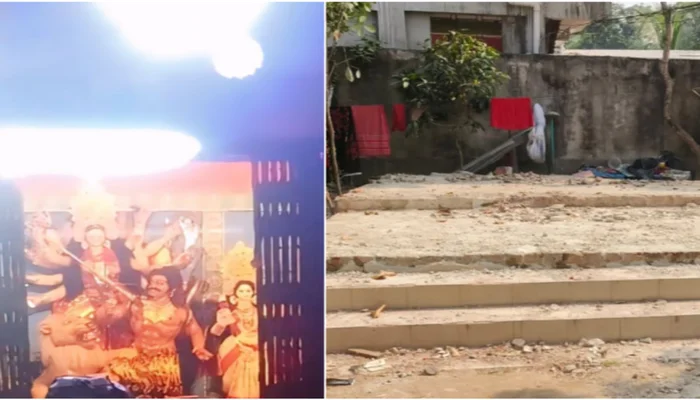
Case Summary
In Barisal, Bangladesh, Hindu religious sentiments were insulted after a Hindu temple was demolished at night and its land forcibly occupied by two men and their accomplices. According to reports, the 150-year-old Sundari Mitra Bari Durga Temple stood on a 10-decimal plot purchased in 1986 by Narayan Mitra in Sundari Mahalla of Gouranadi Municipality in Barisal. The temple was used for annual Durga Puja and other religious programmes and was administered by a committee formed by the local Hindu community. On the night of 19 November 2025, the accused, Ripon Mitra and Suman Mitra, sons of the deceased Braj Bilash Mitra, along with hired men and tenants, demolished the Hindu temple in the middle of the night and occupied its land. They also dumped the idols of Hindu deities and other worship materials into the nearby Palardi River. Subsequently, a complaint was filed on 26 November 2025 by a Hindu man named Narayan Mitra, a resident of the Sundardi area, stating that he purchased the land, including the temple land, from its registered owner, Brajvilash Mitra, on 16 February 1986. However, the accused, Ripon Mitra and Suman Mitra, destroyed the temple, claiming that they had inherited the land and had sold it earlier to repay debts incurred during their mother’s illness. When Narayan Mitra attempted to prevent the destruction, he was threatened, forcing him to approach the authorities. After a complaint was filed in this matter, police officers visited the site and halted ongoing encroachment efforts. Narayan also approached the court, and the Additional District Magistrate, who issued a stay order on the property under Sections 144/145 and instructed the Officer-in-Charge to report on the legal status and possession of the land. Local Hindu residents, fearful of reprisals from the opposing party, refrained from speaking publicly, but community leaders privately condemned the incident as a brutal assault on religious heritage and the dignity of an already vulnerable minority. The General Secretary of the Durga Temple Committee, Nani Das, expressed profound sorrow, noting that the temple was not merely a structure but a symbol of collective devotion and cultural identity. Police officers served the court order to both sides and warned that any further activity on the temple land would trigger legal action.
Why it is Hate Crime ?
This case has been added to the tracker under the primary category of - Attack on Hindu religious representations. Within it, the subcategory selected is- Attack on Temples. In Hinduism, a temple is the abode of the Deity. The Deity in the Temple is consecrated, thereby, making it a real, breathing entity. Hindus believe that not just the Deity but the temple premises itself are sacred to Hindus since Hindus hold the faith that the entire Temple space is an amalgamation of the divine energy of the deity. Given the central significance of Temples in Hindu Dharma, any attack against a Hindu Temple or its peripheral premises is an attack on the faith itself and is born out of animosity towards the faith, of which, the Temple is a central tenet. Any manner of attack against a Temple and/or its premises would therefore be considered a religiously motivated hate crime. The other subcategory selected is- Desecration of Hindu religious symbol. Icons and symbols or a religious representation of a spiritual ideal are widely revered in Hinduism. Iconography is of vital significance in the Hindu milieu. It helps connect people’s spiritual beliefs with the real world. Iconography within the Hindu faith takes several shapes and forms. Murtis are of most significance to Hindus, to which daily rituals, prayers and offerings are done. Besides the murtis, there are several other symbols which have deep significance in the Hindu faith – the Om and Swastika for example. Since these Hindu religious symbols hold paramount importance in Hinduism, any desecration of symbols, icons, murtis, religious representations and manifestations, is driven by animosity towards the faith itself which manifests itself through these murtis, icons and symbols. Therefore, any desecration of these Hindu religious symbols and representations is considered religiously motivated hate crimes under this category. The other sub-category selected is - Encroachment or illicit takeover of temple land/land near temple. In Hinduism, a temple is the abode of the Deity. The Deity in the Temple is consecrated, thereby, making it a real, breathing entity. Hindus believe that not just the Deity but the temple premises itself are sacred to Hindus since Hindus hold the faith that the entire Temple space is an amalgamation of the divine energy of the deity. Not only the Temple but the Temple premises in its entirety are considered sacred by Hindus. In several cases, the premises of the Temple and/or religious centre are illicitly taken over by institutions belonging to other faiths – like the Waqf board or the Church. Other times, the temple property, land or the property of religious centres are illicitly encroached by non-Hindu groups. Any illicit take over or encroachment is a crime an initio, however, when non-Hindu groups illicitly take over or encroach the sacred land of Hindus, it is an affront to the Hindu community and is therefore classified as a religiously motivated hate crime under this category. This case has been added to the tracker because a Hindu temple was demolished, sacred deities' idols were thrown into a river, and its land was forcibly occupied by two men. Firstly, the accused, Ripon Mitra and Suman Mitra, destroyed the temple in the middle of the night. The temple as an institution holds immense religious importance in the Hindu faith. For Hindus, temples are not mere physical structures; they are sanctified spaces believed to embody the divine presence of Hindu deities. Acts of violence against such spaces are not isolated incidents of destruction but reflect underlying hostility towards Hindu beliefs and identity. Such an act constitutes a clear and explicit example of a religiously motivated hate crime. Secondly, the temple idols were thrown into the Palardi River, further hurting the sentiments of the Hindu community. In Hinduism, idols of Hindu deities are not just artistic representations but are deeply revered manifestations of the divine. Their desecration is seen as a direct affront to the religious sentiments of Hindus and an act of profound disrespect. Such acts of violence against Hindu temples and their idols are not just an attack on temple property; they are acts of violence against the religious beliefs of the Hindu community that derive spiritual, cultural, and social meaning from that temple space. Thirdly, the decision of the perpetrators to strike in the middle of the night, so as to minimise any resistance they face in the desecration of the temple. The secrecy of the timing underscored the conscious intent to violate a sacred space in the most disruptive and humiliating manner possible. By destroying the temple and discarding the murti into the river at night, they not only wiped out a physical structure but also insulted the faith of the local Hindu community. This was an act designed to inflict emotional harm, to shock the Hindu community, and to strike directly at their religious identity. Fourth, the perpetrators destroyed the temple in an attempt to take over the temple land, claiming that it was their ancestral property. If it were the case, they should have approached the authorities to take possession of the land; instead, they chose to destroy the temple and dump the idols of Hindu deities in the river. Such actions reflect a profound disregard for the faith and its practices, stemming from underlying animosity toward Hinduism. This was clearly done with the intent to mock the Hindu faith and community, underscoring the deep-rooted hatred towards Hinduism in the minds of the perpetrators. Furthermore, the temple and its land are not merely a piece of property but hold deep religious and cultural significance for the local Hindu community. For Hindus, both the temple and its land are considered the abode of the deity, embodying divine energy. Any form of encroachment or seizure of temple land is an attack on the religious rights and sentiments of Hindus, disrupting their ability to worship and maintain their sacred spaces. Any unauthorised occupation of this space, especially one that halts worship and religious observance, is a violation of that sanctity. Such actions are not only an encroachment in legal terms but a direct affront to the religious beliefs and collective identity of Hindus. Additionally, the psychological impact of such attacks is immense. Devotees who visit temples seek solace, peace, and a sense of connection with the divine. When these sacred temples are targeted and desecrated, it shatters the sense of security and belonging that the Hindu community derives from its religious institutions. The pain caused by the desecration of temple idols is not limited to physical damage; it is a wound to the collective psyche of the Hindu community. Since such actions are motivated by religious animosity towards the Hindu community and their temples, this case has been added to the hate crime database of the Hinduphobia Tracker. Disclaimer: In this case, media reports state that the two main perpetrators are Ripon and Suman. They, along with their accomplices—who were hired men and tenants—desecrated the temple by damaging and discarding idols and attempted to encroach upon the temple land. However, the exact number of accomplices is not specified. Therefore, for the purpose of documentation, the Hinduphobia Tracker uses a conservative estimate and records the perpetrator count as two (2).


Case Status
Case sub-judice


Perpetrators Details
Perpetrators
Others
Perpetrators Range
From 2 To 5
Perpetrators Gender
male
 Sources




