Coca-Cola factory in Ayodhya forcibly cuts off Kalava of Hindu employees, cites ‘food security’ as a reason after outrage
 Ayodhya, Uttar Pradesh, India
  20 September, 2024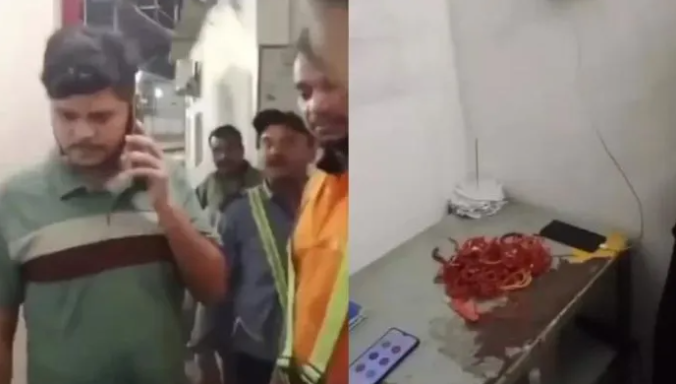
Case Summary
A Coca-Cola factory in Ayodhya, Uttar Pradesh, faced controversy after a video surfaced on social media showing a security guard cutting off the Kalavas (sacred threads worn by Hindus) from employees’ wrists. The incident, which occurred on 21st September, sparked outrage for disrespecting Hindu sentiments. The factory initially remained silent, but after mounting social media pressure, they issued a clarification. Sachchidanand Tiwari, a security officer at Amrit Bottlers Private Limited, explained that the factory’s rules prohibit wearing items like bangles, rings, and wristwatches in the process area to prevent contamination. He claimed that the security guard misunderstood the rule and applied it to all workers, not just those in the procedure unit.
Why it is Hate Crime ?
This case has been added to the tracker under two prime categories. The first is- Restriction/ban on Hindu practices, under which the sub-category chosen is- Restriction on expression of Hindu identity. An example of the state-affected prejudicial and targeted orders against the Hindu community would be a government denying the right of a Hindu or a group of Hindus to hold a religious procession owing to the animosity of non-Hindu groups. Denial of the religious right of the Hindus to assuage the non-Hindu group which harbours animosity to a point where it could lead to violence against Hindus is not only a failure of law and order but is a prejudicial order against Hindus, denying them their fundamental rights to express their religious identity. An example of a hate crime against Hindus by a non-Hindu would be a non-Hindu institution forcing its Hindu employees to abandon religious symbols that a Hindu would wear as an expression of faith owing to inherent prejudice against the faith professed by the victim or a non-Hindu group of people restricting a Hindu group from constructing a place of worship simply because the demography of the area in which the temple is being built is dominated by non-Hindus. Such actions are driven by religious animosity and/or prejudice against Hindus and their faith and would therefore be categorized as a hate crime. The second prime category chosen here is- Attack on Hindu religious symbols. Within this, the sub-category selected is- Defiling religious customs. Sanatan Dharma is not a religion of one book, which is to say that while it has religious scriptures that form the central tenets of the faith, there are several traditions followed through thousands of years, mostly passed from generation to generation orally. There are several such customs and traditions that are followed by various Hindus and Hindu sects. Defiling of these traditions and customs is a breach of an individual or group’s religious practices. Such practices can range from dietary restrictions like not eating non-vegetarian food for a certain period of the year, not eating non-vegetarian food at all, not eating beef since the cow is considered holy in Hinduism, the sanctity of religious customs followed in the house (like many ISCKON devotees), etc. Any malicious action leading to the breach of such traditions or defilement of these traditions owing to animosity towards the faith or for the sake of activism stems not only from the lack of faith in the religion itself but also from disregard for the faith of the devotees who follow the customs/traditions and implicit bias against the faith, the tradition itself. Since these specific traditions are central to the faith of the devotees of that specific sect of Hindus, any non-compliance with these traditional rules would be considered a religiously motivated hate crime. In this case, the security guard of a Coca-Cola factory in Ayodhya forcefully removed sacred threads (Kalavas) from the wrist of one of the factory's employees. In Hinduism, the Kalava holds deep religious, cultural, and spiritual significance. It symbolises protection, blessings, unity, and commitment to spiritual and ethical principles. Its use across various rituals and ceremonies underscores its importance in the Hindu way of life and by forcefully cutting off the Kalava, the guard insulted the Hindu faith and displayed her deep disdain towards the religion. Additionally, the cutting of the Kalavas constitutes a desecration of religious customs, as these threads are often tied with specific prayers and rituals, symbolizing protection, blessings, and spiritual commitments. For many Hindus, removing or damaging the Kalava without proper rites is akin to dishonouring the sacred beliefs it embodies. The act, therefore, not only disrespects an individual's faith but also violates the sanctity of the religious customs associated with it, which is why this case becomes worthy of being documented under this category of the hate tracker.


Case Status
Unknown


Perpetrators Details
Perpetrators
Others
Perpetrators Range
N/A
Perpetrators Gender
unknown
 Sources




