Hindu family attacked by Muslim youths, threats issued to convert to Islam and migrate
 Nuh, Haryana, India
  15 April, 2024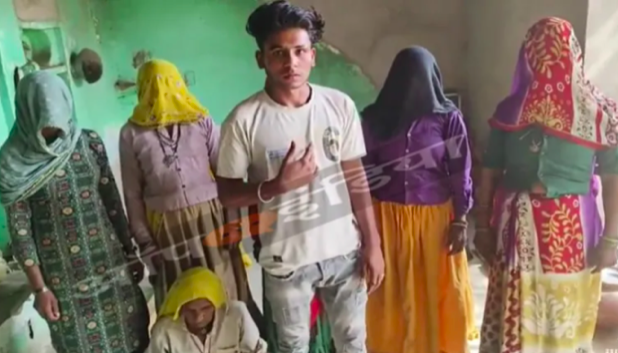
Case Summary
A Hindu family in the Nuh region of Haryana faced an attack by Islamists, prompting a case to be filed by Santram, an Other Backward Class (OBC) member, against several individuals including Idris, Junaid, Zubair, and others. The assailants are accused of assaulting Santram's family, robbing his shop, and pressuring them to convert to Islam. Two women, Sahuni and Raveena, are also implicated in the attack. The incident occurred in the Pinangwan Police Station area, where Santram resides with his family in Ranyala Patakpur village. The attack began when Akhlaq, Zubair, and Nahid reportedly broke into Rameshchand’s residence, assaulting him and making threats. Santram subsequently filed a complaint, leading the police to investigate the matter. However, upon police intervention, Idris and his associates allegedly attacked Santram's business, injuring him, his family, and looting his store. The attackers also harassed Santram's female relatives. During the incident, Junaid tore a Hindu woman's clothes, while others vandalised Santram's shop. The attackers fled upon the arrival of villagers and police, threatening further violence and death in the future. The victims, fearing for their safety, demanded severe punishment for the accused and protection for their family and property. A family member of the victim attempted to capture the attack on a cell phone when Idris grabbed the phone and broke it. All of the villagers gathered when they heard the loud noises. The police were notified of the ruckus as well. The attackers began to flee as soon as they spotted the police and threatened, “Today the police saved you but we will kill you the next time.” Apart from Idris, Junaid, Zubair, Akhlaq, Zafar, Akram, Shamim, Rabina, Javed, Ayyub, Sahuni and Wasim, around 25 to 30 other unidentified people were also reported to be among the assailants. The complainant also said that the village is Muslim-majority with only 4-5 houses of Hindus. Santram has disclosed in his complaint that they are under pressure to embrace Islam and leave the village. He has demanded severe punishment for the accused, as well as protection of his family and belongings. The Pinangwan police station has taken two suspects into custody, with investigations ongoing.
Why it is Hate Crime ?
This particular case has been classified as a religiously motivated hate crime under two core categories 'predatory proselytisation' and 'attack not resulting in death' because of the various distinct components that demonstrate the perpetrator's bias against the Hindu faith and the deliberate attempt to alienate the victims from their Hindu identity. Due to the details of the case, it has been placed under the sub-category of 'Harassment, threats, coercion for conversion' under the core category of 'Predatory Proselytisation'. Harassment covers a wide range of behaviours of an offensive nature. It is commonly understood as behaviour that demeans, humiliates, and intimidates a person, including threats and coercion. Harassment and threats in this case find their root on discriminatory grounds which have the effect of nullifying a person’s rights or infringing upon his freedom to exercise his right specifically owing to the victim’s religious identity. Verbal and physical threats and psychological or physical harassment are often used against Hindu victims because they choose to practice their professed religion. Religious harassment also includes forced and involuntary conversions by harassment, threats or coercion. Coercion includes intimidatory tactics like force-feeding a Hindu victim beef to convert to another religion and forceful circumcision. In several cases documented, non-Hindu perpetrators or those who harbour specific animosity towards Hinduism, harass victims simply based on their religious identity. Such cases often also include harassment in an attempt to make the Hindu victim abandon his/her professed religion and adopt the religion of the perpetrator. In this sub-category, we would include cases where the non-Hindu perpetrator harassed, threatened or coerced the victim to convert, however, the Hindu victim did not convert to another faith. Cases where the victim was converted owing to the harassment and threats would be documented in another sub-category. Such cases where Hindu victims are harassed to convert to the perpetrator’s religion are rooted in animosity towards the victim’s religious identity and are therefore documented as religiously motivated hate crimes. This case has further been added to the primary category 'attack not resulting in death' under two sub-categories. The first sub-category is 'attacked for Hindu identity'. In several cases, Hindus are attacked merely for their Hindu identity without any perceived provocation. A classic example of this category of religiously motivated hate crime is a murder in 2016. 7 ISIS terrorists were convicted for shooting a school principal in Kanpur because they got ‘triggered’ seeing the Kalava on his wrist and tilak that he had put. In this, the Hindu victim had offered no provocation except for his Hindu religious identity. The motivation for the murder was purely religious, driven by religious supremacy. Such cases where Hindus are targeted merely for their religious identity would be documented as a hate crime under this category. The second sub-category this case has been added to is 'attacked to induce migration from non-Hindu dominated area'. There have been cases where the Hindus living in an area, often with a majority dwelling belonging to non-Hindus or those harbouring animosity towards the Hindu faith, the Hindu residents experience threats and violence. The violence is employed with the aim of making the Hindus leave the area and relocate, so the area could be turned into an exclusive ghetto for adherents of the non-Hindu faith or those who harbor animosity towards the Hindu faith. In several cases, the aim of exodus is explicit. However, in several cases, the demand for exodus of Hindu residents is not explicit, however, violence by non-Hindu residents leaves the Hindu residents no option but to leave the area, thereby, turning the area into an exclusive ghetto of non-Hindu residents. In such cases, there are instances violence against the Hindu residents explicitly. For example, in the Hauz Qazi case of 2019, the Muslim residents claimed that mob violence against the Hindu residents had been triggered by a parking dispute. However, the violence did turn religious with a temple being desecrated and was directed specifically against the Hindu residents. The Hindu residents of the area were clear that the violence was religiously motivated and one of the motives was to affect an exodus of the Hindu residents. In such cases, even though the perpetrators have not explicitly expressed the aim of affecting exodus, the given circumstances and violence and precedent point to the intention of exodus and therefore would be categorized under this sub-category. Such crimes are religiously motivated and therefore are hate crimes. In this case, the Hindu family was assaulted by a Muslim mob who was threatening them to convert to Islam or leave the village. The Hindu complainant mentioned that the village was Muslim-dominated and only 4-5 Hindu families resided in the village. In areas with a predominant Muslim dominated areas, it is often seen that the Hindu community faces persecution with the Muslim extremists asking them to either convert to Islam or leave the village. The attacks are either for proselytisation, failing which, it is to induce migration, in order to make the area a ghettoised Muslim area with no other religious denominations residing in that area. This tactic of the Muslim extremists was seen prominently in the 1990 Kashmir genocide and exodus as well, where Muslim extremists had given an ultimatum to Hindus, asking them to either convert, leave Kashmir or be killed. Here, the Hindu family, one of the few in the Muslim dominated area, was being threatened and pressured to convert to Islam or leave the village. The attack on the family, including the attempted molestation of a woman of the family, was aimed to affect migration from the Muslim dominated area. Further, even after the police intervened, the mob threatened Hindus claiming that police had save them but the next time they would be killed. The attack itself was motivated by inherent hostility towards Hinduism and its adherents, which led the mob to attack the Hindu family to convert them or make them migrate. For that reason, this case is being added to the hate crime database.
Victim Details
Total Victim
4
Deceased
0
Gender
- Male 3
- Female 1
- Third Gender 0
- Unknown 0
Caste
- SC/ST 0
- OBC 4
- General 0
- Unknown 0
Age Group
- Minor 0
- Adult 4
- Senior Citizen 0
- Unknown 0


Case Status
Complaint registered


Perpetrators Details
Perpetrators
Muslim Extremists
Perpetrators Range
From 10 to 100
Perpetrators Gender
both
 Sources




