Hindus brutally attacked for protecting police from Muslim mob in anti-Hindu Haldwani riots
 Haldwani, Uttarakhand, India
  7 February, 2024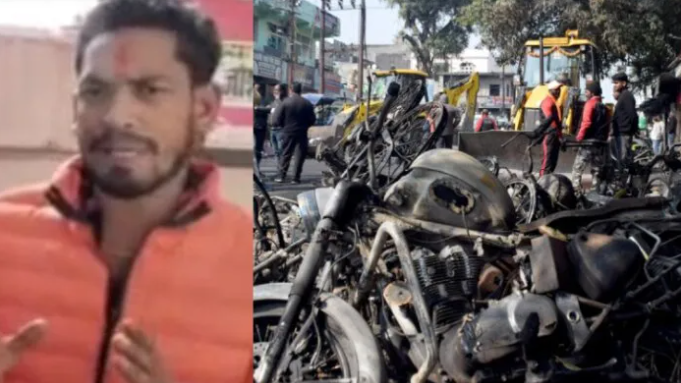
Case Summary
In the Banbhoolpura area of Haldwani, Uttarakhand, following the demolition of an illegally constructed madrasa and mosque on government land, a Muslim mob carried out a pre-planned assault: mobs armed with petrol bombs, swords, guns, and stockpiled stones attacked the police and municipal staff, torched vehicles, and even besieged the Banbhulpura police station. Curfew and shoot-at-sight orders had to be imposed as the situation spiralled out of control. On the other hand, several local Hindu residents of Gandhinagar, a neighbouring locality, stepped in to protect fleeing police and administration staff. Eyewitnesses and community members described how families opened their doors to shelter wounded officers, tended to their injuries, and even provided food and water. Many Hindu men were injured while physically confronting the mob to prevent them from entering the city further. Accounts from Gandhinagar highlighted how residents, chanting “Jai Shri Ram,” positioned themselves against the rioters, giving police time to regroup until backup forces arrived. Women from these households used scarves and shawls as makeshift bandages for bleeding officers, while youths risked themselves to block the mob’s advance. The violence escalated quickly. Multiple eyewitness accounts and video footage showed mobs not only throwing stones and bricks but also using petrol bombs, sharp weapons, and even firearms. Many police vehicles, including patrol vans and bulldozers, were gutted in flames. Policemen and policewomen recounted that they were surrounded from all sides, targeted from rooftops, and nearly set ablaze. A number of injured officials later testified from hospitals about the intensity of the attack, describing it as a pre-planned attempt to kill police personnel. Several women officers said they were attacked, their uniforms torn, and that they only survived by hiding in houses with the help of locals. Ordinary Hindus showed remarkable courage when thousands of rioters armed with petrol bombs, stones, and swords attacked policemen and municipal staff. Families like that of Manish Sonkar sheltered the injured officers in their homes, bandaging wounds and giving food and tea, even while mobs attempted to break into their locality. When the situation worsened, Hindu youths stood shoulder to shoulder with the police, chanting “Jai Shri Ram” and pushing the rioters back until reinforcements arrived. Many Hindus were injured in the attack. The defence was not only by men on the streets but also by women within the homes. As Amardeep Sonkar and others resisted the mob with the police, their wives and sisters turned their homes into makeshift first-aid centres. Women like Pooja Sonkar tore their scarves and shawls to bandage bleeding policemen, while others cooked, tended to wounds, and gave shelter. This collective Hindu response ensured that the police—many of whom were severely injured and terrified—could survive the night. During the clashes, Hindu journalists became primary targets. Several reporters were assaulted with sticks, stones, and sharp weapons. Victims included Sanjay, a reporter for Amrit Vichar, and Atul Aggarwal, of Uttarakhand 24. According to their testimonies, mobs specifically identified Hindu journalists by name and religion before attacking them. Vehicles were overturned, cameras destroyed, and several people were left injured. In contrast, Muslim journalists working in the same area were not harmed, highlighting a selective targeting on communal lines. One of the assaulted reporters, Aggarwal, stated that he had earlier written in support of the encroaching community, yet his Hindu identity alone made him a target. The mobs, allegedly prepared in advance with petrol bombs, weapons, and stone stockpiles, also attacked police stations and government property, leading to a breakdown of law and order in the locality. The state administration imposed curfews and internet suspensions in Haldwani to contain the violence. Police reinforcements were deployed, and FIRs were registered against hundreds of rioters. Testimonies of injured Hindu journalists have since become central to understanding the communal nature of the violence.
Why it is Hate Crime ?
This case has been added to the tracker under the prime category- Attack not resulting in death. The sub-category relevant in this case is- Attacked for Hindu identity. In several cases, Hindus are attacked merely for their Hindu identity without any perceived provocation. A classic example of this category of religiously motivated hate crime is a murder in 2016. 7 ISIS terrorists were convicted for shooting a school principal in Kanpur because they got ‘triggered’ seeing the Kalava on his wrist and tilak that he had put. In this, the Hindu victim had offered no provocation except for his Hindu religious identity. The motivation for the murder was purely religious, driven by religious supremacy. Such cases where Hindus are targeted merely for their religious identity would be documented as a hate crime under this category. The other sub-category selected is- Communal clash/ attack. Communal clash is a form of collective violence that involves clashes between groups belonging to different religious identities. For a communal clash between Hindus and non-Hindus to qualify as a religiously motivated hate crime, the trigger of the violence itself would have to be anti-Hindu in essence. For example, if there is a Hindu religious procession that comes under attack from a non-Hindu mob and after the initial attack, Hindus retaliate in self-defence, leading to a communal clash between the two religious communities. While at a later stage, both communities are involved in the clash/violence, the initial trigger of the violence was by the non-Hindu mob against the Hindus and therefore, it could safely be termed as an anti-Hindu violence. Further, the trigger would also have to be religiously motivated. In the cited example, the attack by the non-Hindu mob was against religious processions and therefore, can be concluded to be religiously motivated. In some cases, the trigger may be non-religious, however, it develops into religious violence against Hindus at a later stage. In such cases too, the foundational animosity towards Hindus becomes the motivating factor of the crime and therefore, it would be classified as a religiously motivated hate crime against Hindus under this category. The other sub-category selected is - Attacked for opposing radicals or trying to save victim. In several cases, Hindus are attacked for opposing religiously motivated crimes being committed against a fellow Hindu or simply for voicing an opinion opposing radical elements, who either have in the past or continue to persecute Hindus. In such cases, the initial attack against the victim, against which the Hindu was trying to defend the victim, would also need to be classified as a religiously motivated hate crime. Since the initial crime itself was religiously motivated and the subsequent crime of attempting to save the victim or speaking against the radical elements ends up inviting a violent attack, it would also be classified as a religiously motivated hate crime under this category. In the Haldwani riots, Hindu journalists present on the scene were singled out and assaulted solely because of their religious identity. Multiple testimonies confirm that mobs spared Muslim journalists while attacking their Hindu counterparts, despite some of them having earlier reported in support of the same community. This selective targeting demonstrates that the violence was not incidental but motivated by religious animosity towards Hindus. The violence began after the demolition of an illegal madrasa and mosque on government land, but the response of the mob was not limited to a protest against administrative action. Instead, it escalated into a targeted communal assault, where Hindu individuals—especially journalists—were attacked with weapons, petrol bombs, and stone-pelting. The trigger of the violence was therefore anti-Hindu in essence, as the crowd’s rage was directed at Hindus, visible in their identity-based assaults. While clashes eventually spread and became widespread street violence, the initial and defining trigger was a religiously motivated attack against Hindus. Hence, this case is added to the hate crime database. In this case, the Hindus of Gandhinagar were not passive bystanders but actively resisted a violent, religiously motivated mob. The rioters sought to kill policemen and municipal staff. Ordinary Hindu men like Manish Sonkar, Amardeep Sonkar, and others risked their lives to protect the officers, sheltering them inside their homes and standing in defence of law and order. Their act of opposing the radicals and saving the victims of the mob’s violence directly invited targeted attacks on them, leaving many Hindus gravely injured. At the same time, Hindu women and families became targets of this hate-fuelled violence simply because they treated, bandaged, and fed the wounded policemen. By standing against the radical mob and ensuring the survival of those being hunted, they too were opposing religiously motivated violence. This retaliation by the rioters against Hindus for siding with the police demonstrates the hate-crime nature of the attack. The violence was not a random clash but a deliberate attempt to punish Hindus for defending the victims of Muslim aggression, thereby making it a textbook case of a hate crime. The Haldwani riots cannot be reduced to a mere law-and-order problem arising out of the demolition of an illegal structure. The very character of the violence reveals its anti-Hindu orientation. The mob that gathered did not restrict its outrage to protesting government action; instead, it resorted to targeted attacks against Hindus, particularly those visible in public life, such as journalists. The fact that Muslim individuals present in similar circumstances were spared further underlines the communal and discriminatory nature of the violence. Moreover, the manner in which the riots escalated shows that the trigger was explicitly anti-Hindu in motivation. Stone-pelting, petrol bombs, and arson were not directed indiscriminately, but fell disproportionately on Hindus. This is consistent with patterns of communal violence where Hindus are attacked collectively in response to actions of the state. In Haldwani, the religious anger was channelled not merely at the authorities but at Hindus at large, thereby transforming an administrative decision into a religiously motivated anti-Hindu communal assault.


Case Status
Complaint filed


Perpetrators Details
Perpetrators
Muslim Extremists
Perpetrators Range
Unknown
Perpetrators Gender
male
 Sources




