Brothers Mehtab and Shadab arrested for running a gang to shut down pro-Hindu accounts and extort money; gave death threats when victims resisted
 Sitapur, Uttar Pradesh, India
  2 August, 2024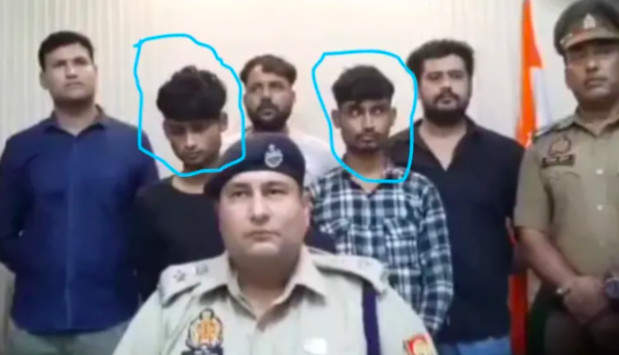
Case Summary
On September 29, 2024, police in Sitapur, Uttar Pradesh, apprehended Mehtab Ansari and Shadab Ansari, two brothers involved in orchestrating a major cybercrime network. Their operation focused on shutting down social media accounts, particularly pro-Hindu handles, through the misuse of copyright complaints. The brothers would file fake copyright strikes, getting legitimate social media profiles suspended, and then extort money from the account owners to restore them. The case came to light after the administrator of Instagram’s @randombrigade profile filed a complaint on September 27. The victim had received threatening messages from the Instagram user @soloxkakashi, who demanded money to prevent a copyright strike against his account. Despite initially transferring Rs 500 on August 3, the victim was pressured into sending additional payments, totalling Rs 3,750. Mehtab even escalated demands, requesting a Rs 70,000 gift through Amazon or Flipkart. When the victim could not meet these demands, he was threatened with defamation, account suspension, and death threats. Fearing for his and his family’s safety, the victim lodged a complaint with the Sitapur police, labelling the harassment as illegal extortion and seeking stringent punishment. The police registered the case under sections 318 (4), 352, 351 (2), 308 (5) of the Bharatiya Nyaya Sanhita (BNS), and section 66-D of the Information Technology (IT) Act. Upon investigating, the police found that Mehtab and Shadab used social media tools like Insta Pro 2, an APK file downloaded from Google, to steal photos and data from real Instagram accounts. They manipulated Instagram’s copyright system by submitting false claims, making it appear as though their fake accounts were authentic while the legitimate ones were fraudulent. These claims led to the suspension of many accounts, allowing the brothers to extort victims for money to delete or reverse the strikes. The investigation revealed that Shadab and Mehtab had targeted over 600 Instagram accounts, primarily focusing on pro-Hindu profiles, and extorted money from many of them. Three mobile phones were recovered during the arrests, which provided crucial evidence of their activities.
Why it is Hate Crime ?
The Muslim brothers running the extortion racket were mainly focussed on pro-Hindu social media accounts and were deliberately targeting them for extorting money. This case has been categorised under the primary category of 'hate speech'. The sub-categories chosen is 'violent threats'. Violent threats, explicit, implicit or implied, is the most dangerous form of hate speech since it goes beyond discriminatory and prejudicial language to express the intent of causing harm to an individual or a group of people based on their religious identity and faith. There could be several different kinds of threats that are issued to Hindus based on religious animosity. An explicit threat would mean the direct threat of violence towards an individual Hindu, a group of Hindus or Hindus at large. Physical violence, death threats, threats of destruction of property belonging to Hindus and threats of genocide would mean explicit threats against Hindus for their religious identity. Implicit threats may not be a direct threat but implied through the use of symbols of actions – for example – in the Nupur Sharma case, other than explicit threats, there were also implicit threats when Islamists took to the streets to burn and beat her effigies. It implies that they want to do the same to Nupur Sharma – thereby is considered an implicit threat. Violent threats can be delivered in person, through letters, phone calls, graffiti, or increasingly through social media and other online platforms. It would be important to understand that a threat – explicit or implicit, online or offline – to an individual who happens to be a Hindu does not qualify as a religiously motivated threat. Such a threat, while vile and dangerous, could be owing to non-religious reasons and/or personal animosity. To qualify as a religiously motivated threat, it would need to exhibit an indication that the individual is being targeted for religious reasons and/or owing to his/her religious identity as a Hindu. In this case, we do not know the nature of the threats that were being made by the perpetrators, however, from the details of the case, it is evident that the very foundation of their racket was exploiting, harassing, extorting and threatening social media handles which were viewed as pro-Hindu. This would essentially mean that the perpetrators were specifically choosing their targets based on the religious identity, faith and views of the victims. Targeting victims on the basis of their religious identity is the very definition of a religiously motivated hate crime. After getting the social media handles suspended, the perpetrators would issue violent threats to those they viewed as pro-Hindu if they refused to give in to their extortion. Since the victims were selected based on their religious identity and views, this case is being categorised as a religiously motivated hate crime.
Victim Details
Total Victim
600
Deceased
0
Gender
- Male 0
- Female 0
- Third Gender 0
- Unknown 600
Caste
- SC/ST 0
- OBC 0
- General 0
- Unknown 600
Age Group
- Minor 0
- Adult 0
- Senior Citizen 0
- Unknown 600


Case Status
Arrested


Perpetrators Details
Perpetrators
Muslim Extremists
Perpetrators Range
From 2 To 5
Perpetrators Gender
male
 Sources




