Muslim men barge into Durga Puja pandal; desecrate religious symbols and stop bhajans, threaten devotees
 Balrampur, Uttar Pradesh, India
  4 October, 2024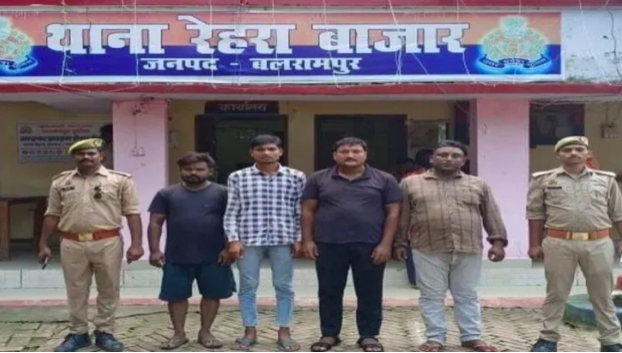
Case Summary
On October 5, 2024, in Panchudih village, Balrampur district, Uttar Pradesh, four Muslim men, Kaleem, Arbaaz, Imran, and Mukhtar, disrupted a Durga Puja celebration at a local pandal. The accused entered the pandal, misbehaved with female devotees, and tore down the saffron flag, throwing it into a nearby drain. They also broke an electricity pole and forcibly stopped the bhajans by pulling the generator’s wires, demanding that Bhojpuri songs be played instead. When devotees objected, the accused threatened them with death. Villagers, including Ram Sajeevan, Ram Pyare, Ramsurat Verma, and Hansraj Yadav, filed a formal complaint, demanding strict action. A copy of the complaint revealed that the accused were involved in deliberately attempting to disrupt the Navratri celebrations and intimidate the devotees. Following the complaint, the police registered an FIR under sections 298, 324, 352, and 351 (3) of the Indian Penal Code. On October 6, the police arrested all four accused and initiated a thorough investigation.
Why it is Hate Crime ?
This case has been added as a religiously motivated hate crime under two prime categories of the tracker. The first is- Attack on Hindu religious symbols. Under this, the first sub-category chosen is- Desecration of Hindu religious symbol. Icons and symbols or a religious representation of a spiritual ideal are widely revered in Hinduism. Iconography is of vital significance in the Hindu milieu. It helps connect people’s spiritual beliefs with the real world. Iconography within the Hindu faith takes several shapes and forms. Murtis are of most significance to Hindus, to which daily rituals, prayers and offerings are done. Besides the murtis, there are several other symbols which have deep significance in the Hindu faith – the Om and Swastika for example. Since these Hindu religious symbols hold paramount importance in Hinduism, any desecration of symbols, icons, murtis, religious representations and manifestations, is driven by animosity towards the faith itself which manifests itself through these murtis, icons and symbols. Therefore, any desecration of these Hindu religious symbols and representations is considered religiously motivated hate crimes under this category. The second sub-category selected under the aforementioned prime category is- Violence against religious structures or centres. In Hinduism, a religious structure is also considered divine. Hindus believe that not just the Deity but the religious structure itself is sacred. In this sub-category, we would document attacks against religious structures which are not consecrated temple spaces. Such religious spaces could be temporary in nature – for example – the religious spaces erected specifically for festivals like Durga Puja etc. This category would also document cases of attacks against religious centres. These spaces in their own right may not be ‘sacred’ per se, however, are often spaces where religious gurus live, religious teaching is imparted, or belong to religious institutions. Any attack against religious structures is a result of animosity towards the religion itself, which manifests itself through the religious spaces and therefore, such attacks are considered religiously motivated hate crimes. Religious centres are also manifestations of the religion, its teachings or gurus and therefore, attacks against such centres would be considered religiously motivated hate crimes. Further, the second prime category chosen here is- Attack not resulting in death and within this, the sub-category selected is- Attack against Hindu devotees. Hindu devotees are a few of the easiest targets of religiously motivated hate crimes because during the festival/procession/puja etc, for non-Hindus it is easy to profile their victims on the basis of religion. Hindu devotees come under attack on several occasions by individual non-Hindus or mobs of non-Hindus owing to their animosity against Hinduism, its symbols and tradition/practices. There are several instances of Hindu devotees being attacked while they worship in temples or temporary religious structures, during religious processions, doing bhajan/kirtan/puja in their own homes, in the residential society etc. These attacks are perpetrated by non-Hindus primarily because of their animosity towards Hindus and their faith. In some cases, the trigger for the violence may be non-religious, however, there are two elements that make these hate crimes. First, the Hindus who come under attack are attacked violently while indulging in religious activity. Whether they are in a place of worship or not is immaterial to the crime. When individuals are attacked while indulging in religious practices, the attack in itself is a hindrance to their freedom to practice religion and therefore constitutes a hate crime. Secondly, religious supremacist doctrines and ideologies deem religious practices of Hindus to be offensive ab initio since they are considered “sinful” by these ideologies, worthy to be annihilated by force or coercion. Driven by these religious supremacist ideologies and doctrines, the attacks against Hindu devotees stem from intrinsic animosity towards Hinduism. In some cases, the trigger for the violence may be non-religious, however, it develops into a religiously motivated crime during the course of the violence. Since these attacks stem from animosity towards Hindus and Hinduism, they are considered religiously motivated hate crimes under this category. In this incident, the Muslim accused entered a Durga puja the pandal, misbehaved with women devotees, and tore down the saffron flag, throwing it into a nearby drain. They also broke an electricity pole and forcibly stopped the bhajans by pulling the generator’s wires, demanding that Bhojpuri songs be played instead. When devotees objected, the accused threatened them with death. The tearing down of the saffron flag—a sacred symbol within Hinduism—and its subsequent disposal in a drain is a deliberate act of disrespect aimed at Hindu religious sentiments. This action illustrates a direct affront to Hindu symbolism and traditions, underscoring a lack of tolerance for their practices and beliefs. Further, the accused not only desecrated religious symbols but also caused disruption at a Hindu religious structure, the Durga Puja pandal. By breaking an electricity pole, dismantling the generator wires, and demanding an end to the bhajans, they exhibited hostility toward a key Hindu festival space, aiming to halt the ongoing worship and festivities. In sum, this incident encapsulates a deliberate attempt to intimidate and threaten Hindu devotees during their religious observance, while showing open disdain for their practices and sacred symbols. Such actions underscore a pattern of targeting Hindu religious expressions that stems from an inherent animosity for Hindus and their faith, which is why this case has been categorised as a religiously motivated hate crime.


Case Status
Arrested


Perpetrators Details
Perpetrators
Muslim Extremists
Perpetrators Range
From 2 To 5
Perpetrators Gender
male
 Sources




