Hindu teenager issued "Sar Tan Se Juda" threats over online spat with Muslim schoolmate, doxxed by media outlets
 Bahraich, Uttar Pradesh, India
  6 October, 2024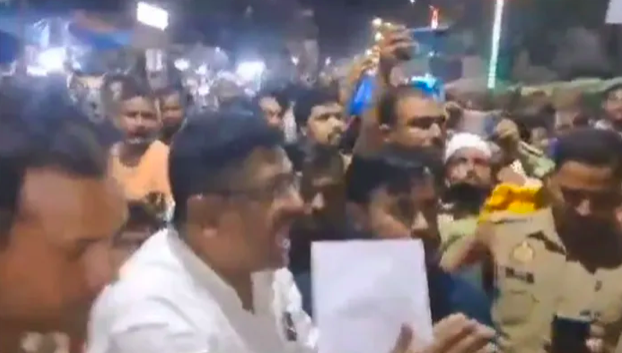
Case Summary
On October 7, 2024, tensions escalated in Nanpara, Bahraich district, Uttar Pradesh, when two school-going teenagers, a Hindu and a Muslim, engaged in an online dispute over religion through direct messages on Instagram. The conflict began around 5 PM and became heated when they made derogatory remarks about each other's faith. The Hindu teenager had responded to a video shared by the Muslim boy featuring controversial cleric Maulana Salman Azhari insulting Hindus. The Hindu teen's comment was simply a reaction to the provocation. However, the comment, perceived as disrespectful to Prophet Muhammad, was subsequently shared and made viral by the Muslim teenager. As news of the comment spread, thousands of protesters from the Muslim community took to the streets, chanting slogans like “Sar Tan Se Juda." The protestors expressed outrage over what they perceived as a hate crime. In their response, the local police, including CO Nanpara and Inspector Pradeep Singh, rushed to the scene to manage the crowd and reassure the demonstrators that appropriate legal action would be taken. However, the protesters insisted on the immediate arrest of the Hindu teen, which led to a chaotic standoff. Police reinforcements were called, and personnel from the Provincial Armed Constabulary (PAC) were deployed. Officers used mild force to disperse the crowd, which continued to protest throughout the night. An FIR was filed by local residents Rahmat Ali Hashmi and Ashiq Ali, who claimed that the derogatory remarks made by the Hindu teen against Prophet Muhammad incited communal disharmony. The Hindu teenager, recognising the gravity of the situation, recorded a video apology, pleading for forgiveness and expressing regret over his comments. He stated, “I made a mistake. I will not make such a mistake again. I was unaware of the consequences. I apologise with folded hands.” Despite his apology, media coverage led to the leakage of personal information about the teenager. Various news outlets, including Bharat Samachar Live, broadcasted his image without blurring his face, raising concerns about potential repercussions for the young boy and his family.
Why it is Hate Crime ?
Distinct elements in this particular case demonstrate that the crime was committed while harbouring a bias against the Hindu faith. As per the details, this case has been added to the tracker under two prime categories. The first is- Attack not resulting in death. Under this, the sub-category selected is- Attacked over 'blasphemy'. Blasphemy essentially refers to the desecration of anything which is held sacred/holy to a group of people. However, for religious supremacist groups, the elements of ‘blasphemy’ are ever-changing, shifting and expanding – leading to infringement on the rights of other religious groups, freedom of speech and expression, threats and even physical violence. There are instances where blasphemy is also used as a dog whistle to target Hindus owing to intrinsic animosity towards Hinduism. There are several instances where stating truths as mentioned in the non-Hindu doctrine itself has led to unmitigated violence against Hindus. There have also been instances where non-Hindus have themselves created a ‘blasphemous’ situation, like placing a Quran in a temple, to use it as an excuse to attack Hindus. Essentially, Blasphemy charges are often made up and/or are used to shut down any form of criticism of non-Hindu faiths and as a tool to target Hindus. Any physical violence over Blasphemy charges against Hindus are foundationally based on animosity for Hindus and their faith owing to religious supremacist ideologies, therefore, such attacks would be documented as religious motivated hate crimes under this category. The second prime category under which this case has been placed is- Hate speech against Hindus. Under this, two sub-categories have been selected. The first is- Doxxing and harassment of Hindu for religious reasons. Doxxing is the act of making available publicly personal, identifiable information of an individual with the intention of compromising their safety, security and privacy. When doxing is done with religious animosity forming the basis of the intention, it often involves severe consequences like loss of employment, physical harm, physical threat, harassment and/or discrimination for the victim’s religious beliefs. Such doxxing also involves projecting the religious beliefs, affiliations, and rituals of the victim, specifically a Hindu, in a manner that can lead to loss of employment, physical harm, physical threat, harassment and/or discrimination. Apart from doxxing, harassment would also include misrepresentation of an individual's views and religious beliefs that would invite abuse, loss of employment, physical harm, physical threat, harassment and/or discrimination owing to religious hate and animosity. There have been several such instances where religious animosity by one section has led to the doxxing and harassment of Hindus. For example, when a Hindu who worked in the UAE commented on the historical persecution of Hindus at the hands of Muslim invaders, his information was leaked online leading to loss of employment, physical harm, physical threat, harassment and/or discrimination. In another case, a Hindu man’s information was leaked online, leading to violent attacks, after he responded with an emoji to a post about Tipu Sultan, the Islamic tyrant who persecuted Hindus. Such cases are born out of intrinsic religious animosity towards Hindus and therefore, would be considered religiously motivated hate speech. The second sub-category under the aforementioned prime category of 'Hate speech against Hindus' that has been selected is- Violent threats. Violent threats, explicit, implicit or implied, are the most dangerous form of hate speech since it goes beyond discriminatory and prejudicial language to express the intent of causing harm to an individual or a group of people based on their religious identity and faith. There could be several different kinds of threats that are issued to Hindus based on religious animosity. An explicit threat would mean the direct threat of violence towards an individual Hindu, a group of Hindus or Hindus at large. Physical violence, death threats, threats of destruction of property belonging to Hindus and threats of genocide would mean explicit threats against Hindus for their religious identity. Implicit threats may not be a direct threat but implied through the use of symbols of actions – for example – in the Nupur Sharma case, other than explicit threats, there were also implicit threats when Islamists took to the streets to burn and beat her effigies. It implies that they want to do the same to Nupur Sharma – thereby is considered an implicit threat. Violent threats can be delivered in person, through letters, phone calls, graffiti, or increasingly through social media and other online platforms. It would be important to understand that a threat – explicit or implicit, online or offline – to an individual who happens to be a Hindu does not qualify as a religiously motivated threat. Such a threat, while vile and dangerous, could be owing to non-religious reasons and/or personal animosity. To qualify as a religiously motivated threat, it would need to exhibit an indication that the individual is being targeted for religious reasons and/or owing to his/her religious identity as a Hindu. Here, the Hindu teenager's reaction to a video of Maulana Salman Azhari making derogatory remarks about Hindus set off a chain of events, resulting in protests with calls for violence, such as “Sar Tan Se Juda” (beheading). “Gustakh-e-Rasool ki Ek hi saza, sar tan se Juda, sar tan se Juda”, which translates to “There is only one punishment for being disrespectful to Rasool (Prophet Muhammad), their head separated from their torso, their head separated from the torso”, is an Islamist clarion call, that has become a staple feature of violent protests that have so far claimed the lives of at least 6 Hindus, including Kanhaiya Lal in Udaipur and Umesh Kolhe in Amravati, after Muslim fundamentalists, egged on by the dog-whistling of Alt News co-founder Mohammed Zubair against former BJP spokesperson Nupur Sharma, resorted to violence for what they perceived as ‘blasphemy’ against Prophet Muhammad. From Kanpur in India’s northern plains to the southern metropolis of Bengaluru, from Kolkata in the east to Hyderabad in the south, protests in the name of blasphemy have erupted in almost every corner of the country as Islamists took to the streets running amok and shouting “Sar Tan Se Juda” chants over the perceived belief of blasphemy against the Prophet. Though a radical Muslim outfit in Pakistan coined the slogan, it has gained popularity among Islamists in regions beyond its geographical origins. Over the years, we have seen large crowds of Islamists chanting the “Sar Tan Se Juda” slogan, which is nothing but a direct incitement to violence, leading to murders committed in the name of blasphemy. The radicalised outcry is not merely a statement of disapproval; it is a call for the execution of an individual through beheading, based on their religious identity. When this slogan is raised, it sends a clear and terrifying message not just to the individual targeted but also to anyone else who might share similar views or dare to express them. This tactic of intimidation aims to silence dissent and suppress freedom of expression, particularly in religious discourse. It aims to instil fear in the broader community. Islamists use this tactic to settle personal scores with Hindu and Christian families by levelling fabricated charges of blasphemy against them, which causes outrage and paints a target behind them. The underlying hatred and animosity toward non-Muslims, especially Hindus, drive these false blasphemy accusations as a means to subjugate and victimise them. As a result, this case is classified as a religiously motivated hate crime and has been documented accordingly. This act of doxxing not only violated his privacy but also placed him and his family at significant risk. By broadcasting his image without blurring his face, the media effectively amplified the outrage from the Muslim community, thereby heightening the potential for targeted harassment and violence against him. The decision to reveal his identity can be seen as part of a broader pattern of media bias that often disproportionately affects Hindus, particularly in sensitive religious contexts. The media’s role in sensationalizing the incident and portraying the Hindu teen as the sole aggressor reinforces a narrative that scapegoats Hindus while overlooking the provocation that initiated the conflict. In essence, the media's role in this case not only exacerbated the situation for the Hindu teenager but also highlighted a broader trend of animosity towards Hindus and this is why this case has been added to the tracker.
Victim Details
Total Victim
1
Deceased
0
Gender
- Male 1
- Female 0
- Third Gender 0
- Unknown 0
Caste
- SC/ST 0
- OBC 0
- General 0
- Unknown 1
Age Group
- Minor 1
- Adult 0
- Senior Citizen 0
- Unknown 0


Case Status
Unknown


Perpetrators Details
Perpetrators
Muslim Extremists
Perpetrators Range
Unknown
Perpetrators Gender
unknown
 Sources




