Hindus falsely accused by Islamists of shooting Muslim cleric in mosque when perpetrator was a Muslim man
 Meerut, Uttar Pradesh, India
  5 October, 2024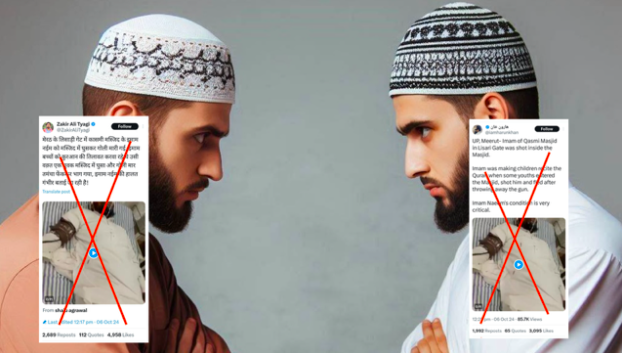
Case Summary
On October 6, 2024, at approximately 6:30 am, Mohammed Naeem, a 30-year-old Muslim cleric teaching Arabic and Urdu, was shot inside a mosque in Meerut by a man named Mohammad Sartaj. However, several Islamists used the incident to insinuate that Muslims are a victim of religious hate crimes, leaving out crucial details such as the name of the accused in their tweets. As per details, the bullet grazed the back of the Muslim cleric's ear, allowing him to narrowly escape serious injury. The shooter, identified as Mohammad Sartaj, was also a Muslim and had previously been acquainted with Naeem. The incident quickly drew attention on social media, where some Islamists attempted to frame it as a hate crime against Muslims. They spread misleading narratives, omitting crucial details about the identities of both the victim and the shooter. For instance, Zakir Ali Tyagi, a journalist, tweeted about the incident without mentioning Sartaj's name. Another Islamist sought to implicate Yati Narsinghanand Saraswati, suggesting a connection between the shooting and anti-Muslim sentiment. In response to the social media frenzy, the Meerut Police issued a statement clarifying that both Naeem and Sartaj were Muslims. SSP Meerut Vipin Tada confirmed the relationship between the two and noted that the shooting stemmed from their earlier disagreement. Despite attempts to communalise the incident, the police maintained that it was not a hate crime but rather a personal conflict between two individuals.
Why it is Hate Crime ?
This incident has been added to the tracker under the prime category-Hate speech against Hindus. Under this, the sub-category selected is 'Anti Hindu subversion and prejudice', within which, the tertiary category of 'Mislabelling/Misrepresentation of perpetrator's religion as Hindu' has been selected. Hate speech is defined as any speech, gesture, conduct, writing, or display that is prejudicial against a specific individual and/or group of people, which is leading to or may lead to violence, prejudicial action or hate against that individual and/or group. Media plays a specific and overarching reach in perpetuating prejudicial attitudes towards a community owing to unfair, untrue coverage and/or misrepresentation/misinterpretation, selective coverage and/or omission of facts of/pertaining to issues affecting a specific religious group. This type of bias can dehumanise the victim group, making it easier for others to justify harmful actions against them, which aligns with the objectives of hate speech laws aimed at preventing such harm. It is often observed that the media takes a prejudicial stand against the Hindu community driven by their need to shield the aggressor community which happens to be a numeric minority, however, is the one perpetrating violence against Hindus. For example, the media is often quick to contextualise religiously motivated crimes against Hindus, omit or misrepresent facts that point towards religiously motivated hate crimes, justify and/or downplay religiously motivated hate crimes or simply present fake news to stereotype Hindus. Such media bias leads to the denial of persecution and is often used to dehumanise Hindus, leading to justification for violence against them. For example, the media covered several fake allegations of Hindus targeting Muslims and forcing them to chant Jai Shree Ram. Most of these cases were proved false and fabricated after police investigation. These fake news reports were subsequently never retracted or clarified. Such fake news led to the justification of violence and dehumanisation of Hindus based on the argument that since Hindus targeted Muslims and forced them to chant Jai Shree Ram, the dehumanisation of Hindus and violence against them was par for the course and merely a retaliation. Such media bias leads to prejudicial portrayal of Hindus and offers a justification for violence against them and therefore, is considered hate speech under this category. In this case, Islamists on social media depicted the violence as primarily communal rather than as a personal conflict between two individuals of the same faith. This was done to create a false narrative portraying Hindus as aggressors and Muslims as victims. By intentionally omitting crucial details, such as the accused's identity, Islamists misrepresented the incident as a hate crime against Muslims, when in reality, it was rooted in a personal dispute between two Muslims. This deliberate framing stems from an underlying animosity held by some Islamists against Hindus. Such biased narratives contribute to animosity against the Hindu community and perpetuate harmful stereotypes. This deliberate targeting through one-sided narratives aims to malign the Hindu identity, culture, and faith, aligning with broader hate crime patterns that seek to marginalize or vilify specific religious communities and this is why this case deserves to be documented here, in the tracker.


Case Status
Unknown


Perpetrators Details
Perpetrators
Muslim Extremists
Perpetrators Range
N/A
Perpetrators Gender
unknown
 Sources




