Cattle head found in Durga Puja pandal
 Cooch Behar, West Bengal, India
  28 September, 2024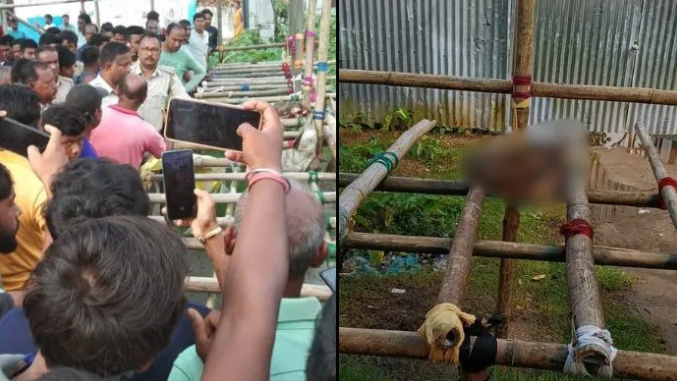
Case Summary
A severed bovine head was found at the site of an under-construction Durga Puja pandal in Khalisamari village, Sitalkuchi block, Cooch Behar district, West Bengal. The discovery, just 10 days before Durga Puja, created anger and unrest in the area. BJP leader Suvendu Adhikari condemned the incident, accusing miscreants of trying to replicate the radical, communal tensions seen in Bangladesh during Durga Puja. He expressed concern that such activities were aimed at creating fear and fanning communal tensions. The desecration of the pandal by slaughtering a sacred animal stirred outrage among the Hindu community, and Adhikari called for immediate intervention to curb such nefarious activities and maintain peace during the festival season.
Why it is Hate Crime ?
This case has been added to the tracker under the prime category- Attack on Hindu religious symbols. Under this two sub-categories have been selected. The first is- Breaking rules of places of worship. Sanatan Dharma is not a religion of one book, which is to say that while it has religious scriptures that form the central tenets of the faith, there are several traditions followed through thousands of years, mostly passed from generation to generation orally. One of these oral traditions or written traditions is the rules of specific temples. Certain temples have rules which are traditional rules, dependent on the worship of the presiding deities. These rules and traditions have been followed for thousands of years whether they find scriptural mention or not. Such traditions are based on the nature and rules of worship of the presiding deity of that temple. Any non-compliance of these traditions owing to animosity towards the faith or for the sake of activism stems not only from the lack of faith in the presiding deity but also disregard for the faith of the devotees of that deity/temple and implicit bias against the faith, the tradition and the deity itself. Since these specific traditions are central to the faith of the devotees of that specific temple and presiding deity, any non-compliance with these traditional rules would be considered a religiously motivated hate crime. The second sub-category relevant here is- Defiling religious customs. Sanatan Dharma is not a religion of one book, which is to say that while it has religious scriptures that form the central tenets of the faith, there are several traditions followed through thousands of years, mostly passed from generation to generation orally. There are several such customs and traditions that are followed by various Hindus and Hindu sects. Defiling of these traditions and customs is a breach of an individual or group’s religious practices. Such practices can range from dietary restrictions like not eating non-vegetarian food for a certain period of the year, not eating non-vegetarian food at all, not eating beef since the cow is considered holy in Hinduism, the sanctity of religious customs followed in the house (like many ISCKON devotees), etc. Any malicious action leading to the breach of such traditions or defilement of these traditions owing to animosity towards the faith or for the sake of activism stems not only from the lack of faith in the religion itself but also from disregard for the faith of the devotees who follow the customs/traditions and implicit bias against the faith, the tradition itself. Since these specific traditions are central to the faith of the devotees of that specific sect of Hindus, any non-compliance with these traditional rules would be considered a religiously motivated hate crime. By placing a severed bovine head at a Durga Puja pandal, the perpetrators not only disrespected a sacred Hindu site but also blatantly violated religious customs that are integral to the celebration of Durga Puja. In Hinduism, the cow is a revered animal, and the presence of its severed head at a place of worship is considered deeply offensive and sacrilegious. Durga Puja pandals are temporarily erected as sacred spaces where devotees gather to worship Goddess Durga, following customs and rituals that are central to Hindu beliefs. The intentional placement of an object that is both symbolically and culturally offensive to Hindus in such a religious space demonstrates a disregard for the beliefs and customs that are sacred to Hindus. The intent behind the action could only possibly be that of provoking Hindus and showing disrespect towards their faith. Since such callous behaviour can only stem from a profound contempt for the Hindu religion, this case deserves to be recorded in this hate tracker. It is also important to mention here that though the last update was that the miscreants were unknown, regardless, the action stemmed out of hatred against Hinduism and resulted in the desecration of the sacred religious space and would therefore be considered a religiously motivated hate crime.


Case Status
Unknown


Perpetrators Details
Perpetrators
Unknown
Perpetrators Range
N/A
Perpetrators Gender
unknown
 Sources




