Bangladesh: Tilak application, Bhagavad Gita distribution and Hare Krishna chanting banned
 Bangladesh
  9 November, 2024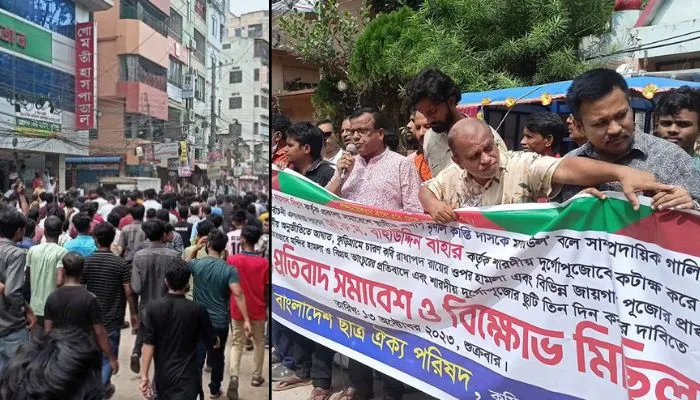
Case Summary
Following the fall of Sheikh Hasina's government, attacks on the Hindu community and religious institutions in Bangladesh surged, with ISKCON temples and followers facing targeted violence. An ISKCON priest condemned the situation, labelling it a grave and shameful development. Followers report that wearing traditional dhoti-kurta, distributing the Bhagavad Gita, applying tilak, and chanting "Hare Krishna" have been banned, threatening their religious freedom. The Hindu community now struggles to practice their faith openly, with fear and confusion about why they are being persecuted. A senior ISKCON official highlighted the organization's historical support for Bangladesh during its formation, emphasizing the sadness and irony of the current atrocities.
Why it is Hate Crime ?
This case has been added to the hate tracker under the prime category of 'Restriction/ban on Hindu practices'. Under this, two sub-categories have been selected. The first is- Restriction on expression of Hindu identity. An example of the state-affected prejudicial and targeted orders against the Hindu community would be a government denying the right of a Hindu or a group of Hindus to hold a religious procession owing to the animosity of non-Hindu groups. Denial of the religious right of the Hindus to assuage the non-Hindu group which harbours animosity to a point where it could lead to violence against Hindus is not only a failure of law and order but is a prejudicial order against Hindus, denying them their fundamental rights to express their religious identity. An example of a hate crime against Hindus by a non-Hindu would be a non-Hindu institution forcing its Hindu employees to abandon religious symbols that a Hindu would wear as an expression of faith owing to inherent prejudice against the faith professed by the victim or a non-Hindu group of people restricting a Hindu group from constructing a place of worship simply because the demography of the area in which the temple is being built is dominated by non-Hindus. Such actions are driven by religious animosity and/or prejudice against Hindus and their faith and would therefore be categorized as a hate crime. The second sub-category selected here is- Administration restricting religious practice. In several cases, it is seen that the administration/state disallows a religious practice owing to prejudicial orders and concerns, targeted specifically against the Hindu community. Such restriction/prohibition would be considered documented as a hate crime because the orders are often a result of pressure by groups that harbour animosity towards Hinduism and Hindus. Often, the restriction by the authorities is driven by bias, hostility, or prejudice against the specific community being stopped from holding a religious practice, by pressure groups that harbour animosity towards Hindus, intrinsic to their faith. Since practices are intrinsic to the faith of the Hindus, such prejudicial restriction is considered a curtailing of the fundamental rights of the Hindu community. In several cases, for example, the authorities ban a Hindu religious practice due to pressure from groups opposed to the religion. In other instances the prohibition is selectively enforced against one religious group (Hindus) while others are allowed to proceed. There are still other cases where the authorities preemptively restrict a religious practice by Hindus because those who hold animosity towards Hindus may get “provoked” leading to them being violent, thereby assuaging the sentiments of those who hold animosity towards Hindus by curtailing the religious rights of Hindus. Such acts and orders are prejudiced, indicating discriminatory motives owing to the capitulation to groups that harbour animosity towards Hindus and therefore, would be categorized as a religiously motivated hate crime since the original pressure leading to the order itself is a result of hatred/bias/prejudice/religious hate against Hindus. The removal of Sheikh Hasina from power in Bangladesh on August 5 escalated the persecution and marginalisation of the Hindu minority in the predominantly Islamic nation, intensifying what can be described as a silent genocide. Since her ouster, Islamists have carried out unchecked atrocities against Hindus, including physical violence, the destruction of temples and religious symbols, and the systematic displacement of Hindus from their ancestral lands. Over 205 attacks on Hindu temples, shops, and businesses have been recorded following Sheikh Hasina's removal as Prime Minister. Many Hindus have been brutally murdered or injured in these assaults. Amidst this, ISKCON temples and followers have also faced targeted violence. This report mentions how ISKCON followers have revealed how the new administration has banned the wearing of traditional dhoti-kurta, distributing the Bhagavad Gita, applying tilak, and chanting "Hare Krishna". The reported bans on traditional Hindu practices, such as wearing dhoti-kurta, applying tilak, distributing the Bhagavad Gita, and chanting "Hare Krishna," highlight targeted efforts to suppress Hindu religious expression in Bangladesh. Such restrictions not only infringe upon the community's fundamental rights to practice and express their faith but also reflect an administrative environment that fosters or tolerates discrimination against Hindus. Further, restricting someone from following their traditional practices can also be considered a prejudicial order denying the Hindu community its fundamental rights. Since the arbitrary action taken against the ISKCON followers was prejudicial to the rights of Hindus and stems from animosity and prejudice against Hindu beliefs, this case is being categorised as a religiously motivated hate crime.


Case Status
Unknown


Perpetrators Details
Perpetrators
State and Establishment
Perpetrators Range
N/A
Perpetrators Gender
unknown
 Sources




