Ancient Hindu temple vandalised, idol of deities broken into pieces in Varanasi, Uttar Pradesh
 Uttar Pradesh, India
  18 October, 2025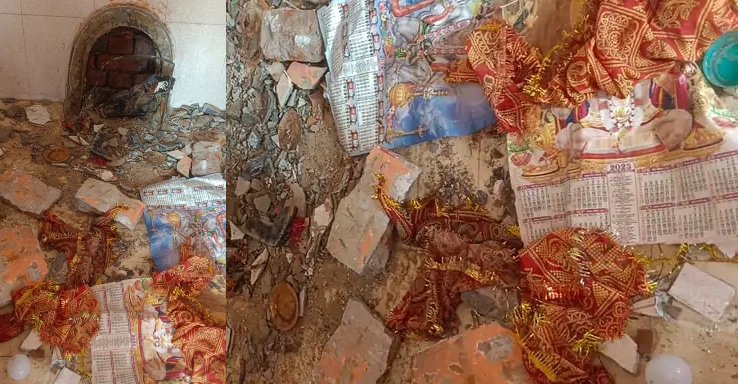
Case Summary
Idol of Goddess Kali destroyed, lights and other materials vandalised at the ancient Kali Mata Temple in Giridharpur village, Varanasi, on Sunday night, 19th October 2025. On next morning, when the local women arrived at the temple for prayers, they were shocked to find the idol broken and the temple in chaos. They quickly alerted their families, and villagers gathered at the site. The incident angered the local community. The police were informed, and Chaubepur Station Officer Ajit Kumar Verma arrived with his team to inspect the situation. Preliminary investigations suggested that the act was carried out by miscreants from the village, and the police were questioning suspects. Villagers demanded the immediate arrest of the perpetrators, calling the incident a direct attack on their religious faith, and requested stronger security for the temple.
Why it is Hate Crime ?
The primary category selected in this case is- Attack on Hindu religious representations. Within this, the subcategory selected is- Attack on temples. In Hinduism, a temple is the abode of the Deity. The Deity in the Temple is consecrated, thereby making it a real, breathing entity. Hindus believe that not just the Deity but the temple premises itself are sacred to Hindus since Hindus hold the faith that the entire Temple space is an amalgamation of the divine energy of the deity. Given the central significance of Temples in Hindu Dharma, any attack against a Hindu Temple or its peripheral premises is an attack on the faith itself and is born out of animosity towards the faith, of which the Temple is a central tenet. Any manner of attack against a Temple and/or its premises would therefore be considered a religiously motivated hate crime. The other subcategory selected is- Desecration of Hindu religious symbol. Icons and symbols, or a religious representation of a spiritual ideal, are widely revered in Hinduism. Iconography is of vital significance in the Hindu milieu. It helps connect people’s spiritual beliefs with the real world. Iconography within the Hindu faith takes several shapes and forms. Murtis are of most significance to Hindus, to which daily rituals, prayers and offerings are done. Besides the murtis, there are several other symbols which have deep significance in the Hindu faith – the Om and Swastika, for example. Since these Hindu religious symbols hold paramount importance in Hinduism, any desecration of symbols, icons, murtis, religious representations and manifestations, is driven by animosity towards the faith itself, which manifests itself through these murtis, icons and symbols. Therefore, any desecration of these Hindu religious symbols and representations is considered a religiously motivated hate crime under this category. This case has been included in the tracker because the perpetrators deliberately targeted and vandalised a Hindu temple just before the auspicious festival of Diwali, signifying that the vandals wanted to dampen the festive environment and raise tension in the local community. Nothing was stolen or reported missing; only the lighting was destroyed, and the murti was desecrated. This implies that the sole purpose of the attackers was to trample upon the sanctity of the Hindu place of worship and its deity. A temple is an institution of profound spiritual significance within the Hindu faith. For Hindus, temples are not merely physical structures; they are consecrated spaces that embody the divine presence of deities. Acts of violence against such spaces constitute clear examples of religiously motivated hate crimes targeting Hindus and their places of worship. The attack also involved the intentional desecration of the murti of Ma Kali. In Hinduism, idols are not simply artistic representations but revered embodiments of the divine, central to the spiritual life. Murti desecration is therefore not just an act of destruction of property but a direct assault on the sanctity of the temple and the faith of the community. Such acts are rooted in hostility towards Hinduism and reflect deep-seated hatred against its symbols and practices. Beyond the physical damage, the psychological impact of such attacks is profound. For devotees, temples are places of solace, peace, and connection with the divine. When sacred temples are targeted and their idols vandalised, especially during an important festival like Diwali, it demonstrates that the perpetrators deliberately intended to insult and hurt Hindu sentiments. Such attacks disrupt the sense of security and belonging, the Hindu community finds in these institutions. The pain caused by idol desecration is not limited to tangible loss; it wounds the collective psyche of Hindus, leaving many feeling isolated, vulnerable, and marginalised. These acts are not just vandalism; they are calculated assaults on the faith, identity, and spiritual dignity of the Hindu community. It is also important to mention here that, till the last update, the miscreants were unknown; regardless, the action stemmed from hatred against Hinduism and resulted in the desecration of the sacred idols in the Hindu temple and would therefore be considered a religiously motivated hate crime. Such attacks underscore religious animosity, warranting their inclusion in the Hinduphobia Tracker under the hate crime database.


Case Status
Complaint filed


Perpetrators Details
Perpetrators
Unknown
Perpetrators Range
Unknown
Perpetrators Gender
unknown
 Sources




