Hindus offered inducements for Christian conversion; missionaries denigrated Hinduism and attacked Hindu activists
 Phulpur, Uttar Pradesh, India
  17 October, 2025
Case Summary
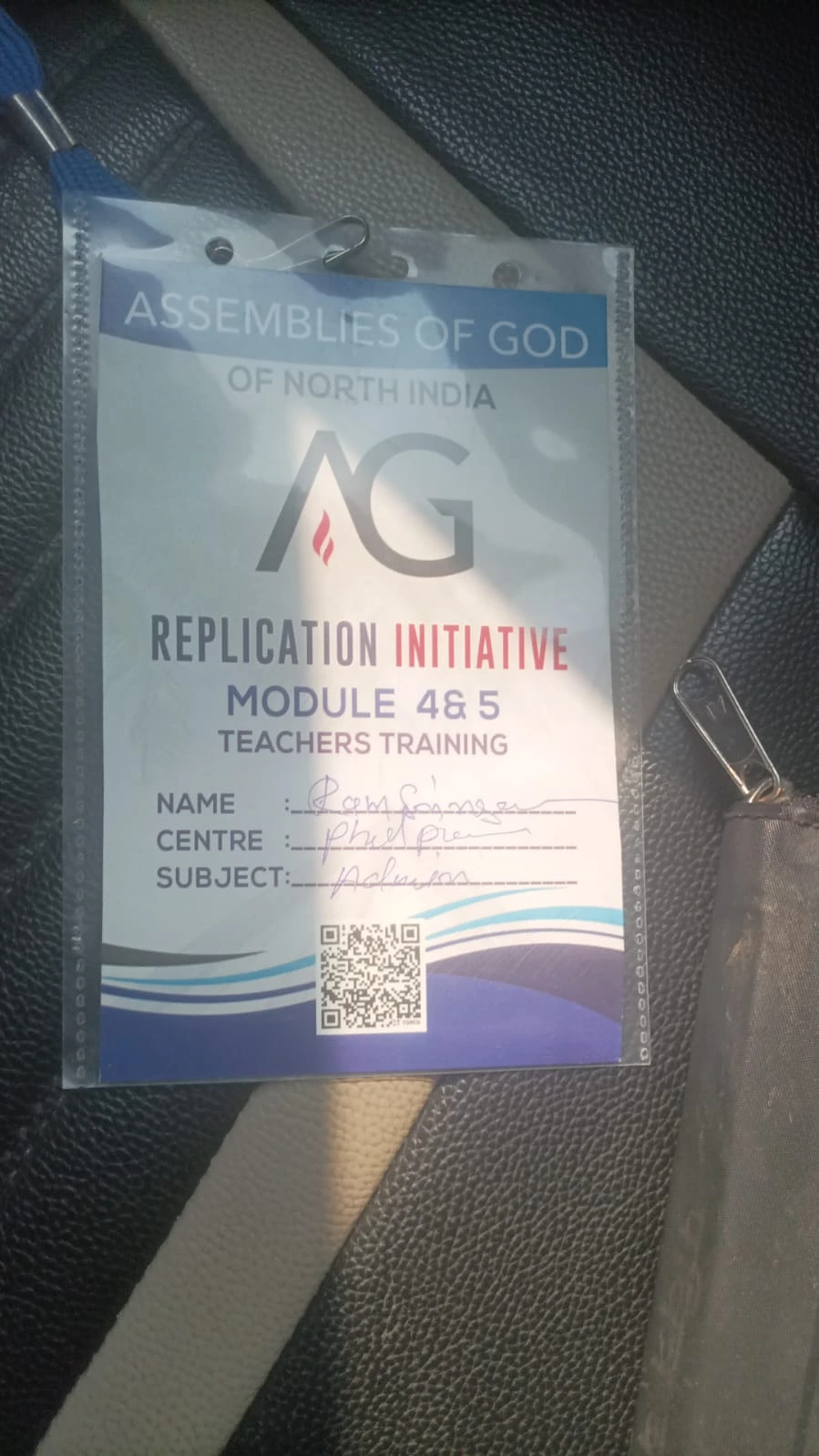
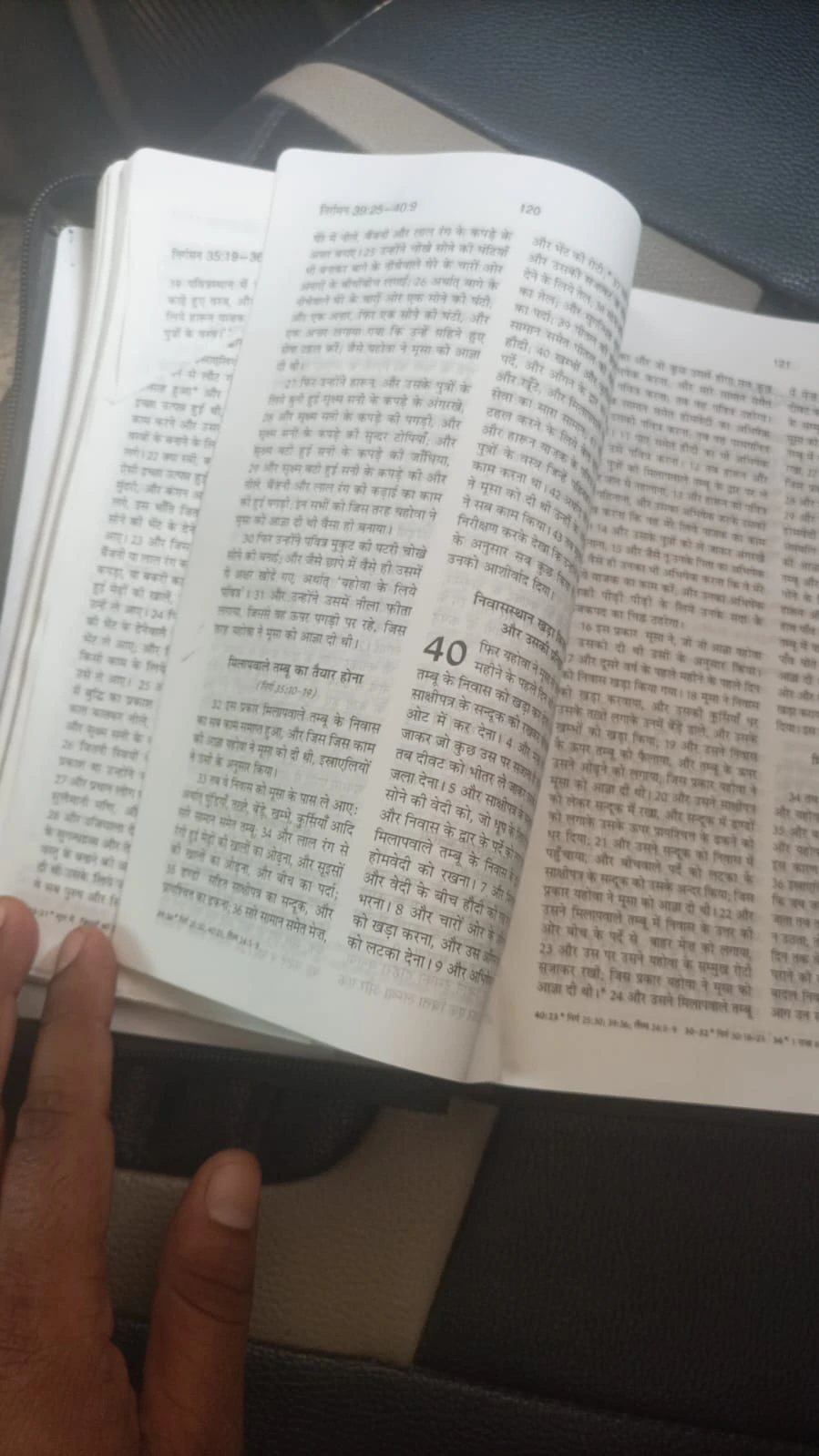
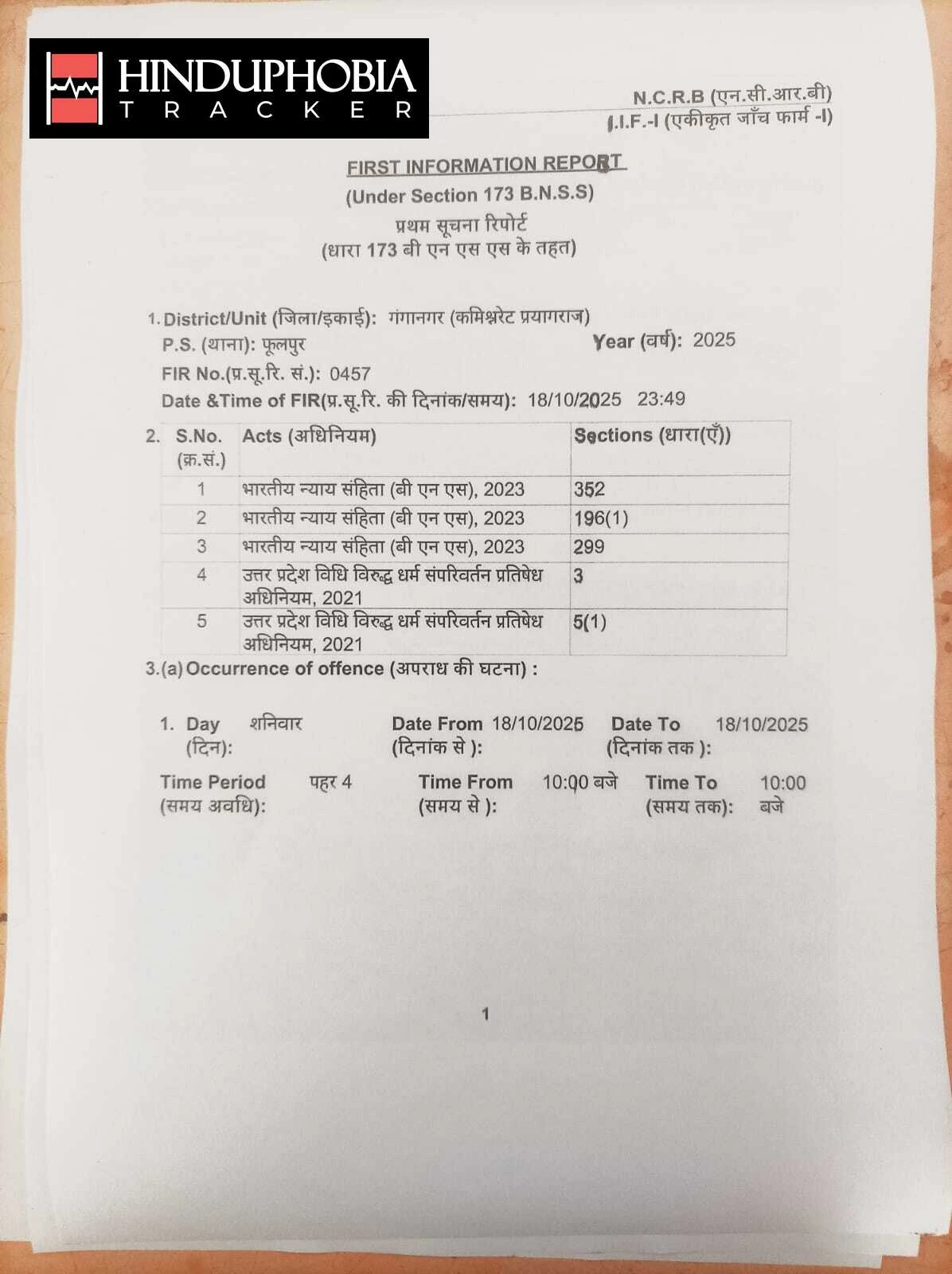
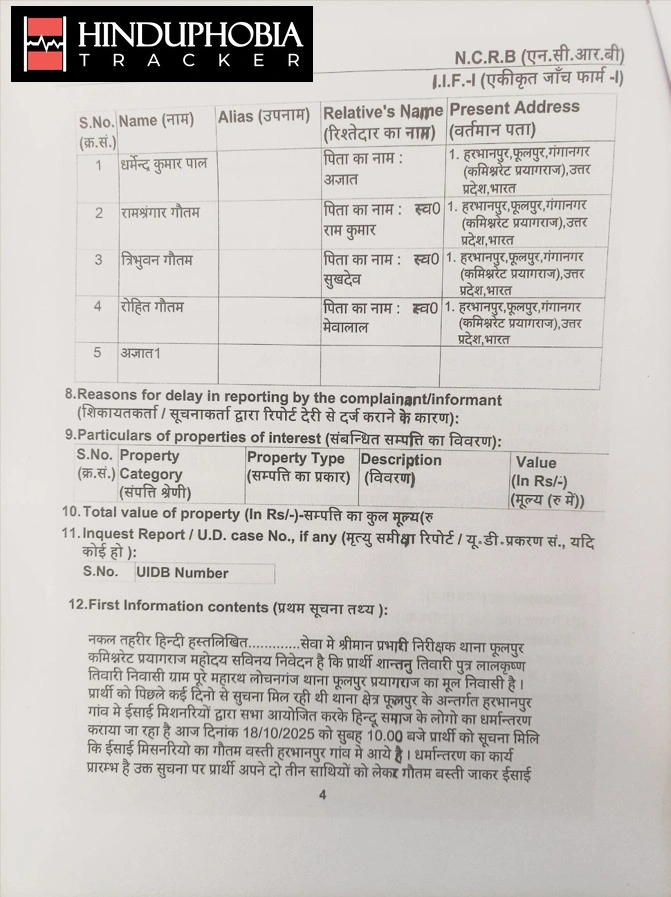
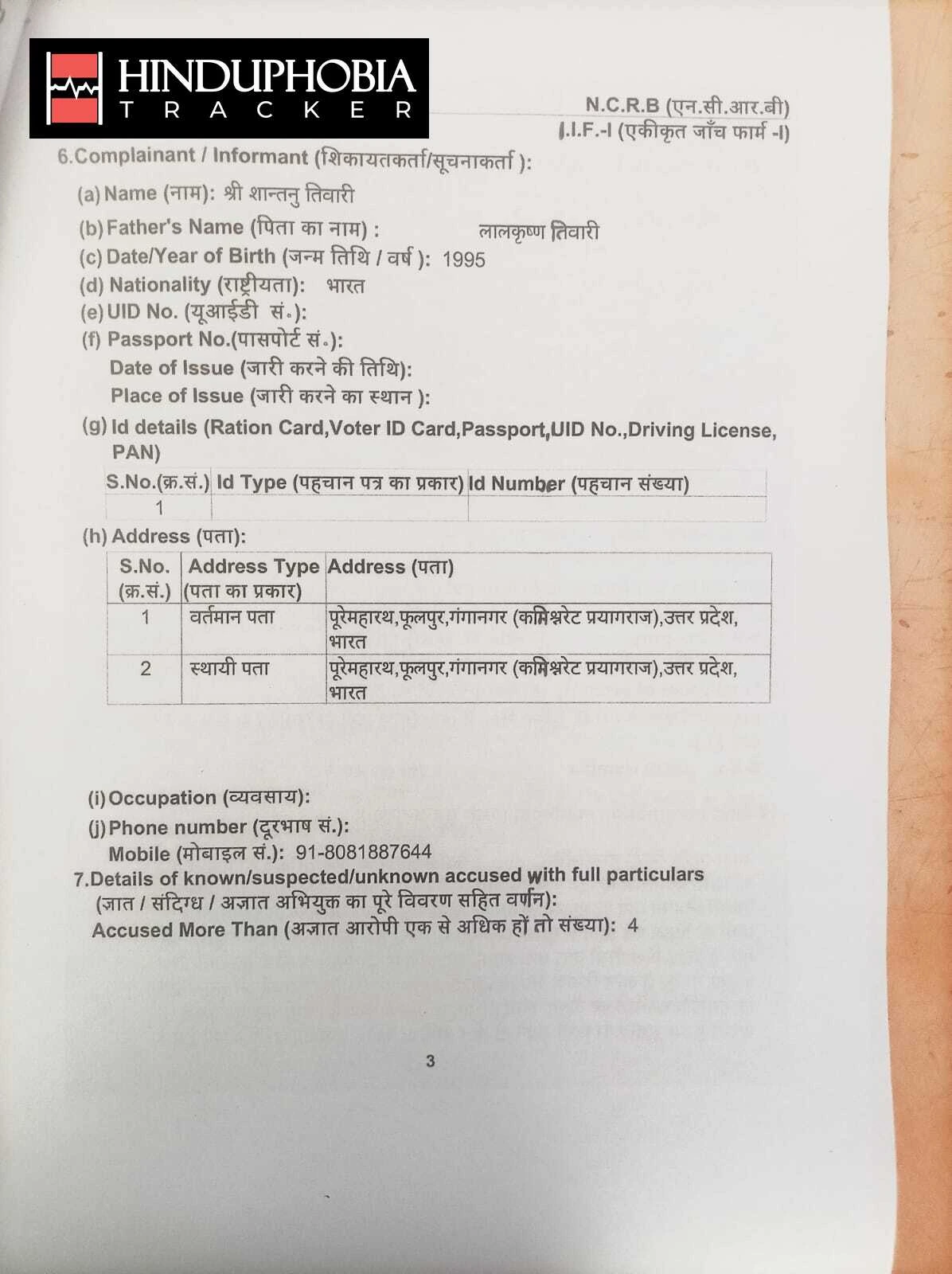
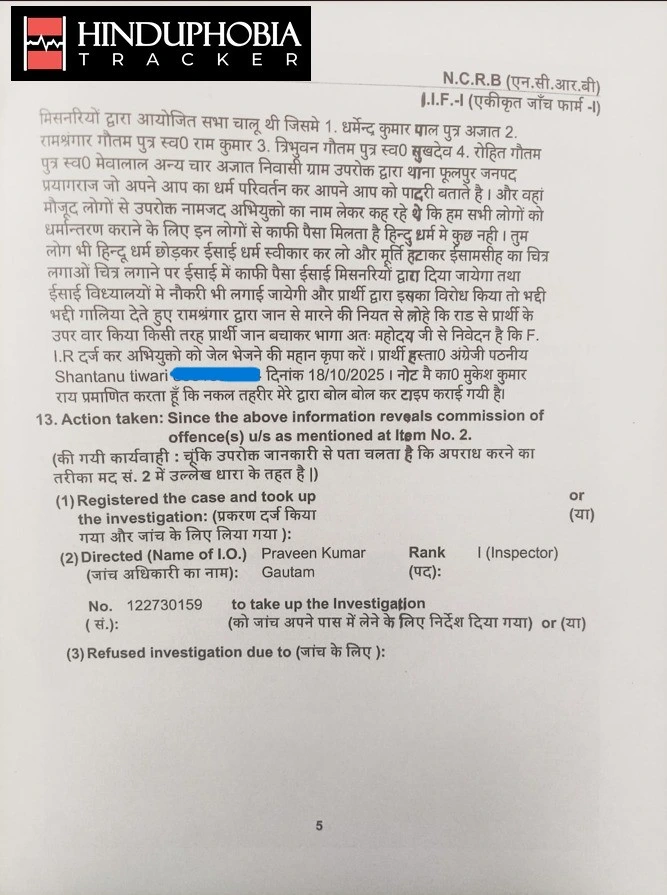
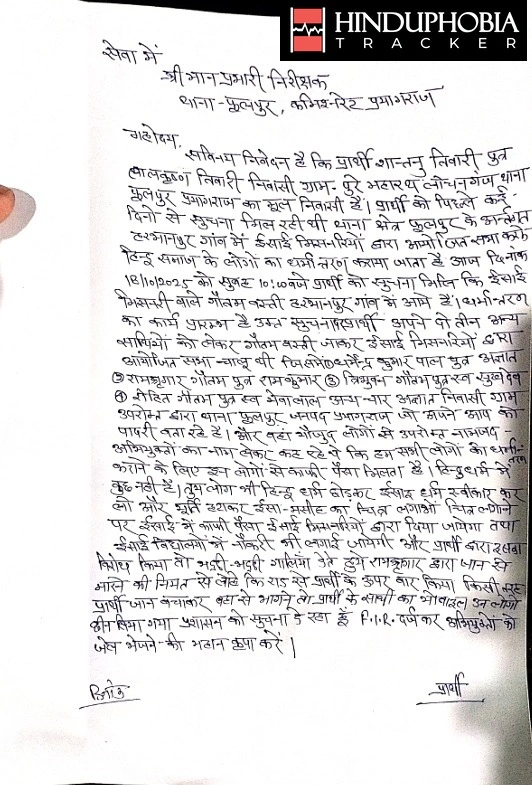
In the Haribhanpur village located under the Phulpur police station in the Prayagraj district of Uttar Pradesh, Hindu villagers were targeted and offered inducements for conversion by Christian missionaries. Furthermore, when Hindu activists objected to illegal conversion, they were physically assaulted by the missionaries. According to reports, missionaries were organising a community prayer meeting in an effort to convert Hindu villagers. When members of Hindu organisations, including Shantanu Tiwari, District Co-Convenor of Bajrang Dal, Vishva Hindu Parishad, reached the site during one such meeting, they found that Hindu villagers were being brainwashed to abandon their faith. The missionaries were offering money, clothes, and employment opportunities at missionary schools in exchange for religious conversion. They also found that missionaries urged attendees to renounce Hindu Gods and Goddesses and place images of Jesus Christ in their homes. They also claimed, "There's nothing left in Hinduism. Convert to Christianity, and it will bring you money and jobs." During the confrontation, the missionaries said that they received hefty payments for converting people to Christianity and that no such rewards were given in Hinduism. When Shantanu Tiwari protested against the conversion activities, the accused brutally attacked him with an iron rod, and in the ensuing scuffle, they also snatched the mobile phone of one of his companions. Shantanu managed to escape and save his life. Subsequently, Shantanu filed a complaint with the police, leading to police registering a case under Sections 352, 196(1), and 299 of the Bharatiya Nyaya Sanhita, 2023, and Sections 3 and 5(1) of the Uttar Pradesh Prohibition of Unlawful Conversion of Religion Act, 2021. Shantanu named four individuals, Dharmendra Kumar Pal, Ramshringar Gautam, Tribhuvan Gautam, and Rohit Gautam, and four unnamed people in his complaint. Three of the accused were arrested and sent to jail, while others remained at large. During the arrests, police also recovered Bibles and other religious literature from the site. As of the date of writing this report, police had initiated a search operation to nab the accused, who was absconding.
Case Images

Why it is Hate Crime ?
This case has been added to the tracker under the primary category- Predatory Proselytisation. Within it, the sub-category selected is - Conversion/ attempts to convert by inducement. Predatory Proselytisation is not just limited to threat, harassment, force and violence, but it also has contours of stealth. In several cases, the Hindu victim is exploited to convert, with non-Hindus taking advantage of their poverty. In such cases, the Hindu victim who is suffering financially is offered monetary benefits, including lucrative offers for jobs, health treatment, education, etc, to induce the victim into changing his/her religion. In such cases, the religious identity of the victim and the aim to disenfranchise him from his faith form the heart of the crime. Also, taking advantage of and exploiting an individual’s economic vulnerabilities is widely acknowledged as exploitation, forms of which are often penalised by law. Such cases therefore are considered religiously motivated hate crimes since the victim’s religious identity forms the very heart of the crime itself. The other sub-category selected is- Attempting to convert/converting by denigrating Hinduism. In several cases, Hindus are converted or an attempt is made to convert Hindus by denigrating their faith, Hinduism. In such cases, the Hindus associate with the non-Hindu perpetrators often by choice and then, the attempt to convert them by insulting their faith, showing the faith down etc begins. An example of this would be a non-Hindu gathering where the Hindus are attending the gathering of their own free will. However, once they attend the gathering, there is an explicit attempt to convert them by abusing their faith and hailing the faith of the perpetrator. The denigration of the Hindu faith is often based on misrepresentation of the Hindu faith, its doctrine and scriptures and insult to espoused traditions if not blatant lies about Hindu beliefs and ways. Such conversions or attempts at conversions are driven by animosity towards the Hindu faith and are therefore documented as religiously motivated hate crimes. The other subcategory selected is- Proselytisation by grooming, brainwashing, manipulation or subtle indoctrination, with the tertiary category being - Pattern of targeting Hindus. Religious brainwashing essentially means the often subtle and forcible indoctrination to induce someone to give up their religious beliefs to accept contrasting regimented ideas. Religious grooming or brainwashing also involves propaganda and manipulation. It involves the systematic effort, driven by religious malice and indoctrination, to persuade “non-believers’ to accept allegiance, command, or doctrine to and of a contrasting faith. Cases of such grooming or brainwashing are far more nuanced than direct threats, coercion, inducement and violence. In such cases, it is often seen that there is repeated, subtle and continual manipulation of the victim to induce disaffection towards their own faith and acceptance of the contrasting faith of the perpetrator. While subtle indoctrination is widely acknowledged as predatory, an element which is often understated in such conversions or the attempts of such conversion is the role of loyalty and trust which might develop between the perpetrator and the victim. Fiduciary relationships are often abused to affect such religious conversion. For example, an educator transmitting religious doctrine of a competing faith to a Hindu student. The Hindu student is likely to accept what the teacher is transmitting owing to existence of the fiduciary relationship. The exploitation of the fiduciary relationship to religiously indoctrinate victims would also be included in this category. Since the underlying animosity towards the victim’s faith forms the basis of predatory proselytization, such cases are considered religiously motivated hate crimes. The second primary category selected here is - Attack not resulting in death. Within it, the sub-category selected is - Attacked for opposing radicals or trying to save victim. In several cases, Hindus are attacked for opposing religiously motivated crimes being committed against a fellow Hindu or simply for voicing an opinion opposing radical elements, who either have in the past or continue to persecute Hindus. In such cases, the initial attack against the victim, against which the Hindu was trying to defend the victim, would also need to be classified as a religiously motivated hate crime. Since the initial crime itself was religiously motivated and the subsequent crime of attempting to save the victim or speaking against the radical elements ends up inviting a violent attack, it would also be classified as a religiously motivated hate crime under this category. This case has been added to the tracker because Hindu villagers were lured and offered inducements for religious conversion by Christian missionaries. The missionaries were offering money, clothes, and employment opportunities at missionary schools in exchange for religious conversion. Firstly, offering incentives or making false promises, especially when directed at vulnerable individuals in need, was not an act of kindness or charity. Instead, it was a calculated move to exploit Hindus because of their religion. By providing inducements or promising healing in exchange for conversion, the accused effectively coerced those who were desperate for assistance or hope. Such instances are seen in multiple cases where members of Christian missionary groups target socially and economically vulnerable Hindus to further their agenda of religious conversions. This form of coercion strips people of their agency and dignity, resulting in coerced conversions. Secondly, the accused denigrated Hinduism by saying that there is nothing left in Hinduism and that converting to Christianity will bring money and jobs. They urged villagers to replace idols of Hindu deities with pictures of Jesus Christ. Such remarks are designed to demean and undermine the faith of Hindus and intend to create an inferiority complex in the minds of the victims against their own faith. This fosters an environment of hostility and disrespect towards the Hindu community and Hindu deities. These acts of insulting Hinduism stem from Christian theology, which harbours disdain and hatred for polytheistic faiths, and which categorises Hindus as ‘polytheists’, thereby fostering hatred against them. Such actions make the religiously motivated nature of the crime even more evident. Thirdly, Shantanu informed the police that the conversion events were happening under the guise of a prayer meeting. The act of inviting Hindus to a prayer gathering while simultaneously conducting conversion activities demonstrated that these meetings were not genuine religious sessions or community prayers. Instead, they were calculated efforts to exploit trust and social cohesion within the Hindu community, disguising conversion attempts as routine gatherings. Fourth, during the arrest, police recovered a Bible and other religious literature from the site. Using the scriptures or literature of one faith to deliberately target and manipulate members of another, with the clear intention of religious conversion, represented a direct attack on the Hindu faith. Such actions were designed to undermine the beliefs of Hindu victims and were clear indicators of religious hostility. When Christian religious material was used to exploit trust, sow doubt, and misrepresent Hindu beliefs to coerce conversion, particularly in a systematic manner, it constituted a religiously motivated offence. Fifth, when Hindu activists attempted to prevent and resist forced conversions, there were brutally attacked by the missionaries. This was an act of calculated aggression clearly designed to silence resistance and assert ideological dominance. Shantanu was attacked precisely because he stood against predatory conversion activities targeting Hindus; the violence was directed at him for defending his faith and resisting religious manipulation of members of his community. Here, too, the underlying animosity stems from a refusal to allow Hindus to safeguard their religious community from coerced conversion. The attack was not a spontaneous personal altercation but a defensive reaction by the perpetrators to protect their religiously motivated operation and deter future opposition. The nature of the conversion efforts and the wider impact on the Hindu community all indicate a targeted action against Hindus as a collectivity. When individuals or groups focus their efforts on converting members of a particular religion, in this case, Hindus, then it demonstrates a fundamental disregard for the Hindu faith. Conversion, especially when not based on personal conviction but rather on external persuasion or pressure, is not simply about sharing a different belief system. It is an attempt to undermine the values, traditions, and identity of the Hindu community. In this context, the Christian perpetrators specifically targeted Hindus, which demonstrates a lack of respect for Hinduism and its followers. Such actions are carried out to strip Hindu victims of their faith, making it a religiously motivated crime. The Christian evangelists employed these methods in pursuit of conversion objectives, including psychological pressure, misinformation, inducements, and denigration of Hinduism. These were not random or isolated incidents, but premeditated efforts to undermine the Hindu faith, persuade Hindus to discard their own beliefs, and convert to Christianity. Such acts were deeply rooted in religious animosity towards Hindu victims, which is why this case has been added to the tracker.


Case Status
Case sub-judice


Perpetrators Details
Perpetrators
Christian Extremists
Perpetrators Range
From 5 to 10
Perpetrators Gender
unknown
 Sources




