Insults to Hindu religious sentiments: Muslim man makes abusive remarks against Hindu deities on social media
 Bareilly, Uttar Pradesh, India
  12 October, 2025
Case Summary
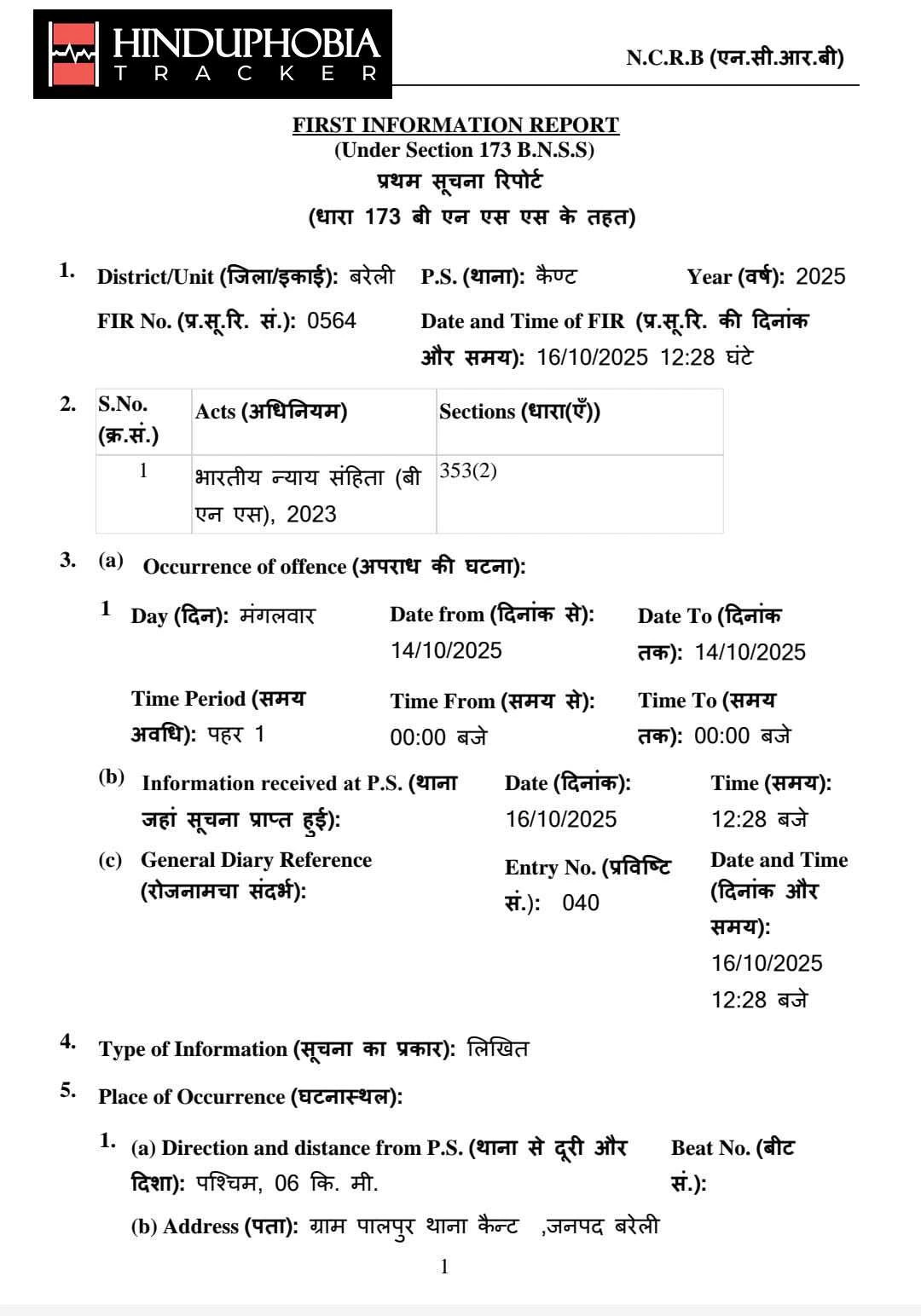
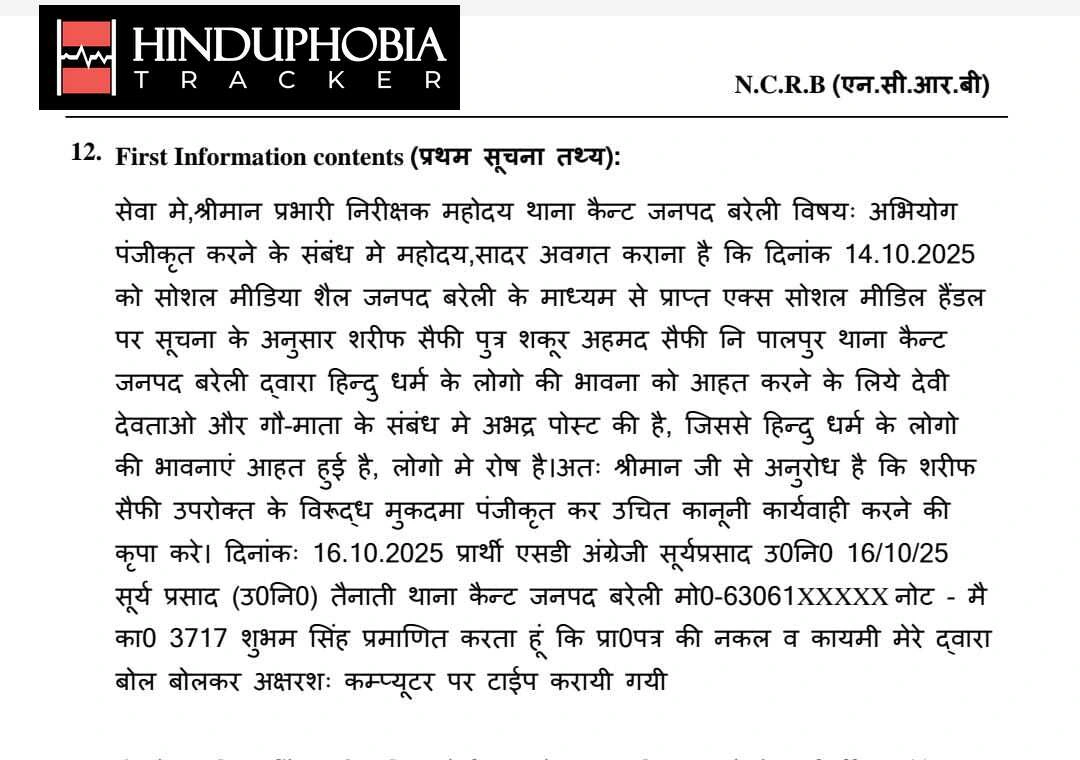
In Bareilly, Uttar Pradesh, Hindu religious sentiments were insulted after objectionable comments were made against Hindu deities and the sacred cow (Gaumata) by a Muslim man named Sharif Saifi. According to the police, the Muslim accused, a resident of Palpur village in the Cantonment police station area, had uploaded a derogatory post on his Facebook account targeting Hindu deities and Gaumata (the sacred cow). The incident came to light after Gaurakshak (cow protector) Himanshu Patel lodged a complaint with the police on 13 October 2025, prompting them to intervene. Acting on the complaint, the Cantonment Police registered an FIR late on 16 October 2025 under the relevant legal sections and launched a search operation to trace the accused. The Hinduphobia Tracker subsequently obtained access to a copy of the FIR, confirming the sections invoked and the seriousness with which the case is being pursued. As of the date of writing this report, police teams were conducting raids in multiple areas to apprehend the Muslim accused, treating the matter as an attempt to hurt religious sentiments through online defamation of revered Hindu symbols.
Case Images
Why it is Hate Crime ?
This case has been added to the tracker under the primary category- Hate Speech against Hindus. The subcategory selected is- Anti-Hindu slurs, mocking faith. Anti-Hindu slurs and the deliberate mocking of the Hindu faith owing to religious animosity involve the usage of derogatory terms, stereotypes, or offensive references to religious practices, symbols, or figures. One of the common anti-Hindu slurs used against Hindus is “cow-worshipper” and “cow piss drinker”. The intention of using this term is to demean and mock Hindus as a group and their religious beliefs since Hindus consider the cow holy. Additionally, some symbols and the slurs attached to them have a historical context that exacerbates the insult, hate, stereotyping, dehumanisation and oppression against Hindus. Cow worship has been used for centuries to denigrate Hindus, insult their faith and oppress Hindus specifically as a religious group. There has been overwhelming documentation about how cow slaughter has been used to persecute Hindus with cow meat being thrown in temples and places of worship. There has also been overwhelming documentation where cow meat (beef) has been force-fed to Hindus to either forcefully convert them to Islam or denigrate their faith. Apart from cow worship, the Swastika – which holds deep religious significance for the Hindus – has also been misinterpreted and distorted to use as a slur against Hindus. Similarly, the worship of the Shivling has been used by supremacist ideologies and religions to denigrate Hindus owing to religious animosity. Such slurs and denigration stem out of inherent animosity and hate towards Hindus and their faith, therefore, it is categorised as hate speech targeted at Hindus specifically owing to their religious identity. This case constitutes a clear instance of anti-Hindu hate speech. The Muslim accused, Sharif Saifi, posted obscene and offensive remarks on social media targeting Hindu deities and the sacred cow, Gaumata. In Hinduism, deities are revered as divine manifestations of truth, virtue, protection, and compassion. They are worshipped daily by millions as embodiments of spiritual guidance and cosmic order. Any affront, abuse, mockery, or disrespect directed at Hindu deities amounts to a direct assault on Hindu religious sentiments and serves to provoke deep emotional and religious hurt. Such actions are therefore categorised as hate speech, as they aim to insult, humiliate, and target a faith community by desecrating what is sacred to them. The accused’s conduct in posting derogatory remarks against Hindu deities was not an act of ignorance but an intentional effort to demean the Hindu religion and its divine figures, reflecting open hostility and prejudice. In addition to defaming Hindu deities, the accused also mocked the sacred cow (Gaumata) — an act that further reveals his contempt for Hindu faith and culture. In Hinduism, the cow is venerated as a symbol of motherhood, purity, and selfless giving, believed to embody divine grace and compassion. She represents life-sustaining virtue and is worshipped as a sacred being worthy of protection and reverence. In light of the accused already abusing Hindu deities, which clearly showcased religious animosity, his mockery of Gaumata must be understood as an extension of the same hate-driven behaviour. By ridiculing the sacred cow, he insulted one of the most profound symbols of Hinduism’s spirituality and ethics. This act reflects religious hatred and a conscious attempt to belittle sacred Hindu values, making it a religiously motivated crime aimed at offending and provoking the Hindu community. It is also important to note that in Islamic theology, idol worship, referred to as Shirk, is regarded as the gravest sin. The Quran strictly condemns it, and Islamic teachings emphasise the complete rejection of any practice associated with idol worship. Muslims are taught from a young age that idolatry is an unforgivable sin. While this belief is central to the Islamic faith, it has also led, historically and in contemporary times, to intolerance and hostility towards idol-worshipping religions, especially Hinduism. Therefore, the derogatory comments made by Sharif Saifi about Hindu deities and the sacred cow reflect this deeper theological prejudice, wherein idol worship is viewed not merely as a difference in belief but as impurity or offence. His online activity thus represented not an isolated act of disrespect but a manifestation of broader religious hostility toward Hinduism. In recent times, social media has increasingly become a platform for anti-Hindu hate, with derogatory memes, videos, and messages targeting Hindu religious symbols, practices, and beliefs. Such content forms part of a broader pattern of Hinduphobia and religiously motivated online hate. The deliberate targeting of Hindu deities and the sacred cow in this case firmly establishes it as an instance of religiously motivated hate speech, and it is therefore being added to the hate crime database of the Hinduphobia Tracker. Disclaimer: The Hinduphobia Tracker records the date of an incident based on when the crime occurred, rather than when it was reported by the media. In this case, the media did not specify the exact date on which the objectionable posts were made. Therefore, the date of the incident has been recorded as the date on which the complaint was filed—13 October 2025.


Case Status
Complaint registered


Perpetrators Details
Perpetrators
Muslim Extremists
Perpetrators Range
One Person
Perpetrators Gender
male
 Sources




