Minor Hindu boy brutally attacked by Muslim youths for refusing to chant "I love Muhammad"
 Baghpat, Uttar Pradesh, India
  11 October, 2025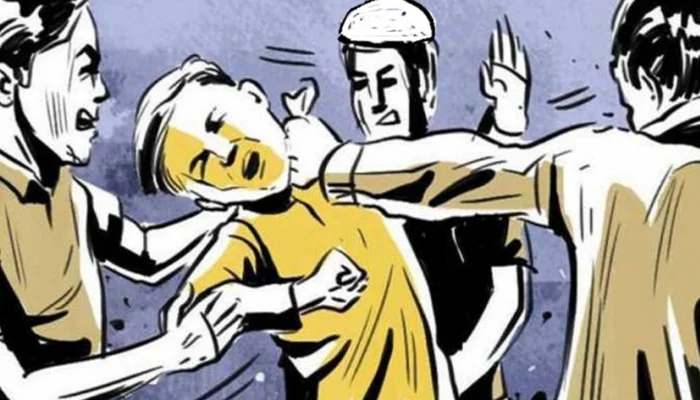
Case Summary
In the Bada village of Baghpat district, Uttar Pradesh, a minor Hindu student named Vishal was brutally attacked by a group of five Muslim youths for refusing to chant "I Love Muhammad." Vishal, a Class 9 student at Adarsh Inter College, was returning home from school after an exam. During this time, he was approached by five Muslim youths, who demanded that Vishal chant "I Love Muhammad." When Vishal refused, they threatened him with a knife, warning that they would kill him if he did not comply. One of the youths punched Vishal hard in the face, causing him to fall and bleed, after which the others joined and began brutally assaulting him. Locals and nearby farmers intervened and rescued Vishal, forcing the attackers to flee the scene. Vishal reached home and informed his family about the incident, who took him to the Khekra police station. Subsequently, the victim's family filed a complaint with the police against the five Muslim youths, reporting abusive language, death threats, and religious coercion. The victim stated that the Muslim youths who assaulted him often pressured Hindu students in college to chant religious slogans and that on the day of the incident, he was threatened with a knife and attacked after refusing to say, "I love Muhammad." The police registered the case and began an investigation into the incident. Police station in-charge Prabhakar Kantura noted that a fight had occurred previously between these students. Police assured that strict action would be taken against the perpetrators. In a social media post, the police claimed that the reports stating that the assault occurred due to Vishal refusing to say "I Love Muhammad" were completely false and unfounded, describing the matter as a personal dispute between students. This incident did not emerge in isolation but forms part of a larger pattern of organised agitation by Muslims across India, centred on the “I Love Muhammad” campaign. The campaign itself arose from a controversy deliberately misrepresented by Muslim groups. On 5th September 2025, violence broke out in Rawatpur, Kanpur, during a Barawafat procession, when Muslims attacked and defaced Hindu posters. This was following a complaint by Hindus, where police removed an “I Love Muhammad” poster that had been fixed on the Ram Navami gate on 4th September 2025. An FIR was then lodged against Muslims for vandalising Hindu posters, but they twisted the narrative, claiming that the police action was taken against Muslims for merely putting up “I Love Muhammad” posters. This distortion became the rallying cry for Muslims to organise protests and violence across several districts. Slogans of “Sar Tan Se Juda” were raised in rallies, and Hindus, as well as police personnel, were attacked. Therefore, this case is not an isolated outburst but a continuation of an orchestrated campaign of intimidation and violence, openly challenging law and order while asserting Islamic supremacy.
Why it is Hate Crime ?
This case has been added to the tracker under the primary category of - Attack not resulting in death. Within it the sub-category selected is - Attacked for opposing radicals or trying to save victim. In several cases, Hindus are attacked for opposing religiously motivated crimes being committed against a fellow Hindu or simply for voicing an opinion opposing radical elements, who either have in the past or continue to persecute Hindus. In such cases, the initial attack against the victim, against which the Hindu was trying to defend the victim, would also need to be classified as a religiously motivated hate crime. Since the initial crime itself was religiously motivated and the subsequent crime of attempting to save the victim or speaking against the radical elements ends up inviting a violent attack, it would also be classified as a religiously motivated hate crime under this category. The other sub-category selected here is - Attacked for Hindu identity. In several cases, Hindus are attacked merely for their Hindu identity without any perceived provocation. A classic example of this category of religiously motivated hate crime is a murder in 2016. 7 ISIS terrorists were convicted for shooting a school principal in Kanpur because they got ‘triggered’ seeing the Kalava on his wrist and tilak that he had put. In this, the Hindu victim had offered no provocation except for his Hindu religious identity. The motivation for the murder was purely religious, driven by religious supremacy. Such cases where Hindus are targeted merely for their religious identity would be documented as a hate crime under this category. This case has been added to the tracker because a minor Hindu student was brutally attacked by a group of five Muslim youths for refusing to chant "I Love Muhammad." This was a clear example of religiously motivated violence against a Hindu boy, rooted in animosity toward his Hindu identity and faith. This case cannot be examined in isolation; it belongs to a wider sequence of events that began with anti-Hindu aggression. The backdrop of this controversy lies in the incident of 4–5 September 2025, when, during a Barawafat procession in Rawatpur, Kanpur, Muslims vandalised Hindu posters and banners. Following this, a complaint was filed by Hindus, and action was taken against rioting Muslims. A day earlier, police had removed an “I Love Muhammad” poster that had been illegally fixed on the Ram Navami gate. The FIR was lodged against Muslims for vandalising Hindu religious posters. However, this straightforward case of vandalism was deliberately distorted by Muslims, who portrayed themselves as victims and claimed that police action had been taken only because they displayed “I Love Muhammad” posters. This misrepresentation was not incidental but calculated, for it became the rallying point for widespread mobilisation across Uttar Pradesh and beyond. In the weeks that followed, Muslims organised rallies and agitations where lethal slogans such as “Sar Tan Se Juda” were openly raised. These slogans are not symbolic protests but direct calls for beheading, a form of religiously sanctioned violence. Hindus were attacked in several places, temples were desecrated, and even police attempting to maintain order were assaulted. The Hindu boy was attacked simply because he decided to oppose the actions of the group, who were forcing him to chant the communal slogan. The "I love Muhammad" was not an ordinary slogan considering its context; it was meant to assert dominance and project Islamic supremacy over the Hindu identity. The attack was triggered solely because the victim refused to verbally affirm Islamic reverence, demonstrating that his Hindu identity was the basis of the hostility. The act of forcing a Hindu child to chant the communal slogan was a form of religious subjugation, revealing deep-rooted contempt for the Hindu identity. Furthermore, when the victim refused to comply, he was subjected to death threats and brutally attacked. In this case, the refusal was interpreted not as a personal disagreement, but as a challenge to Islamic authority, which the perpetrators believed had to be met with violence. These actions reflect a dangerous mindset of religious supremacy that demands dominance and submission through aggression. This supremacist attitude fosters disdain and hostility, especially when a Hindu does not submit or “yield” in a dispute or an argument. The belief that Hindus lack equal standing leads to violent enforcement of dominance. The use of a knife to threaten a Hindu child into uttering a religious slogan indicates a clear pattern of ideological aggression. Additionally, the victim also revealed that Hindu students were routinely pressured by the same youths to chant Islamic slogans. This shows a sustained behavioural pattern, not a one-time conflict. Such repeated attempts to compel Hindu children to chant Islamic slogans is an unmistakable form of religious intimidation, rooted in religious animosity toward Hinduism. Since the perpetrators’ actions demonstrated explicit religious hatred, communal dominance, and deliberate intimidation designed to force Hindus into submission, this case has been added to the tracker. It is also important to note here that the police in a social media post claimed that the reports stating that the assault occurred due to Vishal refusing to say "I Love Muhammad" were completely false and unfounded, describing the matter as a personal dispute between students. While the victim himself stated that he was attacked for refusing to chant "I love Muhammad", the police attempted to deny the communal angle in this case by claiming the incident stemmed from a personal dispute. The police, in many such cases, where the motive behind the crime is obvious but not explicitly mentioned, deny that the crime committed was in any way motivated by a religious bias or say that there was ‘no communal angle’ to the crime. Several factors are generally at play here. Many a time, the police downplay incidents of low-level communal crime because it is their jurisdiction that comes under question. The police also often say that there was ‘no communal angle’ to a crime when there was one because they wish to ensure that, owing to the crime already committed, there is no further flare-up in the area. Likewise, the Left media is also inclined to emphasise this "no communal angle" trope, especially wherever the victim of the crime is a Hindu. However, only a police statement or a media report, for instance, cannot be enough to determine whether there is a communal angle present in the crime that has been committed. In fact, to determine whether the crime is communal in nature or not, we need to give emphasis to the ground realities. For example, in the case of Rinku Sharma, the Bajrang Dal activist who was mercilessly stabbed in his house in front of his family members in Delhi’s Mangolpuri area in the year 2021, the leftist media and the leftist ecosystem had tried to peddle that there was no communal angle to the crime. Even the police denied that the crime was communal in nature. However, Opindia spoke to several people who are on the ground with the family of Rinku Sharma, and we were told that the communal tension in the area is palpable. The family of Rinku Sharma has said that the Muslims of the area held a grudge against Rinku ever since he celebrated the Ram Mandir verdict. Like the case of Rinku Sharma, those cases where even if the police have denied a communal angle or the leftist media have gone on an overdrive to peddle the ‘no communal angle’ trope, the ground reality, like the victim’s family or relative's testimonies, make it clear that there was an obvious religious bias that led to the crime, will be documented in this tracker. Going by the same logic, since the victim himself testified that he was attacked for his refusal to chant the religious slogan, this case has been included in the hate tracker.
Victim Details
Total Victim
1
Deceased
0
Gender
- Male 1
- Female 0
- Third Gender 0
- Unknown 0
Caste
- SC/ST 0
- OBC 0
- General 0
- Unknown 1
Age Group
- Minor 1
- Adult 0
- Senior Citizen 0
- Unknown 0


Case Status
Complaint registered


Perpetrators Details
Perpetrators
Muslim Extremists
Perpetrators Range
From 2 To 5
Perpetrators Gender
male
 Sources




