Hindu religious sentiments insulted: Derogatory post and remarks targeting Hindu deities made on social media
 Hardoi, Uttar Pradesh, India
  7 October, 2025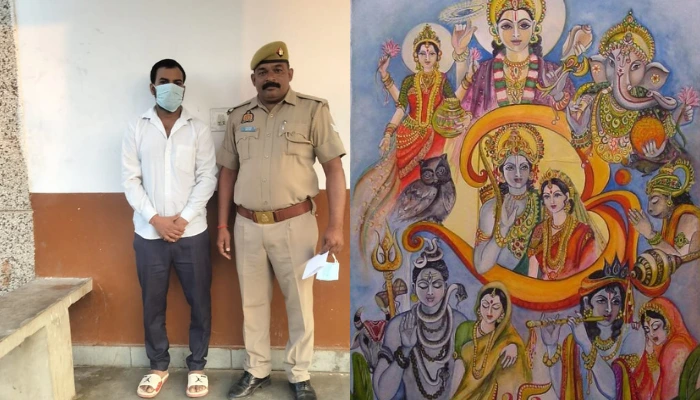
Case Summary
In Pali town, Hardoi district, Uttar Pradesh, derogatory remarks against Hindu deities were made on social media by a man named Vijay Kashyap. According to information received, the accused had posted objectionable comments about Hindu deities on his social media account, which angered local residents who demanded action from the police. The police detained him and filed a challan for disturbing public peace, following which he was sent to jail. Three months earlier, on 4th July 2025, the same individual had posted obscene remarks about Brahmin women on social media, which had also led to his arrest and imprisonment. The accused, Vijay Kashyap, is a resident of Mohalla Bhagwantpur in Pali town, who operated a mobile repair shop at Ramlila Square. On 8th October 2025, he shared an obscene post targeting Hindu deities on his Facebook account, which attracted several responses. In reply to the comments, Vijay posted further remarks that were offensive towards Hindu deities. Enraged by his derogatory remarks, local residents demanded strict action from senior police officials through various social media platforms, including Instagram. Acting on these complaints, the police detained Vijay Kashyap on 8th October 2025. Station House Officer (SHO) Sompal Gangwar stated that Vijay Kashyap was charged with breach of peace and presented before the Sub-Divisional Magistrate (SDM) of Sawaijpur. On the same day, the SDM ordered his judicial custody and sent him to jail on a 14-day remand.
Why it is Hate Crime ?
The primary category selected in this case is- Hate Speech against Hindus. The subcategory selected is- Anti-Hindu slurs, mocking faith. Anti-Hindu slurs and the deliberate mocking of the Hindu faith owing to religious animosity involve the usage of derogatory terms, stereotypes, or offensive references to religious practices, symbols, or figures. One of the common anti-Hindu slurs used against Hindus is “cow-worshipper” and “cow piss drinker”. The intention of using this term is to demean and mock Hindus as a group and their religious beliefs since Hindus consider the cow holy. Additionally, some symbols and the slurs attached to them have a historical context that exacerbates the insult, hate, stereotyping, dehumanisation and oppression against Hindus. Cow worship has been used for centuries to denigrate Hindus, insult their faith and oppress Hindus specifically as a religious group. There has been overwhelming documentation about how cow slaughter has been used to persecute Hindus with cow meat being thrown in temples and places of worship. There has also been overwhelming documentation where cow meat (beef) has been force-fed to Hindus to either forcefully convert them to Islam or denigrate their faith. Apart from cow worship, the Swastika – which holds deep religious significance for the Hindus – has also been misinterpreted and distorted to use as a slur against Hindus. Similarly, the worship of the Shivling has been used by supremacist ideologies and religions to denigrate Hindus owing to religious animosity. Such slurs and denigration stem out of inherent animosity and hate towards Hindus and their faith, therefore, it is categorised as hate speech targeted at Hindus specifically owing to their religious identity. In this case, the accused, Vijay Kashyap, made objectionable posts and comments targeting Hindu deities on his social media account. These remarks were derogatory in nature and amounted to hate speech, as they insulted and denigrated deities central to the Hindu faith. Hindu deities occupy an immensely important and sacred position in Hinduism and are deeply revered by the Hindu community. Targeting them in a derogatory and abusive manner is not merely offensive; it reflects direct religious animosity towards Hinduism and its followers. By publicly maligning revered Hindu deities, the accused not only disrespected the faith but also incited hostility, making this a clear example of a religiously motivated crime. This was not the first instance of the accused displaying such anti-Hindu behaviour. Three months earlier, the accused had made offensive and abusive comments on social media directed towards Brahmin women. Brahmins hold a significant place in Hindu society, and targeting them, especially in such a derogatory manner, reflects hostility towards the Hindu community. Furthermore, while in that incident the abuse was directed specifically at Brahmin women, it nevertheless insulted a section of the Hindu community as a whole, making it a broader act of anti-Hindu speech. It was not an isolated personal attack but a deliberate affront to the religious and cultural dignity of Hindus. Considering both incidents together, a clear and repeated pattern emerges. In each case, the accused deliberately targeted core aspects and respected members of Hindu society, first by insulting Hindu deities and then by disrespecting Hindu women belonging to the Brahmin community. Both actions are consistent with hate speech, as they were designed to provoke hostility, offend religious sentiments, and spread contempt for Hinduism and its adherents. This sustained targeting demonstrates deliberate intent rather than casual or ignorant discourse, firmly categorising these actions as religiously motivated hate speech. In recent times, there has been a surge in derogatory memes, comments, abusive posts, and slanders directed towards Hinduism, its deities, the Hindu community, and respected Hindu scholars across online platforms. This case stands as a glaring example within that trend. The accused’s derogatory statements form part of a broader pattern of online Hinduphobia — a toxic environment in which hate against Hindus is normalised and spread through targeted insults and ridicule. Such actions serve to deepen divisions, attack Hindu identity, and vilify an entire faith community. Given that this case meets the clear parameters of religiously motivated hate speech, it is being recorded in the Hate Crime database of the Hinduphobia Tracker.


Case Status
Case sub-judice


Perpetrators Details
Perpetrators
Others
Perpetrators Range
One Person
Perpetrators Gender
male
 Sources




