Poor Hindu villagers targeted with money and false promises, urged to denounce Hindu gods and convert to Christianity
 Alwar, Rajasthan, India
  4 October, 2025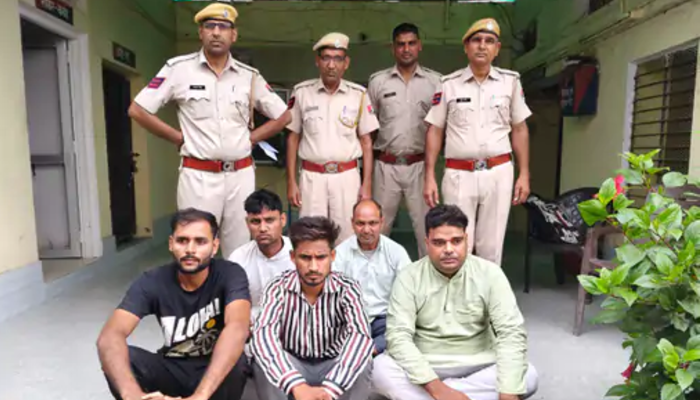
Case Summary
Five people were arrested in Nainapur village under the Barodameo police station limits in Alwar, Rajasthan, for attempting to convert Hindu men and women to Christianity through deception, inducement, and fear. The arrests followed a complaint lodged by Kantilal, a resident of Butoli, on 5 October 2025, who reported that several outsiders were conducting a conversion gathering at the house of Mawasi Ram in Nainapur. According to the complaint, around 40 to 50 Hindu villagers, including men and women, were made to participate in Christian prayers. The accused reportedly called Hindu deities “fake gods” and declared Jesus Christ as the “true God.” They also lured the villagers with promises of large sums of money, relief from suffering, healing from diseases, construction aid for houses, and educational benefits for their children. Witnesses stated that the accused cited incidents of temple vandalism to instil fear, saying that a god unable to protect himself could not protect his devotees. Alarmed by the ongoing activities, Kantilal, along with Abhayram, Devaram, Rajesh Jain, Ramotar Chaudhary, Jagdish Gurjar, Lekhram, and Rajaram, informed the police. Following the alert, the investigation was assigned to Assistant Sub-Inspector Banshi Ram, and a case was registered under Sections 196(2) and 299 of the Indian Judicial Code. The arrested individuals were identified as Keshav Bendada of Jaipur, Mahesh Chand of Mohabbatpur in Malakheda, Ramnarayan of Bhadkol in Malakheda, Rohit of Paigambarpur in Moradabad, and Prashant of Bahala. All five were presented before Civil Judge Laxmangarh Paramjit Kaur and remanded to judicial custody. Station House Officer Vijay Pal Singh confirmed the arrests and said the investigation was ongoing to determine whether the accused were linked to larger inter-state conversion networks.
Why it is Hate Crime ?
The primary category in this case is: Predatory Proselytisation. The first subcategory in this case is: Conversion/ attempts to convert by inducement. Predatory Proselytisation is not just limited to threat, harassment, force and violence, but it also has contours of stealth. In several cases, the Hindu victim is exploited to convert, with non-Hindus taking advantage of their poverty. In such cases, the Hindu victim who is suffering financially is offered monetary benefits, including lucrative offers for jobs, health treatment, education, etc, to induce the victim into changing his/her religion. In such cases, the religious identity of the victim and the aim to disenfranchise him from his faith form the heart of the crime. Also, taking advantage of and exploiting an individual’s economic vulnerabilities is widely acknowledged as exploitation, forms of which are often penalised by law. Such cases therefore are considered religiously motivated hate crimes since the victim’s religious identity forms the very heart of the crime itself. The second subcategory in this case is: Attempting to convert/converting by denigrating Hinduism. In several cases, Hindus are converted or an attempt is made to convert Hindus by denigrating their faith, Hinduism. In such cases, the Hindus associate with the non-Hindu perpetrators often by choice and then, the attempt to convert them by insulting their faith, showing the faith down etc begins. An example of this would be a non-Hindu gathering where the Hindus are attending the gathering of their own free will. However, once they attend the gathering, there is an explicit attempt to convert them by abusing their faith and hailing the faith of the perpetrator. The denigration of the Hindu faith is often based on misrepresentation of the Hindu faith, its doctrine and scriptures and insult to espoused traditions if not blatant lies about Hindu beliefs and ways. Such conversions or attempts at conversions are driven by animosity towards the Hindu faith and are therefore documented as religiously motivated hate crimes. This case has been added to the Hinduphobia Tracker because it represents a deliberate and organised attempt to dismantle the faith of economically vulnerable Hindus through manipulation, deceit, and denigration. The incident in Nainapur village is not an isolated case of unauthorised religious activity; it is part of a recurring pattern of predatory proselytisation, where the conversion of Hindus is pursued through psychological coercion, social pressure, and targeted exploitation of poverty. The first layer of this crime lies in inducement. The accused entered a Hindu household and gathered around forty to fifty Hindu villagers under the pretext of prayer and healing. They deliberately targeted men and women from poor rural backgrounds, offering them false assurances of financial relief, improved health, housing support, and educational opportunities for their children. These inducements were not acts of charity but calculated instruments of control, designed to prey upon material distress and create a sense of dependency on a foreign faith system. Such practices exploit human vulnerability under the guise of religious benevolence. By conditioning material welfare upon conversion, the accused attacked the victims’ right to freedom of conscience and dignity, reducing faith to a transactional exchange. The second layer is the denigration of Hinduism. Once the villagers were gathered, the accused reportedly began to call Hindu deities “fake gods” and mocked the spiritual beliefs of the community. They contrasted this ridicule with assertions of Christian supremacy, declaring Jesus Christ as the “real God.” By further claiming that Hindu gods were powerless to protect even their own temples and idols, the accused sought to erode the spiritual confidence of the victims, implanting doubt and guilt in their minds. This calculated denigration of the Hindu faith was aimed at dismantling the victims’ sense of cultural identity and belonging. Such behaviour moves beyond the realm of religious persuasion into the territory of hate-driven manipulation. The contempt shown toward Hindu gods and traditions reflects a deep-seated prejudice and hostility towards Hinduism itself. When faith is mocked and the poor are tempted to abandon their religion for material promises, the intent is not spiritual upliftment but religious displacement. The message delivered to the victims was clear: their gods were false, their culture was inferior, and their suffering was divine punishment for adhering to their ancestral faith. In essence, the crime at Nainapur was not a peaceful exercise of religion but an act of religiously motivated aggression. It attacked both the spiritual dignity and the social stability of a Hindu community. The accused manipulated economic vulnerabilities, induced conversion through deceit, and then sought to justify it through verbal degradation of Hindu deities. Such a combination of inducement and denigration constitutes an assault on the identity, faith, and heritage of Hindus. The inclusion of this case under the “Predatory Proselytisation” category, with subcategories of “Conversion by Inducement” and “Conversion by Denigrating Hinduism,” is therefore essential. It captures both the deceitful methods employed and the ideological hostility underpinning the act. The victims were not merely offered a new belief system—they were first bribed, then humiliated, and finally coerced to renounce their faith. This incident underscores how modern proselytisation in rural India often conceals coercive intent behind the facade of compassion. It highlights the urgent need to recognise such conversions as hate crimes, because the motive lies in dismantling Hindu identity rather than offering spiritual enlightenment. Disclaimer: The number of perpetrators has been set to 50 because, according to the complaint, around 40 to 50 Hindu villagers, including men and women, were made to participate in Christian prayers.
Victim Details
Total Victim
50
Deceased
0
Gender
- Male 0
- Female 0
- Third Gender 0
- Unknown 50
Caste
- SC/ST 0
- OBC 0
- General 0
- Unknown 50
Age Group
- Minor 0
- Adult 0
- Senior Citizen 0
- Unknown 50


Case Status
Arrested


Perpetrators Details
Perpetrators
Christian Extremists
Perpetrators Range
From 2 To 5
Perpetrators Gender
male
 Sources




