Attack on Hindu religious sentiments: Muslim owned factory prints images of Hindu deities on cigarette packaging
 Satna, Madhya Pradesh, India
  5 October, 2025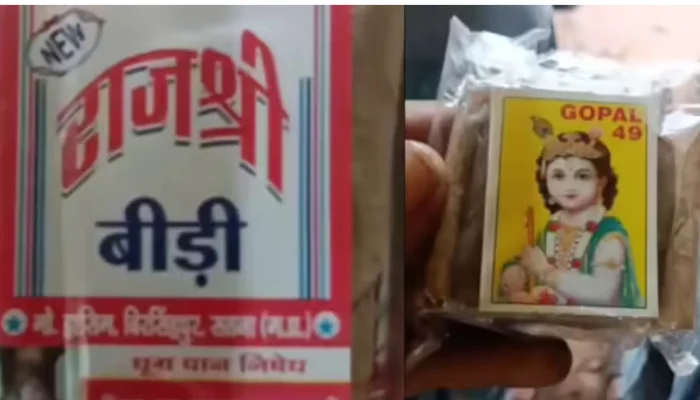
Case Summary
In Satna, Madhya Pradesh, a deliberate attack on Hindu sentiments was carried out by a Muslim man who owned a cigarette factory. The accused's factory printed pictures of Hindu deities on their cigarette packaging and matchboxes. According to media reports, the incident occurred in Ward Number 5 of Birsinghpur town, within the Sabhapur police station area, where the accused, Mohammad Hashim, was operating a bidi (cigarette) factory from his home. Images of Hindu deities were being printed on the packaging of cigarettes and matchboxes produced at his factory. Local Hindus and Hindu activists stated that this act deeply hurt the religious sentiments of Hindus. The issue came to light when bidis and matchboxes with such objectionable packaging were sold in the market. Some witnesses filmed the incident and posted it on social media. As soon as the video surfaced, local residents and Hindu organisations became outraged, demanding immediate action from the administration. Given the sensitivity of the matter, Birsinghpur Tehsildar Shailendra Bihari Sharma and Sabhapur Police Station Inspector Shankhdhar Dwivedi, accompanied by police, raided Mohammad Hashim's factory on 6th October 2025. Upon confirming the complaint was valid, officials took immediate action and sealed the factory. Tehsildar Shailendra Bihari Sharma told the media that the video had been circulating on social media. Furthermore, based on the complaints received, the factory was sealed with immediate effect, considering public sentiment. Further action was being taken as per the law. Additionally, officials issued strict instructions to the factory operator to immediately recall the goods bearing this objectionable packaging from all shops.
Why it is Hate Crime ?
This case has been added to the tracker under the primary category- Attack on Hindu religious symbols. Within this, the subcategory selected is- Iconoclastic representation of Hindu Gods/Goddesses. An icon is a symbol of someone or something that is revered, or a religious representation of a spiritual ideal. Iconography is of vital significance in the Hindu milieu. It helps connect people’s spiritual beliefs with the real world. Iconography within the Hindu faith takes several shapes and forms. Murtis are of most significance to Hindus, to which daily rituals, prayers and offerings are done. Besides the murtis, there are several other symbols which have deep significance in the Hindu faith – the Om and Swastika for example. Any iconoclastic representation of these symbols, images and murtis is an affront to the religious beliefs and faith of the Hindu community itself since the symbols and icons are deeply religious in nature. In this sub-category of crime, we would record hate crimes and iconoclastic representations, in words, art, or any other form of representations of symbols that hold religious significance for the Hindu community. Since these symbols, icons and murtis are central to the Hindu faith, any iconoclastic representation of these symbols is born out of animosity towards the faith itself, manifesting itself through these symbols and therefore, these representations would be considered religiously motivated hated crimes. This case clearly qualifies as a hate crime against Hindus because the Muslim perpetrator’s own factory printed cigarettes and matchsticks featuring images of Hindu gods and goddesses. Cigarettes are regarded as impure objects, and associating sacred Hindu deities with such items constitutes a direct insult aimed at deeply hurting Hindu religious sentiments. The act of placing images of revered deities on cigarette packaging is a blatant form of desecration and disrespect, designed to provoke outrage and humiliate the Hindu faith. If the act had been innocuous or random, there would be no particular reason for the accused to use Hindu imagery specifically. The accused could have chosen images or symbols from his own Islamic faith or any other religious tradition, but he did not. Instead, he deliberately selected Hindu deities, underscoring a targeted intent to offend and provoke the Hindu community. This was a conscious choice to hurt Hindu religious sentiments and to inflame communal tensions. Such acts are not isolated incidents but reflect a broader pattern of religious animosity directed towards Hindus. They exemplify iconoclastic attacks that disrespect and degrade Hindu religious symbols, which are central to the faith and identity of millions. The deliberate misuse of these sacred images in this way is indicative of deep-seated prejudice, and the act must be recognised and treated as a religiously motivated hate crime with serious social consequences. Iconoclastic portrayals like this are not harmless or isolated acts of expression but carry deep-seated consequences. They encourage and normalise disrespect towards Hindu deities, emboldening others to partake in similar mockery and perpetuate derogation. This cultivates an environment of sustained religious hostility, signalling an entrenched intolerance for Hindu beliefs that threatens social harmony. This case represents a calculated act of iconoclastic representation aimed at hurting Hindu religious sentiments. It forms part of a rising pattern of hate crimes against Hindus and is therefore being added to the hate crime database of the Hinduphobia Tracker. Disclaimer: The Hinduphobia Tracker records the date of an incident based on when the hate crime actually occurred. However, in this case, since the exact date of the incident is not mentioned in the available reports, we are using an indicative date. The indicative date used for this incident is 6th October 2025, based on when the media first reported it. This date is only for reference purposes and should be understood as an estimated date of the incident.


Case Status
Complaint filed


Perpetrators Details
Perpetrators
Muslim Extremists
Perpetrators Range
One Person
Perpetrators Gender
male
 Sources




