Hindus threatened in Muslim-dominated village, forced to halt bhajans on loudspeaker during Durga Puja celebrations
 Sant Kabir Nagar, Uttar Pradesh, India
  28 September, 2025
Case Summary
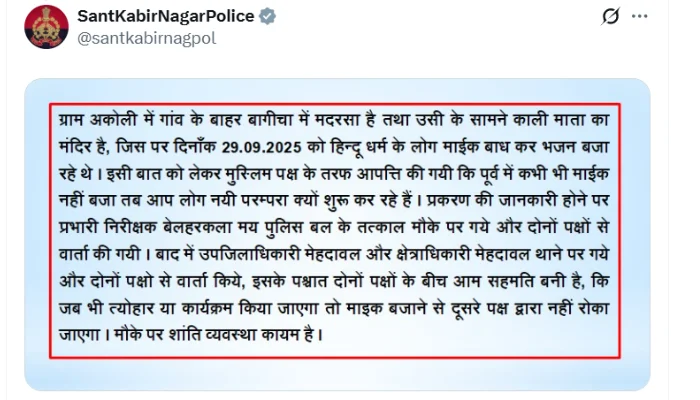
In Akoli village, a Muslim-dominated area in Sant Kabir Nagar, Uttar Pradesh, Hindus playing bhajans in a Kali temple during the Durga Puja celebrations were threatened by Muslims. The Hindus were forced to halt the bhajans being played on the loudspeaker. This incident further heightened tension between the two communities. A video of the incident went viral on X (formerly Twitter), shared by an account named Treeni. The video showed Hindu villagers stating that on the night of 29th September 2025, Muslims, after offering namaz at a nearby madrasa, came to the Kali temple and threatened the Hindus to stop playing bhajans. The Hindu villagers said that while the Muslims used loudspeakers for Azaan, the Islamic call to prayer, they always respected it and refrained from playing bhajans during Azaan or madrasa hours. However, when the Hindus played bhajans only for a few nights during Navratri (Durga Puja), the Muslims objected, saying they should behave like their ancestors and avoid using loudspeakers, insisting the Hindus sing bhajans privately at home. Under the viral X post by Treeni, the official X handle of Sant Kabir Nagar Police responded, stating: “In village Akoli, there is a madrasa located in a garden outside the village and in front of it stands a Kali Mata temple, where on 29.09.2025, people of the Hindu community were playing bhajans using a microphone. The Muslim side objected, claiming that the microphone had never been used in the past and questioning why a new tradition was being started. Upon receiving information about the incident, Inspector-in-Charge Belharkala and the police force immediately reached the spot and spoke to both sides. Later, the Sub-Divisional Magistrate and Circle Officer of Mehdawal also engaged with both parties, after which a consensus was reached that during any festival or function, the use of microphones would not be stopped by the other side. Peace and order remained at the spot.” The Hindu villagers also stated that similar acts of intimidation had occurred earlier during Janmashtami celebrations. They said such threats and pressure from the Muslim community had been recurring for a long time, especially during Hindu festivals. Media reports confirmed that the madrasa owner, Aqbal Hussain, had led the opposition and threats from the Muslim community against the Hindu villagers. Reports further stated that during Ram Navami processions and other Hindu festivals, Hindu celebrations and devotees were targeted by Muslims, and in some previous instances, Hindu women had also been assaulted.
Case Images
Why it is Hate Crime ?
This case has been added to the tracker under the primary category- Restriction/ban on Hindu practices. The subcategory selected is- Restriction on expression of Hindu identity. An example of the state-affected prejudicial and targeted orders against the Hindu community would be a government denying the right of a Hindu or a group of Hindus to hold a religious procession owing to the animosity of non-Hindu groups. Denial of the religious right of the Hindus to assuage the non-Hindu group which harbours animosity to a point where it could lead to violence against Hindus is not only a failure of law and order but is a prejudicial order against Hindus, denying them their fundamental rights to express their religious identity. An example of a hate crime against Hindus by a non-Hindu would be a non-Hindu institution forcing its Hindu employees to abandon religious symbols that a Hindu would wear as an expression of faith owing to inherent prejudice against the faith professed by the victim or a non-Hindu group of people restricting a Hindu group from constructing a place of worship simply because the demography of the area in which the temple is being built is dominated by non-Hindus. Such actions are driven by religious animosity and/or prejudice against Hindus and their faith and would therefore be categorized as a hate crime. Another primary category selected is- Attack on Hindu religious representations. Within this, the subcategory selected is- Breaking rules of place of worship. Sanatan Dharma is not a religion of one book, which is to say that while it has religious scriptures that form the central tenets of the faith, there are several traditions followed through thousands of years, mostly passed from generation to generation orally. One of these oral traditions or written traditions is the rules of specific temples. Certain temples have rules which are traditional rules, dependent on the worship of the presiding deities. These rules and traditions have been followed for thousands of years whether they find scriptural mention or not. Such traditions are based on the nature and rules of worship of the presiding deity of that temple. Any non-compliance of these traditions owing to animosity towards the faith or for the sake of activism stems not only from the lack of faith in the presiding deity but also disregard for the faith of the devotees of that deity/temple and implicit bias against the faith, the tradition and the deity itself. Since these specific traditions are central to the faith of the devotees of that specific temple and presiding deity, any non-compliance with these traditional rules would be considered a religiously motivated hate crime. Another primary category selected is- Attack not resulting in death. The subcategory selected is- Attacked for crossing 'Muslim Area'. One of the reasons that Hindus get attacked unprovoked specifically by Islamists is for crossing ‘Muslim areas’. Essentially, Muslim mobs often attack Hindus crossing or present in certain areas which have a majority Muslim population. It has often been cited as one of the reasons to blame Hindus for attacks against themselves, signalling that Hindus displaying religious symbols, taking our religious processions or crossing any area which is dominated by Muslim residents is a provocation in and of itself. These areas are mostly ghettoized areas where mobs mobilize quickly to attack Hindus for a variety of reasons like playing music during a religious procession, crossing a mosque, wearing a tilak or any other religious symbol in a Muslim-dominated area, praying at a local temple in that area etc. There have been cases where the few local Hindus of that area have been attacked on their way to the Temple for prayers as well, simply because the area is considered a Muslim-dominated area. Several times, it is entirely possible that the immediate trigger for the violence against Hindus was non-religious in nature, however, the violence became religiously motivated in nature because the area was Muslim dominated and the residents on the whole harboured animosity towards Hindus, evidenced from the actions of the mob, the slogans, and the nature of the attack. Such crimes are motivated by the religious identity of the victims and are therefore classified as hate crimes under this category. In this case, the act of stopping bhajans inside a Hindu temple during one of the most revered Hindu festivals, Durga Puja, is a restriction on Hindu identity and religious expression. Hindus were prevented from publicly expressing their devotion to Goddess Durga during the celebrations in a space dedicated to their faith. Such an act not only suppresses Hindu religious expression but also symbolises deep-seated hostility towards Hindu religious and cultural identity. The implications of such restriction include an atmosphere of religious intimidation, an increased sense of vulnerability among Hindus, and the signalling that their beliefs and practices are unwelcome or illegitimate in certain spaces. In effect, it is an attempt to limit and marginalise the public visibility of the Hindu faith. It is important to note that this incident took place during Durga Puja, one of the most sacred and culturally significant festivals for Hindus. Targeting Hindus for playing devotional songs during their festival was a deliberate act of disruption. Moreover, the incident occurred within a Kali temple, where devotees were threatened at a time of religious celebration. Such an act demonstrates clear religious hostility, aimed not only at silencing expressions of devotion but also at undermining the sanctity of the festival and violating the sacred atmosphere of the temple. This deliberate interference during a revered occasion reflects deep-seated animosity towards the Hindu faith. Some may argue that the opposition from the Muslim side was merely about the use of loudspeakers and not the bhajans themselves. However, if the issue had truly been with loudspeakers, the Muslims would have refrained from using them for the daily Azaan, the Islamic call to prayer. The Hindus clearly stated that they never objected to the Muslims using loudspeakers for Azaan and even avoided playing bhajans during the time of prayer or madrasa hours out of respect. However, whenever the Hindus played bhajans during Durga Puja, the Muslims objected, threatened them, and forced them to stop. This selective opposition exposes that the real issue was not noise or loudspeakers, but the overt expression of Hindu devotion. The act directly targeted Hindu religious practice and sought to suppress visible expressions of Hindu faith, reflecting deep-seated religious animosity and making it an unequivocal case of a religiously motivated hate crime against Hindus. It is also important to note that this incident took place in a Muslim-dominated village and in close proximity to a madrasa. In many such areas, Muslims often consider the surroundings to be their religious domain and call it 'Muslim areas'. This reveals a disturbing sense of Islamic supremacy harboured by the Muslims. In this case, the perpetrators viewed the predominantly Muslim-occupied region as an exclusive zone where non-Muslims, particularly Hindus, were unwelcome. This sense of entitlement and superiority not only reflects deep-seated prejudice but also highlights an attempt to assert religious dominance over public spaces. The threats issued to Hindus were motivated by this Islamic supremacist ideology, where Muslims in the area looked down upon Hindus, believing that they had the right to dictate who could practice their faith freely in the area. This illustrates a dangerous mindset rooted in exclusion, intolerance and religious animosity, making this case an ideal example of a religiously motivated hate crime. Hindu villagers also stated that this pattern of threats and restrictions had occurred previously during Ram Navami and Krishna Janmashtami celebrations. Muslims in the area had issued similar directives, telling Hindus not to play bhajans or hold loud public festivities. This repeated behaviour reveals an underlying aim to erase Hindu identity from public life in the village, replacing it with Islamic dominance. It is a clear manifestation of religious supremacy and continuous undermining of Hindu faith and traditions, highlighting an entrenched, religiously motivated hostility. Such actions qualify as hate crimes against Hindus due to an ideological foundation stemming from Islamic doctrine, which holds contempt for and dehumanises other faiths. Polytheistic religions like Hinduism are particularly targeted, as they are seen as illegitimate or inferior within the theological frameworks of Islam. This case exemplifies how religious indoctrination can foster hostility, leading to repeated acts of intimidation and suppression of Hindu practices, all rooted in the belief that Islamic norms should override pluralistic religious expression. Given that this case meets all parameters of a religiously motivated hate crime — targeted at a specific religious group, carried out during a sacred festival, rooted in hostility towards the faith, and occurring in a context of repeated similar offences — it is being added to the hate crime database of the Hinduphobia Tracker. Disclaimer: As per media reports, the Hindu villagers stated that several Muslims had come to the Kali temple and threatened the Hindus to stop playing bhajans. However, the exact number of perpetrators was not mentioned. Media reports, however, identified one of the accused as Aqbal Hussain, the madrasa owner who led the opposition against the Hindu devotees. Therefore, we are using a conservative estimate and keeping the perpetrator count as '1'.


Case Status
Case adjudicated


Perpetrators Details
Perpetrators
Muslim Extremists
Perpetrators Range
One Person
Perpetrators Gender
male
 Sources




