Durga Puja mandap desecrated, Hindu devotees brutally beaten by Muslim youths in Bangladesh for turning off music
 Netrokona District, Bangladesh
  1 October, 2025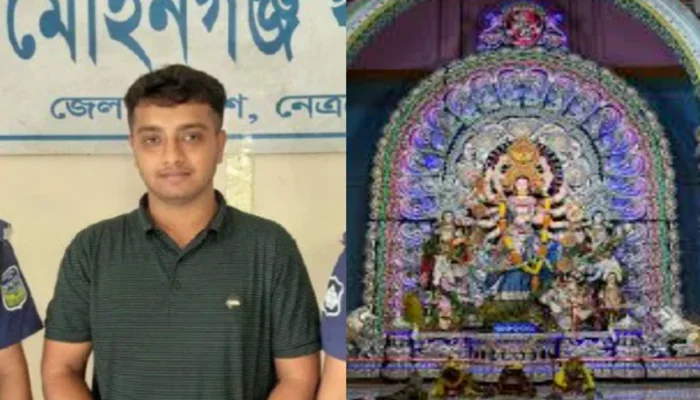
Case Summary
In Khurshimul village, Netrokona district, Bangladesh, a Durga Puja mandap was attacked, with devotees beaten by members of the Muslim community, led by a Muslim youth named Arif Chowdhury Antar (22). According to reports, at around 1:30 am on October 2, 2025, Arif, along with 15 to 16 other Muslim youths, went to the mandap during Durga Puja and demanded that the organisers, who were Hindu devotees, play music on a sound box. The organisers submitted to the demands, and the Muslim youths danced to the music. However, when the organisers turned off the music as it was late at night, the group led by Arif attacked the Hindu organisers and devotees, injuring at least eight people. The youths also attacked the Durga Puja mandap, desecrating it. The police arrived later and brought the situation under control. The next day, one of the injured, a Hindu man named Amit Chandra Das, filed a case at Mohanganj Police Station, naming nine individuals and nine to ten unknown persons as accused. Police began an investigation into the incident and collected CCTV footage from the mandap, based on which Arif Chowdhury Antar, son of Rehen Mia, was identified and arrested. He was produced before a court, where the judge ordered him to be sent to jail. Efforts were underway to apprehend the remaining accused involved in the incident. While police action in this particular case led to one arrest, such isolated responses do little to address the larger climate of impunity that emboldens these attacks. Across Bangladesh, Hindus continue to face growing hostility during their festivals, with violence often erupting over fabricated provocations or trivial disputes. The assault on the Durga Puja mandap in Netrokona was not an aberration but part of a broader wave of intimidation and desecration targeting Hindu spaces of worship and cultural expression, which has only intensified since the ouster of Sheikh Hasina’s Awami League government on 5 August 2024. Islamist extremists have taken advantage of the political vacuum to unleash widespread violence, marked by arson attacks on Hindu homes, abductions of women, and destruction of temples across the country. Reports indicate that Hindu teachers, professors, and officials have been forced to resign under pressure from Muslim students, while the community faces coercion to join Jamaat-e-Islami. Religious events have been repeatedly targeted: a Ganesh procession was attacked in Chittagong on 6 September; idol vandalism struck Mymensingh, Pabna, Rajshahi, Kishoreganj, and Dhaka ahead of Durga Puja; and on 29 November, three temples in Patharghata, Chittagong, were attacked after Jumma Namaz. Hindu voices have been further silenced, with the arrest of journalist Munni Saha on 30 November. On 22 May 2025, Hindu homes were set ablaze in Dahar Mashihati village, Jessore. Even ISKCON leaders such as Chinmoy Krishna Das Prabhu have been targeted, alongside efforts to ban ISKCON and brand Hindu protests as sedition. The cumulative record of mob violence, cultural censorship, forced resignations, and suppression of Hindu organisations demonstrates a systemic campaign of persecution against Bangladesh’s Hindu minority.
Why it is Hate Crime ?
This case has been added to the tracker under the primary category of - Attack on Hindu religious representations. Within it, the sub-category selected is - Desecration of Hindu religious symbols. Icons and symbols or a religious representation of a spiritual ideal are widely revered in Hinduism. Iconography is of vital significance in the Hindu milieu. It helps connect people’s spiritual beliefs with the real world. Iconography within the Hindu faith takes several shapes and forms. Murtis are of most significance to Hindus, to which daily rituals, prayers and offerings are done. Besides the murtis, there are several other symbols which have deep significance in the Hindu faith – the Om and Swastika for example. Since these Hindu religious symbols hold paramount importance in Hinduism, any desecration of symbols, icons, murtis, religious representations and manifestations, is driven by animosity towards the faith itself which manifests itself through these murtis, icons and symbols. Therefore, any desecration of these Hindu religious symbols and representations is considered religiously motivated hate crimes under this category. The other sub-category selected here is - Violence against religious structures or centres. In Hinduism, a religious structure is also considered divine. Hindus believe that not just the Deity but the religious structure itself is sacred. In this sub-category, we would document attacks against religious structures which are not consecrated temple spaces. Such religious spaces could be temporary in nature – for example – the religious spaces erected specifically for festivals like Durga Puja etc. This category would also document cases of attacks against religious centres. These spaces in their own right may not be ‘sacred’ per se, however, are often spaces where religious gurus live, religious teaching is imparted, or belong to religious institutions. Any attack against religious structures is a result of animosity towards the religion itself, which manifests itself through the religious spaces and therefore, such attacks are considered religiously motivated hate crimes. Religious centres are also manifestations of the religion, its teachings or gurus and therefore, attacks against such centres would be considered religiously motivated hate crimes. The other sub-category selected is - Defiling religious customs. Sanatan Dharma is not a religion of one book, which is to say that while it has religious scriptures that form the central tenets of the faith, there are several traditions followed through thousands of years, mostly passed from generation to generation orally. There are several such customs and traditions that are followed by various Hindus and Hindu sects. Defiling of these traditions and customs is a breach of an individual or group’s religious practices. Such practices can range from dietary restrictions like not eating non-vegetarian food for a certain period of the year, not eating non-vegetarian food at all, not eating beef since the cow is considered holy in Hinduism, the sanctity of religious customs followed in the house (like many ISCKON devotees), etc. Any malicious action leading to the breach of such traditions or defilement of these traditions owing to animosity towards the faith or for the sake of activism stems not only from the lack of faith in the religion itself but also from disregard for the faith of the devotees who follow the customs/traditions and implicit bias against the faith, the tradition itself. Since these specific traditions are central to the faith of the devotees of that specific sect of Hindus, any non-compliance with these traditional rules would be considered a religiously motivated hate crime. The second primary category selected here is - Attack not resulting in death. Within it, the sub-category selected is - Attack against Hindu devotees. Hindu devotees are a few of the easiest targets of religiously motivated hate crimes because during the festival/procession/puja etc, for non-Hindus it is easy to profile their victims on the basis of religion. Hindu devotees come under attack on several occasions by individual non-Hindus or mobs of non-Hindus owing to their animosity against Hinduism, its symbols and tradition/practices. There are several instances of Hindu devotees being attacked while they worship in temples or temporary religious structures, during religious processions, doing bhajan/kirtan/puja in their own homes, in the residential society etc. These attacks are perpetrated by non-Hindus primarily because of their animosity towards Hindus and their faith. In some cases, the trigger for the violence may be non-religious, however, there are two elements that make these hate crimes. First, the Hindus who come under attack are attacked violently while indulging in religious activity. Whether they are in a place of worship or not is immaterial to the crime. When individuals are attacked while indulging in religious practices, the attack in itself is a hindrance to their freedom to practice religion and therefore constitutes a hate crime. Secondly, religious supremacist doctrines and ideologies deem religious practices of Hindus to be offensive ab initio since they are considered “sinful” by these ideologies, worthy to be annihilated by force or coercion. Driven by these religious supremacist ideologies and doctrines, the attacks against Hindu devotees stem from intrinsic animosity towards Hinduism. In some cases, the trigger for the violence may be non-religious, however, it develops into a religiously motivated crime during the course of the violence. Since these attacks stem from animosity towards Hindus and Hinduism, they are considered religiously motivated hate crimes under this category. This case has been added to the tracker because the Durga Puja mandap was attacked, with devotees beaten by members of the Muslim community. The incident occurred during the sacred Durga Puja festival, a period of deep religious significance for Hindus. The attack targeted Hindu devotees gathered for worship, representing not merely a dispute but a direct assault on the public expression of Hindu faith and religious identity. In this case, the dispute over music was merely a pretext; the real motivation was religious animosity and disdain towards outward expressions of Hindu identity or worship. The Hindu organisers, who were managing the mandap, turned off the music late at night in accordance with local regulations, which angered the Muslim youths. Enraged by this, they launched an attack on the organisers and desecrated the Durga Puja mandap. If the anger had truly been only about the music, there would have been no reason to desecrate a Hindu place of worship. This makes it clear that the music was just an excuse, while the actual target of hatred was the faith of the Hindus and the sacred space in which it was being expressed. It is important to note that in several other cases, Muslim mobs have been provoked both by the presence and the absence of music during Hindu religious observances. In some places, Hindus are attacked for playing devotional music or kirtan near mosques, while in others, as in this case, they are attacked for not playing music when demanded to do so. This contradictory pattern establishes that music itself is not the real issue; it serves only as a pretext to justify religious aggression. The underlying hostility remains the same — a deep resentment toward Hindu religious visibility and the assertion of Hindu identity in public spaces. A similar incident also occurred in Cuttack, Odisha, where a Hindu religious procession was attacked by a Muslim mob for playing music, leading to a confrontation. This parallel makes it even clearer that the objection to music was only a pretext, masking deeper religious hostility towards Hindu worship and public celebration. This disproportionate violence over a trivial matter reveals the entrenched hostility within the perpetrators towards the Hindu community, driven by religious identity and intolerance. Such acts expose a mindset of communal dominance, where minor or fabricated triggers are used as justification for violent retaliation when the victims are Hindus. This pattern of behaviour underscores an alarming trend of identity-based hostility and religious hatred defining such hate crimes. The attack on the Durga Puja mandap qualifies as a hate crime because it was directed at a religious space and community identified explicitly by their faith. The mandap, serving as a temporary temple for Goddess Durga during the festival, symbolises collective Hindu devotion and identity. By targeting it, the attackers sought to humiliate and intimidate Hindus for practising their religion in public. The desecration of a consecrated site and the assault on devotees demonstrate that the motivation behind the act was not personal grievance but religious hostility aimed at suppressing Hindu expression. Such violence against a sacred site represents an attempt to erase or subjugate the religious presence of Hindus within the shared public sphere. In Islamic theology, idol worship, referred to as shirk, is regarded as the gravest sin, and the Qur’an explicitly condemns it. Islamic teachings strictly oppose any act associated with idolatry. This doctrinal rejection of idol worship has historically manifested as hostility towards idol-worshipping religions, particularly Hinduism. Thus, the attack on a Durga Puja mandap and the Hindu organisers reflects more than just a civil dispute; it represents a deep-seated theological contempt towards Hindu religious practice, rooted in the doctrinal view that idol worship is impure and offensive. Such acts of aggression against Hindu devotees during religious festivals highlight a broader pattern of intolerance and hostility towards the public expression of Hindu faith. The targeting of Hindu organisers and devotees, identifiable through their participation in a religious ritual, indicates that the violence was aimed not at random individuals but specifically at Hindus for practising their faith collectively. The incident was designed to instil fear, disrupt Hindu religious observance, and assert communal dominance over public spaces in Bangladesh. These recurring attacks, whether through mob violence or the desecration of sacred spaces of Hindus, are not isolated or spontaneous. They form part of a larger continuum of persecution where Hindu religious expression is systematically targeted and suppressed. Each such incident chips away at the already fragile sense of security among Bangladesh’s Hindus, revealing a society where intolerance is not only socially tolerated but increasingly legitimised by political silence and administrative complicity. Since the ouster of Sheikh Hasina’s Awami League government on 5 August 2024, persecution of Hindus in Bangladesh has sharply intensified under the interim rule of Muhammad Yunus. Islamist extremists have taken advantage of the political vacuum to unleash widespread violence, marked by arson attacks on Hindu homes, abductions of women, and destruction of temples across the country. In this context, attacks like the one in Netrokona represent not isolated incidents, but symptoms of a deepening climate of anti-Hindu hatred enabled by political instability and the growing influence of Islamist forces.


Case Status
Case sub-judice


Perpetrators Details
Perpetrators
Muslim Extremists
Perpetrators Range
From 10 to 100
Perpetrators Gender
unknown
 Sources




