Hindu deities abused, Hindu devotees assaulted, Durga Puja pandal desecrated in hate-fueled attack in Sonbhadra
 Sonbhadra, Uttar Pradesh, India
  3 October, 2025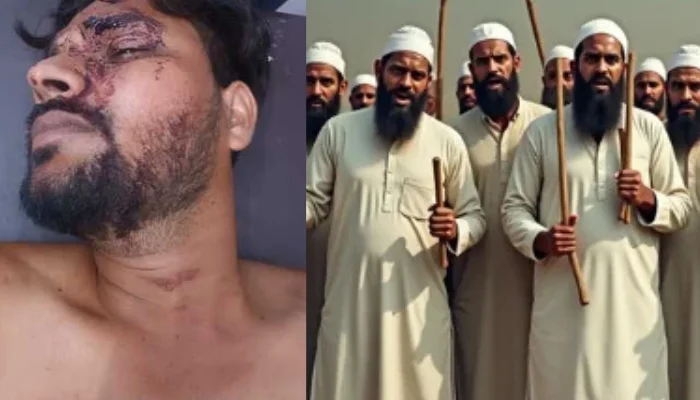
Case Summary
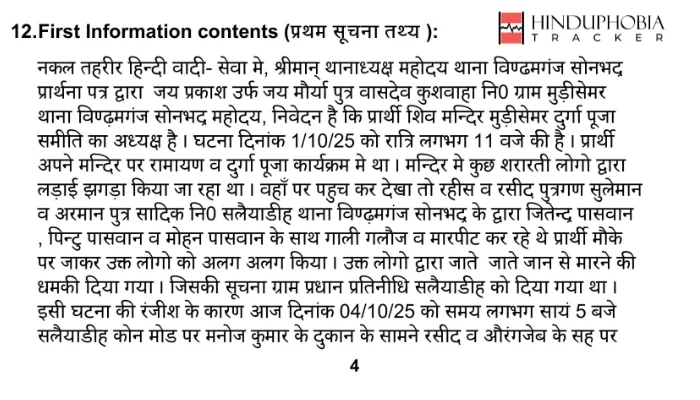
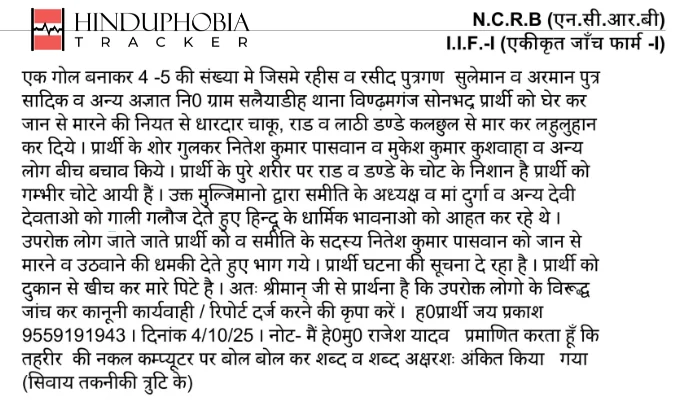
In Sonbhadra, Uttar Pradesh, Muslim men abused Hindu gods and goddesses and desecrated a religious Durga puja pandal. A Hindu man named Jaiprakash alias Jai Maurya was brutally attacked. Prior to this incident, the same perpetrators had also assaulted Hindu devotees inside a Durga Puja venue. According to media reports, on 4th October 2025, a group of Muslims abused Hindu deities, including Goddess Durga, and attacked Jaiprakash, the president of the Durga Puja Committee, at Kon Mod in Salaiyadih Gram Panchayat. Jaiprakash sustained serious head injuries inflicted with sharp weapons and sticks. At the time of the assault, Jaiprakash had been sitting at a fast-food stall at Kon Mod in the evening. The Muslim perpetrators, identified as Rayees, a resident of Salaiyadih, his brother Rasheed, and Arman, arrived with four to five accomplices and launched a violent assault using sticks, rods, ladles, and sharp weapons. They also threatened to kill Jaiprakash and Nitish Kumar Paswan, a member of the Durga Puja Committee. Hindu villagers rushed to the scene and managed to save Jaiprakash’s life. Upon receiving information, the station in charge, Chandrashekhar Singh, reached the location and took the injured man to the hospital. The police registered a case against Rayees, Rasheed, Arman, and others under Sections 110, 115(2), 191(2), 191(3), 299, 351(3), 352, and 333 of the Bharatiya Nyaya Sanhita (BNS), along with Sections 3(1) and 3(2) of the SC/ST Act. The attack on 4th October 2025 was linked to an earlier dispute during the Durga Puja celebrations on 1st October 2025 at the premises of a Shiva Temple. During that event, the Muslim accused had entered the Durga Puja pandal and began abusing and attacking Hindus, namely, Jitendra, Pintu, and Mohan Paswan. Jaiprakash intervened to stop the attack and protect the Hindu participants. After being restrained, the Muslims left the spot, threatening Jaiprakash and the other Hindu victims with death. Residents, including BJP leader Shravan Gond, Mandal President Virendra Chaudhary, Sanju Tiwari, Manoj Patel, Vijay Paswan, Saryu Yadav, Abhishek Pratap Singh, and Manish Madheshiya, visited the police station and demanded the immediate arrest of the accused. The station in charge confirmed that two of the accused had been arrested and that efforts were underway to apprehend the remaining suspects. The Hinduphobia Tracker contacted the police and spoke to ASP (Assistant Superintendent of Police) Tribhuvan Nath Tripathi, who stated that the dispute between the Hindu victim and the Muslim perpetrators stemmed from issues related to gambling and money on 1st October 2025. Following this, the Muslim perpetrators launched a violent assault on the Hindu victim on 4th October 2025. However, the Hinduphobia Tracker obtained the FIR filed by the Hindu victims, which detailed that both the attacks, on 1st and 4th October 2025, were acts of religiously motivated violence against Hindus. The FIR made no mention of gambling. It clearly stated that the Muslims denigrated Hindu deities, defiled the sanctity of the Durga Puja pandal by attacking Hindu participants, and following this, attacked the Hindu victim, Jaiprakash.
Case Images
Why it is Hate Crime ?
This case has been added to the tracker under the primary category- Hate Speech against Hindus. Within this, the subcategory selected is- Anti-Hindu slurs, mocking faith. Anti-Hindu slurs and the deliberate mocking of the Hindu faith owing to religious animosity involve the usage of derogatory terms, stereotypes, or offensive references to religious practices, symbols, or figures. One of the common anti-Hindu slurs used against Hindus is “cow-worshipper” and “cow piss drinker”. The intention of using this term is to demean and mock Hindus as a group and their religious beliefs since Hindus consider the cow holy. Additionally, some symbols and the slurs attached to them have a historical context that exacerbates the insult, hate, stereotyping, dehumanisation and oppression against Hindus. Cow worship has been used for centuries to denigrate Hindus, insult their faith and oppress Hindus specifically as a religious group. There has been overwhelming documentation about how cow slaughter has been used to persecute Hindus with cow meat being thrown in temples and places of worship. There has also been overwhelming documentation where cow meat (beef) has been force-fed to Hindus to either forcefully convert them to Islam or denigrate their faith. Apart from cow worship, the Swastika – which holds deep religious significance for the Hindus – has also been misinterpreted and distorted to use as a slur against Hindus. Similarly, the worship of the Shivling has been used by supremacist ideologies and religions to denigrate Hindus owing to religious animosity. Such slurs and denigration stem out of inherent animosity and hate towards Hindus and their faith, therefore, it is categorised as hate speech targeted at Hindus specifically owing to their religious identity. Another primary category selected is- Attack not resulting in death. Within this, the subcategory selected is- Attacked for opposing radicals or trying to save victim. In several cases, Hindus are attacked for opposing religiously motivated crimes being committed against a fellow Hindu or simply for voicing an opinion opposing radical elements, who either have in the past or continue to persecute Hindus. In such cases, the initial attack against the victim, against which the Hindu was trying to defend the victim, would also need to be classified as a religiously motivated hate crime. Since the initial crime itself was religiously motivated and the subsequent crime of attempting to save the victim or speaking against the radical elements ends up inviting a violent attack, it would also be classified as a religiously motivated hate crime under this category. The other subcategory selected is- Communal Clash/ Attack. Communal clash is a form of collective violence that involves clashes between groups belonging to different religious identities. For a communal clash between Hindus and non-Hindus to qualify as a religiously motivated hate crime, the trigger of the violence itself would have to be anti-Hindu in essence. For example, if there is a Hindu religious procession that comes under attack from a non-Hindu mob and after the initial attack, Hindus retaliate in self-defence, leading to a communal clash between the two religious communities. While at a later stage, both communities are involved in the clash/violence, the initial trigger of the violence was by the non-Hindu mob against the Hindus and therefore, it could safely be termed as an anti-Hindu violence. Further, the trigger would also have to be religiously motivated. In the cited example, the attack by the non-Hindu mob was against religious processions and therefore, can be concluded to be religiously motivated. In some cases, the trigger may be non-religious, however, it develops into religious violence against Hindus at a later stage. In such cases too, the foundational animosity towards Hindus becomes the motivating factor of the crime and therefore, it would be classified as a religiously motivated hate crime against Hindus under this category. Another primary category selected is- Attack on Hindu religious representations. The subcategory selected is- Defiling religious customs. Sanatan Dharma is not a religion of one book, which is to say that while it has religious scriptures that form the central tenets of the faith, there are several traditions followed through thousands of years, mostly passed from generation to generation orally. There are several such customs and traditions that are followed by various Hindus and Hindu sects. Defiling of these traditions and customs is a breach of an individual or group’s religious practices. Such practices can range from dietary restrictions like not eating non-vegetarian food for a certain period of the year, not eating non-vegetarian food at all, not eating beef since the cow is considered holy in Hinduism, the sanctity of religious customs followed in the house (like many ISCKON devotees), etc. Any malicious action leading to the breach of such traditions or defilement of these traditions owing to animosity towards the faith or for the sake of activism stems not only from the lack of faith in the religion itself but also from disregard for the faith of the devotees who follow the customs/traditions and implicit bias against the faith, the tradition itself. Since these specific traditions are central to the faith of the devotees of that specific sect of Hindus, any non-compliance with these traditional rules would be considered a religiously motivated hate crime. This case constitutes a clear instance of a hate crime against Hindus, as the attack was motivated by deep-seated religious animosity towards the Hindu faith and its followers. On 4th October 2025, the accused Muslims assaulted a Hindu man, Jaiprakash alias Jai Maurya, prior to which they also abused Hindu gods and goddesses. The act of abusing revered deities such as Goddess Durga demonstrates a clear intent to humiliate and provoke Hindus on the basis of their religion. Hindu deities are highly revered and respected by the Hindus, and verbal abuse directed at them emphasises the Muslim perpetrators’ hostility towards the Hindu community and their beliefs. Such deliberate religious abuse categorically defines this incident as a hate-driven, religiously motivated crime. If the attack had truly stemmed from a personal dispute, such as gambling or financial disagreements as later claimed by the police, there would have been no reason for the perpetrators to resort to denigrating Hindu faith or insulting sacred deities. The targeted verbal assault on Hindu gods and goddesses serves no purpose in a personal quarrel and can only be understood as an act of religious provocation. This deliberate humiliation of Hindu faith prior to the physical assault confirms that the motive was communal and not personal in nature. Following this verbal abuse of Hindu deities, the Muslim perpetrators launched a brutal physical attack on Jaiprakash. They assaulted him with rods, sticks, and sharp weapons, leaving him severely injured. This sequence of events — abuse of Hindu gods followed by the violent assault — demonstrates that the attack was not random but communally charged. The perpetrators displayed open hatred towards Hinduism and acted with the intent to harm both the physical and religious dignity of the Hindu victim. Their actions constituted a direct communal assault targeting an individual solely on account of his Hindu identity and role in leading Durga Puja celebrations. The attack on Jaiprakash on 4th October 2025 did not occur in isolation. It had a direct backdrop in the events of 1st October 2025, when the same Muslim perpetrators had defiled the sanctity of the Durga Puja pandal at a Shiva Temple. They entered the sacred premises, created havoc, and attacked Hindu participants — including Jitendra, Pintu, and Mohan Paswan. By desecrating the holy space of Durga Puja and disrupting worship, the perpetrators exhibited open contempt and religious hatred towards the Hindu community. Additionally, the attack on the three Hindu participants made the religious motivations behind the crime very evident. The incident clearly revealed their communal intent to insult and intimidate Hindus by defiling their sacred festival. The attack on Jaiprakash on 4th October was a continuation of the same pattern of hate. It took place because Jaiprakash had intervened on 1st October to stop the perpetrators from attacking Hindus and to protect the sanctity of the Durga Puja. His act of defence enraged the attackers, leading them to seek revenge against him for standing up for the Hindu participants. Therefore, this assault was not just personal but rooted in communal hatred. It was a targeted act of violence against a Hindu individual because he had defended fellow Hindus against religious aggression from the Muslim perpetrators. Following the attacks on both 1st and 4th October, the Muslim perpetrators also issued death threats to Jaiprakash and other Hindu participants — namely Jitendra, Pintu, and Mohan Paswan. Such threats were intended to terrorise the victims and silence the Hindu community through intimidation. This continuous pattern of violence, threats, and desecration demonstrates a systematic attempt to suppress Hindus and their religious expression. It further establishes that the motive was not personal enmity but deep-rooted hostility towards the Hindu faith, qualifying the entire episode as a religiously motivated hate crime. In this case, however, the police response reflected a concerning bias. Authorities suggested that the dispute on 1st October 2025 was related to gambling and financial matters, completely overlooking or deliberately ignoring the documented communal attack that took place inside the Durga Puja pandal. But if the incident were truly linked to gambling, there would be no conceivable reason for the accused to abuse Hindu gods or desecrate a religious venue. The act of insulting deities like Goddess Durga has no relevance to gambling and therefore cannot be dismissed as a mere side incident. Such actions reveal a clear element of religious hatred that the police narrative conveniently ignores. This attempt to downplay or whitewash the religious nature of the violence represents a serious failure of justice. By disregarding the hate motive and treating it as an ordinary quarrel, the police undermined the gravity of the crime and the suffering of the Hindu victims. This negligence not only distorts the truth but also emboldens the Muslim perpetrators of communal hate crimes against Hindus. It is also important to note that the police, in many such cases, where the motive behind the crime is obvious but not explicitly mentioned, deny that the crime committed was in any way motivated by a religious bias or say that there was ‘no communal angle’ to the crime. Several factors are generally at play here. Many a time, the police downplay incidents of low-level communal crime because it is their jurisdiction that comes under question. The police also often say that there was ‘no communal angle’ to a crime when there was one because they wish to ensure that, owing to the crime already committed, there is no further flare-up in the area. Likewise, the Left media and the leftist elite are also inclined to emphasise this "no communal angle" trope, especially wherever the victim of the crime is a Hindu. However, only a police statement or a media report, for instance, cannot be enough to determine whether there is a communal angle present in the crime that has been committed. In fact, to determine whether the crime is communal in nature or not, we need to give emphasis to the ground realities. For example, in the case of Rinku Sharma, the Bajrang Dal activist who was mercilessly stabbed in his house in front of his family members in Delhi’s Mangolpuri area in the year 2021, the leftist media and the leftist ecosystem had tried to peddle that there was no communal angle to the crime. Even the police denied that the crime was communal in nature. However, Opindia spoke to several people who were on the ground with the family of Rinku Sharma, and they were told that the communal tension in the area is palpable. The family of Rinku Sharma had also said that the Muslims of the area held a grudge against Rinku ever since he celebrated the Ram Mandir verdict. Like the case of Rinku Sharma, those cases where even if the police have denied a communal angle or the leftist media have gone on an overdrive to peddle the ‘no communal angle’ trope, the ground reality, like the victim’s family or relative's testimonies, make it clear that there was an obvious religious bias that led to the crime, will be documented in this tracker. Going by the same logic, since the FIR itself states that the attack on both 1st October 2025 and 4th October 2025 was religiously motivated, therefore, we are considering it as a hate crime and adding to the hate crime database of the Hinduphobia Tracker.
Victim Details
Total Victim
4
Deceased
0
Gender
- Male 4
- Female 0
- Third Gender 0
- Unknown 0
Caste
- SC/ST 4
- OBC 0
- General 0
- Unknown 0
Age Group
- Minor 0
- Adult 4
- Senior Citizen 0
- Unknown 0


Case Status
Case sub-judice


Perpetrators Details
Perpetrators
Muslim Extremists
Perpetrators Range
From 5 to 10
Perpetrators Gender
male
 Sources




