Hindu priest threatened and manhandled by Muslims for playing Hanuman Chalisa on loudspeaker in Muslim-dominated area
 Varanasi, Uttar Pradesh, India
  1 October, 2025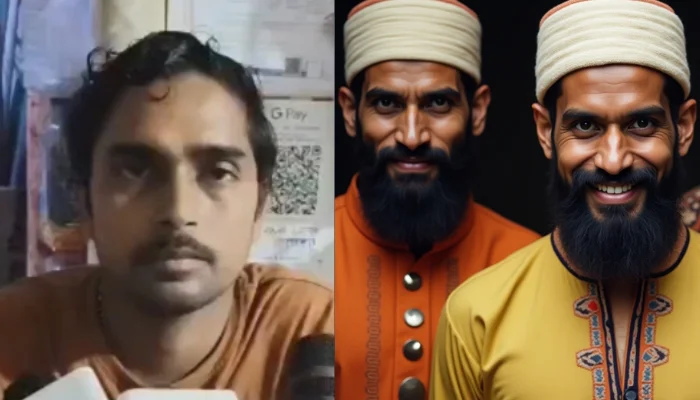
Case Summary
In the Muslim-dominated area of Madanpura, Varanasi, Uttar Pradesh, a Hindu priest named Sanjay was threatened and manhandled by Muslims for playing the Hanuman Chalisa on a loudspeaker in a Hanuman temple. According to media reports, on the morning of Vijayadashami (2nd October 2025), the Hanuman Chalisa was being played in the ancient Hanuman temple located on the roadside in Madanpura. The issue began when a Muslim man named Abdul Naasir arrived at the temple while the priest was on his scooter. Naasir threatened the priest to stop playing the Hanuman Chalisa and warned him that it must not reach his ears. CCTV footage showed that Naasir manhandled the priest and kicked his scooter. Following this, 10-12 Muslims gathered and began threatening the priest to stop the Hanuman Chalisa. Members of the Hindu community also gathered and opposed the Muslims, asking, "When the Azaan or other Islamic prayers are played on loudspeakers, do you Muslims shut it down?" However, fearing for his safety, priest Sanjay stopped playing the Hanuman Chalisa. After a video of the altercation went viral on social media, the police took cognisance of the matter and filed a case based on a complaint from the victim, Sanjay. This incident angered the members of the Hindu community in the area. They began demanding that the police take strict action against the Muslim perpetrators.
Why it is Hate Crime ?
This case has been added to the tracker under the primary category- Attack not resulting in death. Within this, the subcategory selected is- Attacked for Hindu identity. In several cases, Hindus are attacked merely for their Hindu identity without any perceived provocation. A classic example of this category of religiously motivated hate crime is a murder in 2016. 7 ISIS terrorists were convicted for shooting a school principal in Kanpur because they got ‘triggered’ seeing the Kalava on his wrist and tilak that he had put. In this, the Hindu victim had offered no provocation except for his Hindu religious identity. The motivation for the murder was purely religious, driven by religious supremacy. Such cases where Hindus are targeted merely for their religious identity would be documented as a hate crime under this category. Another primary category selected is- Hate Speech against Hindus. Within this, the subcategory selected is- Violent Threats. Violent threats, explicit, implicit or implied, is the most dangerous form of hate speech since it goes beyond discriminatory and prejudicial language to express the intent of causing harm to an individual or a group of people based on their religious identity and faith. There could be several different kinds of threats that are issued to Hindus based on religious animosity. An explicit threat would mean the direct threat of violence towards an individual Hindu, a group of Hindus or Hindus at large. Physical violence, death threats, threats of destruction of property belonging to Hindus and threats of genocide would mean explicit threats against Hindus for their religious identity. Implicit threats may not be a direct threat but implied through the use of symbols of actions – for example – in the Nupur Sharma case, other than explicit threats, there were also implicit threats when Islamists took to the streets to burn and beat her effigies. It implies that they want to do the same to Nupur Sharma – thereby is considered an implicit threat. Violent threats can be delivered in person, through letters, phone calls, graffiti, or increasingly through social media and other online platforms. It would be important to understand that a threat – explicit or implicit, online or offline – to an individual who happens to be a Hindu does not qualify as a religiously motivated threat. Such a threat, while vile and dangerous, could be owing to non-religious reasons and/or personal animosity. To qualify as a religiously motivated threat, it would need to exhibit an indication that the individual is being targeted for religious reasons and/or owing to his/her religious identity as a Hindu. This incident was a clear attack on the Hindu priest for his religious identity as a Hindu. The priest was targeted specifically because he openly expressed his faith by playing the Hanuman Chalisa. Such targeting of an individual for practising and asserting their Hindu identity constituted a direct assault on their fundamental rights to religious freedom and expression. It reflected a deliberate attempt to intimidate and suppress the public expression of the Hindu faith by singling out the priest because of his beliefs. The violent threats issued to the priest by the Muslim perpetrators revealed deep-seated animosity aimed at intimidating him and deterring other members of the Hindu community from practising their religion openly. Such behaviour is rooted in prejudice and hostility, seeking to create an atmosphere of fear and exclusion. The severity and aggression of the threats demonstrated the intention to oppress and diminish the public visibility of Hindu devotional practices. If the real issue had been noise from loudspeakers disturbing the area, the objections would logically have extended to the Azaan and other Islamic prayers as well, which were also broadcast on loudspeakers. However, as local Hindu residents pointed out, the opposition was selectively directed only at the Hanuman Chalisa. This selective targeting highlighted that the problem was not with the loudspeaker, but with the assertion of Hindu religious identity through the recitation of the Hanuman Chalisa in a "Muslim-dominated area." It is also important to highlight that, in this case, the Muslim perpetrators viewed the predominantly Muslim-occupied region as an exclusive zone where non-Muslims, particularly Hindus, were unwelcome. This sense of entitlement and superiority not only reflects deep-seated prejudice but also reveals an attempt to assert Islamic dominance over public spaces. The threats and the manhandling of the Hindu priest by Muslims were motivated by this supremacist ideology, where Muslims in the area look down upon Hindus, believing they have the right to dictate who can move freely or practice their faith in 'their area'. This act is rooted in a dangerous mindset of exclusion, intolerance and religious animosity, making this case an ideal example of a religiously motivated crime. Since this case involved the deliberate targeting of a Hindu priest for his religious identity, the forcible cessation of the Hanuman Chalisa, and the intimidation of an individual for practising his faith, it qualified as a religiously motivated hate crime. Consequently, this incident is being added to the hate crime database of the Hinduphobia Tracker.
Victim Details
Total Victim
1
Deceased
0
Gender
- Male 1
- Female 0
- Third Gender 0
- Unknown 0
Caste
- SC/ST 0
- OBC 0
- General 1
- Unknown 0
Age Group
- Minor 0
- Adult 1
- Senior Citizen 0
- Unknown 0


Case Status
Complaint filed


Perpetrators Details
Perpetrators
Muslim Extremists
Perpetrators Range
From 10 to 100
Perpetrators Gender
male
 Sources




