Hindus threatened with violence; Bangladeshi Muslim politician calls for ''Ghazwa-e-Hind'' against India
 New York, United States
  28 September, 2025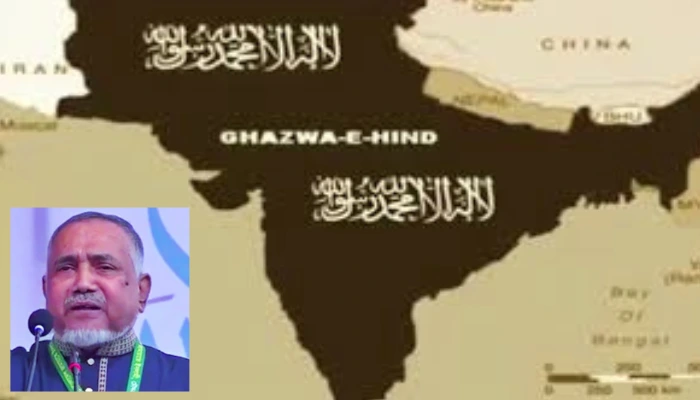
Case Summary
A violent threat was issued to Hindus of India by Syed Abdullah Muhammad Taher, a senior leader of Bangladesh Jamaat-e-Islami and its International Affairs Secretary. He provoked outrage with a provocative speech delivered in New York City, where he threatened India with "Ghazwa-e-Hind". Ghazwa-e-Hind is an Islamic fantasy that refers to the complete conquest of India by invading Islamic forces. This term has been used by the Pakistani terrorists and Islamic zealots against India for decades. The concept of Ghazwa-e-hind roots in several works of Islamic literature named Hadiths. The doctrine predicts an onslaught upon the citizens of India by Islamist forces and their takeover of them. The doctrine prophesies a pitched battle between Hindus and Muslims before (qayamat), resulting in a decisive victory of Muslims over Hindu India. According to media reports, Taher, a former Member of Parliament from Comilla-12 (2001–2006) and currently nayeb-e-ameer of the Islamist party, openly called for militant mobilisation against India, invoking the anti-Hindu concept of Ghazwa-e-Hind. A video of the speech circulated widely online. In the video, Taher declared, “At least five million of our youth (Muslims) will fight for independence against India.” He further suggested that an armed confrontation with India would vindicate Jamaat-e-Islami’s controversial role during the 1971 Liberation War. He stated, “Many say there is a risk of an attack from India if Jamaat comes to power. I would say we are praying that happens. If India enters Bangladesh, the bad name imposed on us in 1971 will be erased. We shall get a chance to prove ourselves as true freedom fighters.” Taher outlined a concerning strategy, stating that while one section of Jamaat’s youth would engage in guerrilla warfare inside Bangladesh, the rest would infiltrate Indian territory to execute Ghazwa-e-Hind. This Islamist mindset of Taher directly correlated with the faith-based persecution of Hindus in Bangladesh, which intensified manifold following Sheikh Hasina’s ouster on 5 August 2024. After her violent removal, Bangladesh descended into chaos, with Islamist extremists exploiting the political turmoil to launch a wave of terror and violence against the Hindu community. Islamist mobs attacked Hindu homes, set them ablaze, and abducted women in a horrifying collapse into anarchy. Numerous temples across the country suffered destruction in a major crackdown on Hindus. Reports revealed that Muslim students forced approximately 60 Hindu teachers, professors, and government officials to resign. Exiled Bangladeshi activist Asad Noor disclosed that the minority Hindu community was coerced into joining Jamaat-e-Islami. Hindu religious events repeatedly became targets. On 6 September, a procession carrying Lord Ganesha’s idol was attacked in Chittagong. Ahead of Durga Puja, multiple incidents of idol vandalism occurred in Mymensingh, Pabna, Rajshahi, Kishoreganj, and Dhaka. On 29 November, a violent Muslim mob attacked three temples in Patharghata, Chittagong, immediately after Jumma Namaz. The crackdown on Hindu voices escalated further when Hindu journalist Munni Saha was arrested in Dhaka on 30 November. Muslim mob attacks surged in Bangladesh. For instance, on 22 May 2025, a Muslim mob carried out selective arson attacks on Hindu homes in Dahar Mashihati village, Abhaynagar upazila, Jessore district. ISKCON leader Chinmoy Krishna Das Prabhu and his associates faced targeted attacks, with attempts made to ban ISKCON and suppress Hindu protests through sedition charges. These arbitrary actions indicated a systematic pattern of persecution under Muhammad Yunus’s interim government.
Why it is Hate Crime ?
This case has been added to the tracker under the primary category- Hate Speech against Hindus. Within this, the subcategory selected is- Violent Threats. Violent threats, explicit, implicit or implied, is the most dangerous form of hate speech since it goes beyond discriminatory and prejudicial language to express the intent of causing harm to an individual or a group of people based on their religious identity and faith. There could be several different kinds of threats that are issued to Hindus based on religious animosity. An explicit threat would mean the direct threat of violence towards an individual Hindu, a group of Hindus or Hindus at large. Physical violence, death threats, threats of destruction of property belonging to Hindus and threats of genocide would mean explicit threats against Hindus for their religious identity. Implicit threats may not be a direct threat but implied through the use of symbols of actions – for example – in the Nupur Sharma case, other than explicit threats, there were also implicit threats when Islamists took to the streets to burn and beat her effigies. It implies that they want to do the same to Nupur Sharma – thereby is considered an implicit threat. Violent threats can be delivered in person, through letters, phone calls, graffiti, or increasingly through social media and other online platforms. It would be important to understand that a threat – explicit or implicit, online or offline – to an individual who happens to be a Hindu does not qualify as a religiously motivated threat. Such a threat, while vile and dangerous, could be owing to non-religious reasons and/or personal animosity. To qualify as a religiously motivated threat, it would need to exhibit an indication that the individual is being targeted for religious reasons and/or owing to his/her religious identity as a Hindu. This incident stands as a glaring example of hate speech and violent threats directed squarely at the Hindu community. The content, tone, and context of the video reveal a deliberate attempt to incite fear, provoke communal discord, and incite violence against Hindus. Such actions pose a direct threat to the safety, dignity, and very existence of Hindus. Firstly, Syed Abdullah Muhammad Taher issued violent threats invoking Ghazwa-e-Hind towards Hindus in India. "Ghazwa-e-Hind" is inherently anti-Hindu because it transcends mere political opposition and amounts to direct incitement to violence and extermination of the entire Hindu community in India through forced Islamisation. The doctrine entails the destruction of Hindu temples, the rape and forced conversion of Hindu women, and the killing or forced conversion of Hindu men. Such language goes beyond free speech and enters the realm of incitement to violence, which constitutes one of the most egregious forms of hate speech. Taher’s statements reveal a deeply entrenched hatred towards India, which, as a Hindu-majority nation, effectively means hatred towards Hindus themselves. Secondly, the foundation of the Partition of India and the creation of Pakistan rested on the belief that Islam constituted a separate nation incompatible with a Hindu-majority India. This separation was premised on the idea that Muslims owed loyalty primarily to the global Muslim community, the ummah, rather than the nation-state. In this context, Taher’s threats against India seek to galvanise Muslims worldwide against the so-called ‘kafir’ Hindus of India. His rhetoric aims to unite the Muslim ummah in a militant confrontation targeting India as a Hindu-majority country. This hostility towards India thus embodies a profound and systemic hatred of the Hindu community. Furthermore, Ghazwa-e-Hind’s anti-Hindu nature directly fuels the subjugation and discrimination of Hindus, especially as evident in Bangladesh. This hatred for Hindus emerged sharply following Sheikh Hasina’s forced exile on 5th August 2024. Since then, Bangladesh has witnessed an Islamist frenzy where Hindus have been killed, raped, murdered, and brutally lynched by Muslim mobs. Hindu temples have been regularly desecrated, and Hindu religious processions and events have been consistently targeted by Islamist extremists. This hatred, articulated through ideologies like Ghazwa-e-Hind, manifests in severe real-world consequences for the Hindu minority in Bangladesh and reflects a broader pattern of faith-based persecution. Hence, this case epitomises intense anti-Hindu hate speech, the ideological roots of which have directly produced violent discrimination and persecution against Hindus in both India and neighbouring Bangladesh. The incitement to violence, the call for forced religious conversion, and the targeted attacks against Hindu communities clearly reveal a deep-seated hatred that far transcends political rhetoric and constitutes a grave form of communal hate speech. Such speeches stem from profound animosity towards the Hindu community and their faith. Accordingly, this case has been added to the hate crime database of the Hinduphobia Tracker, an initiative dedicated to documenting and combating anti-Hindu hate crimes. Disclaimer: The Hinduphobia Tracker records the date of incidents based on when the speech or action actually took place, rather than when it is reported by the media. However, in this particular case, media reports did not specify the exact date when the accused issued the violent threat against Hindus. Therefore, for the purpose of documentation, we are using the date when the incident was first reported by the media, which is 29th September 2025. This date is being used as an indicative date of the incident for recording and analytical purposes.


Case Status
Unknown


Perpetrators Details
Perpetrators
Muslim Extremists
Perpetrators Range
One Person
Perpetrators Gender
male
 Sources




