Attack on Hindu religious sentiments: Bollywood Sikh celebrity mocks Dussehra festival, glorifies Ravan on social media
 India
India  1 October, 2025
Case Summary
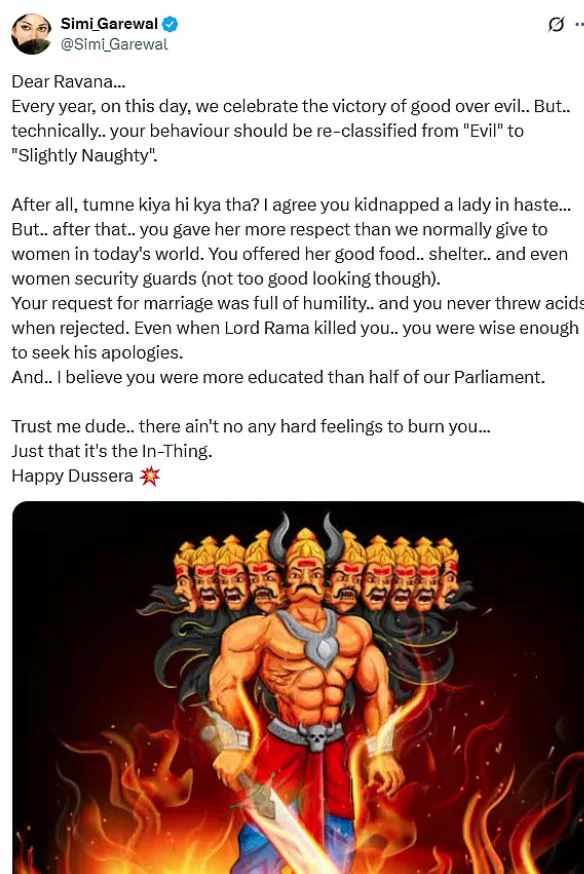
An anti-Hindu speech was made by Simi Garewal, a Sikh by faith, an Indian director, producer, talk show host, and former actress. She directly mocked the sacred festival of Dussehra and glorified Ravan, the antagonist of the Hindu epic Ramayana, calling him "slightly naughty" and "not evil." According to media reports, the accused made these remarks on X, formerly Twitter, on 2nd October 2025. She wrote: "Dear Ravana... Every year, on this day, we celebrate the victory of good over evil.. But.. technically.. your behaviour should be re-classified from "Evil" to "Slightly Naughty". After all, tumne kiya hi kya tha? I agree you kidnapped a lady in haste... But.. after that.. you gave her more respect than we normally give to women in today's world. You offered her good food.. shelter.. and even women security guards (not too good looking though). Your request for marriage was full of humility.. and you never threw acids when rejected. Even when Lord Rama killed you.. you were wise enough to seek his apologies." She further added, "And.. I believe you (Ravan) were more educated than half of our Parliament. Trust me dude.. there ain't no any hard feelings to burn you...Just that it's the In-Thing. Happy Dussera." This comment provoked outrage among Hindus. One Hindu user, Sameer, wrote, "If only pseudo-intellectual @Simi_Garewal had bothered to read the Ramayana before posting this idiotic tweet and making a fool of herself on social media. Ravana was no embodiment of virtue; he was a despicable character who once violated the Apsara Rambha and was cursed by her husband Nalakubera that if he ever forced himself on any woman again, his head would split into several pieces. It was the fear of this curse that kept Ravana away from Ma Sita. But modern-day asuras will continue to eulogise evil like Ravana." Another Hindu user, Gauri Khandekar, wrote, "Women like Simi who belittle other women’s trauma are a true curse on society and womanhood! Grow a soul, Simi."
Case Images
Why it is Hate Crime ?
This case has been added to the tracker under the primary category- Hate Speech against Hindus. Within this, the subcategory selected is- Anti-Hindu slurs, mocking faith. Anti-Hindu slurs and the deliberate mocking of the Hindu faith owing to religious animosity involve the usage of derogatory terms, stereotypes, or offensive references to religious practices, symbols, or figures. One of the common anti-Hindu slurs used against Hindus is “cow-worshipper” and “cow piss drinker”. The intention of using this term is to demean and mock Hindus as a group and their religious beliefs since Hindus consider the cow holy. Additionally, some symbols and the slurs attached to them have a historical context that exacerbates the insult, hate, stereotyping, dehumanisation and oppression against Hindus. Cow worship has been used for centuries to denigrate Hindus, insult their faith and oppress Hindus specifically as a religious group. There has been overwhelming documentation about how cow slaughter has been used to persecute Hindus with cow meat being thrown in temples and places of worship. There has also been overwhelming documentation where cow meat (beef) has been force-fed to Hindus to either forcefully convert them to Islam or denigrate their faith. Apart from cow worship, the Swastika – which holds deep religious significance for the Hindus – has also been misinterpreted and distorted to use as a slur against Hindus. Similarly, the worship of the Shivling has been used by supremacist ideologies and religions to denigrate Hindus owing to religious animosity. Such slurs and denigration stem out of inherent animosity and hate towards Hindus and their faith, therefore, it is categorised as hate speech targeted at Hindus specifically owing to their religious identity. The other subcategory selected is- Subversion of scriptures. Subverting the religious scriptures of Hindus has particularly devastating consequences. Subversion of the scriptures of Hindus is often done to justify or promote hatred, discrimination, or violence against specific individuals or groups of Hindus. Religious scriptures are often nuanced and those who harbour religious animosity towards Hindus often misquote or misrepresent the scripture to legitimise their animosity and hate towards the faith and its adherents. Any such misquoting of scriptures or subversion to justify hate, violence and discrimination against Hindus owing to religious animosity is hate speech and is categorised as such. In this case, firstly, the accused's statements mocked the entire Ramayana, a revered Hindu epic, and the sacred Dussehra festival by glorifying Ravan, the antagonist, claiming he was merely "a little naughty" and not evil in any way. This is completely false and a grave misrepresentation. Ravan’s most heinous crime was the abduction of Goddess Sita. Yet the accused tried to justify this by saying Ravan treated her better than women are treated today, providing her food, shelter, and even female security guards who were "not very attractive." Even his marriage proposal was described as humble, and it was noted that he did not resort to acid attacks upon refusal. The accused further claimed that Ravan sought apologies from Lord Ram and was more educated than half the Indian parliament. Such statements portray Ravan in a positive light and attempt to legitimise the abduction of a revered Hindu goddess. This reveals deep-seated religious hostility towards Hindus and their deities, belittling the Ramayana and the very foundation of the Dussehra festival itself, making it an instance of mocking Hindu faith and its sacred epics. Secondly, the timing of these statements, made specifically during the Dussehra festival, underscored this animosity. Dussehra symbolises the victory of good over evil, as Lord Ram triumphs over Ravan. It holds profound religious and cultural significance for Hindus worldwide by affirming the moral order and righteousness. By openly denigrating this festival and its core story at the time of its celebration, the accused demonstrated a clear intent to hurt Hindu religious sentiments, fulfilling a key parameter of a religiously motivated hate crime. Another point to address is that if Simi Garewal had made such comments based on her creativity or individual views about festivals, deities, divine figures, or scriptures of any other faith, she would have immediately faced severe backlash. A common example is the case of Nupur Sharma, the ex-BJP leader, who was relentlessly hounded by Muslim extremists and their Left-wing allies for merely quoting directly from Islamic scriptures about the Prophet of Islam, Muhammad and his child bride Aisha's marriage. Knowing this, people like Simi Garewal would not dare to make antagonistic remarks about any other faith. However, she comfortably targeted the Hindu faith. This selective targeting of Hindu festivals, scriptures, and deities reveals deep-seated animosity towards the Hindu community, thereby constituting religiously motivated hate speech. Simi Garewal’s comments represent a subversion of Hindu scriptures, particularly the Ramayana, which holds profound spiritual and moral lessons for Hindus. By portraying Ravan, the central antagonist, as merely "slightly naughty" rather than evil, and by justifying his abduction of Goddess Sita as respectful treatment, she distorts the fundamental narrative that Dussehra celebrates: the triumph of dharma (righteousness) over adharma (unrighteousness). This revisionist approach undermines the revered scripture’s authority and disrespects deeply held beliefs of millions. Such subversion fuels hatred and discrimination against Hindus by casting doubt on their sacred texts and traditions. It fosters negative stereotypes portraying Hinduism and its followers as subjects of mockery and contempt. When sacred stories are twisted in this manner by influential figures, it emboldens hostility, alienation, and prejudices that manifest socially and culturally as intolerance and religious animosity towards the Hindu community. This is not merely an academic disagreement but a deliberate attack that seeks to weaken Hindu identity and create divisions, making it a clear example of religiously motivated hate speech. In conclusion, this case meets multiple criteria of anti-Hindu hate speech: it mocks sacred Hindu texts and festivals, attempts to justify disrespectful narratives about Hindu deities, targets Hindu religious sentiments intentionally during festive occasions, and promotes hostile stereotypes against Hinduism and the Hindu community. Therefore, it is being added to the hate crime database of the Hinduphobia Tracker.


Case Status
Unknown


Perpetrators Details
Perpetrators
Sikh Extremists
Perpetrators Range
One Person
Perpetrators Gender
female
 Sources




