Insult to Hindu faith; derogatory remarks made against Lord Shri Ram and 33 crore Hindu deities on social media
 Haryana, India
 27 November, 2026
Case Summary
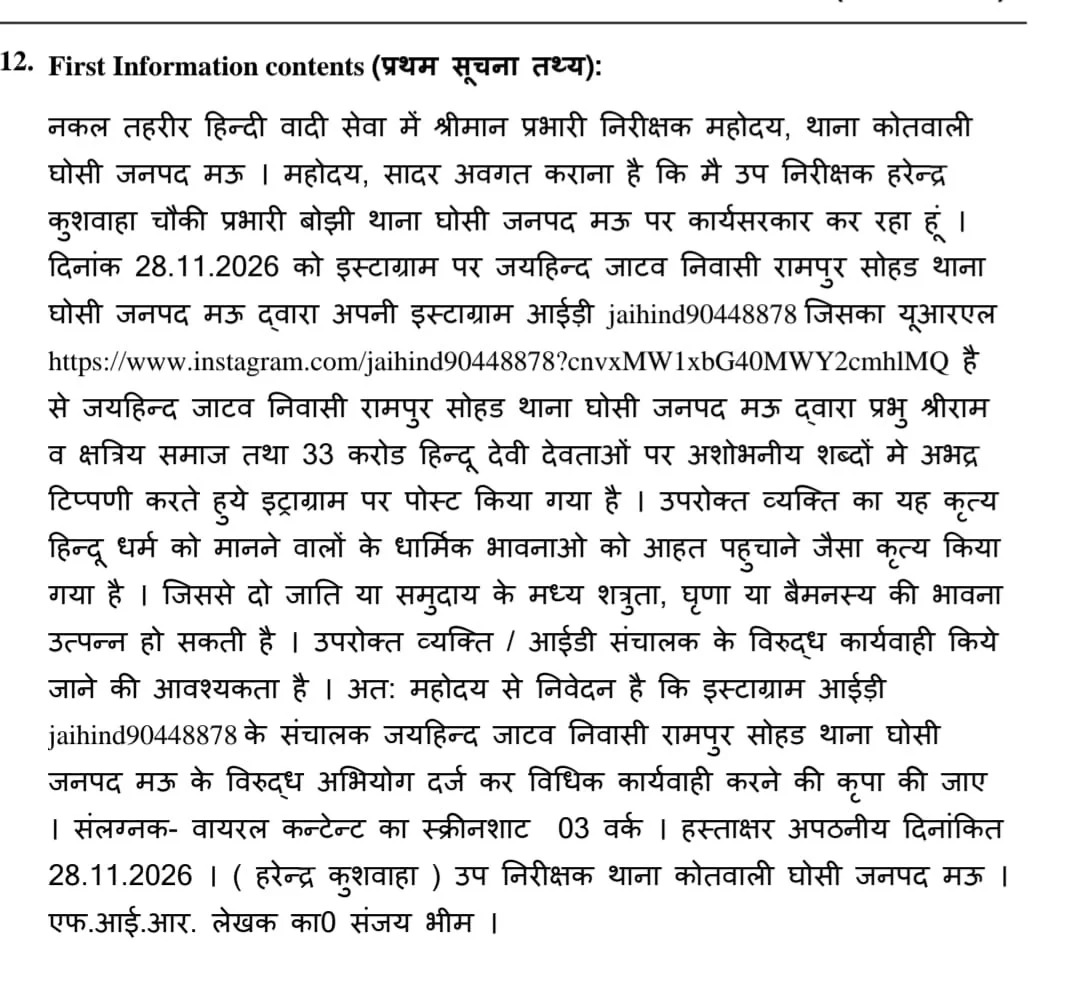
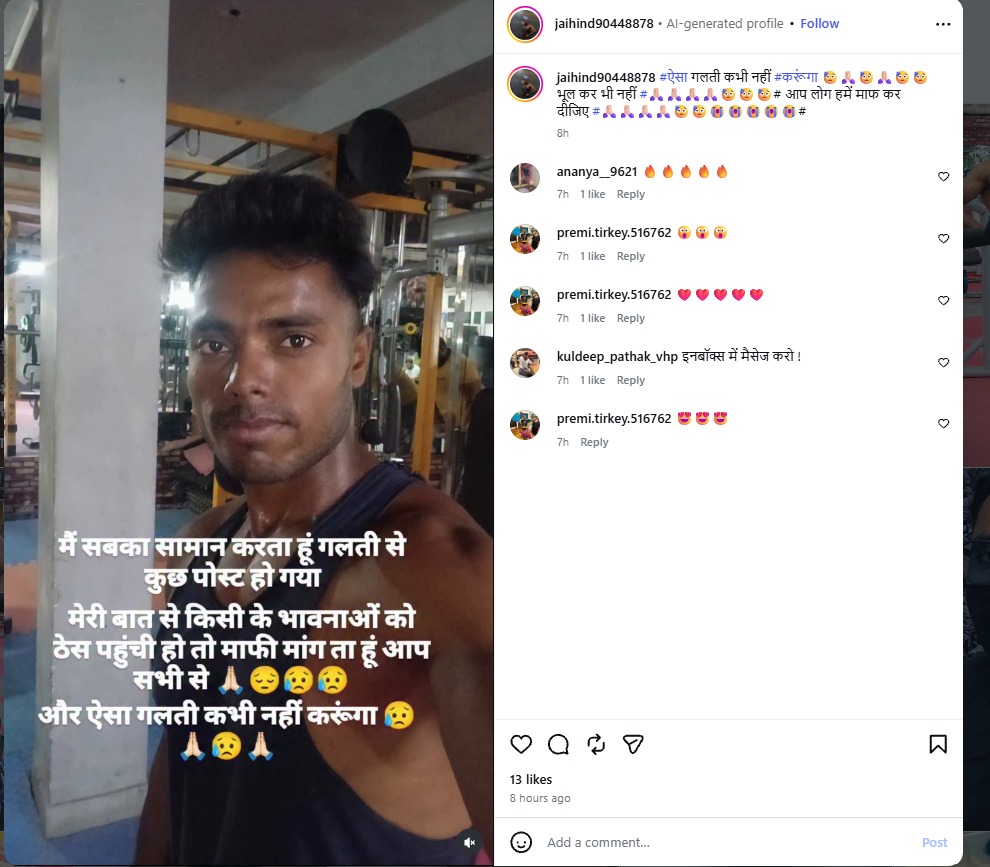
A man named Jai Hind Jatav published derogatory remarks against Lord Shri Ram and 33 crore Hindu gods and goddesses on Instagram, insulting Hindu religious beliefs and sentiments. On 28 November 2026, Jai Hind Jatav, a resident of Rampur Sohad village under Ghosi police station in Mau district, published a post on Instagram through his account, `jaihind90448878`, containing derogatory and indecent remarks against Lord Shri Ram, the Kshatriya community and 33 crore Hindu gods and goddesses. The post used objectionable language to target Hindu religious figures, deities and the Kshatriya community, offending the religious sentiments of followers of Hinduism and provoking resentment in the area. Sub-Inspector Harendra Kushwaha, the in-charge of the Bojhi police outpost under Ghosi police station, submitted a written complaint at Ghosi police station regarding the incident. In his complaint, he identified Jai Hind Jatav as the operator of the Instagram account `jaihind90448878` and stated that the individual had published the objectionable remarks through his account. He further stated that the post had hurt the religious sentiments of Hindus and could create hostility between castes and communities. He requested that a case be registered against Jai Hind Jatav and appropriate legal proceedings be initiated against him. Acting on the complaint, Ghosi police registered a case against him under Section 353(2) of the Bharatiya Nyaya Sanhita (BNS) and Section 67 of the Information Technology Act, 2008, as amended. Inspector-in-charge Amarjeet Yadav confirmed the registration of the case and stated that the police had begun efforts to apprehend the accused. Local reports stated that Jai Hind Jatav was residing in Haryana and had published the objectionable post from there. Since he was in another state, the police were making efforts to trace and arrest him. Amarjeet Yadav further stated that the accused would be arrested and sent to jail soon. Subsequently, Jai Hind Jatav published another post on Instagram in which he claimed that the objectionable remarks in his earlier post had been made by mistake and expressed regret over his actions.
Case Images
Why it is Hate Crime ?
This incident has been added to the tracker under the primary category of - Hate speech against Hindus. Within it, the sub-category selected here is - Anti-Hindu slurs, mocking faith. Anti-Hindu slurs and the deliberate mocking of the Hindu faith owing to religious animosity involve the usage of derogatory terms, stereotypes, or offensive references to religious practices, symbols, or figures. One of the common anti-Hindu slurs used against Hindus is “cow-worshipper” and “cow piss drinker”. The intention of using this term is to demean and mock Hindus as a group and their religious beliefs since Hindus consider the cow holy. Additionally, some symbols and the slurs attached to them have a historical context that exacerbates the insult, hate, stereotyping, dehumanisation and oppression against Hindus. Cow worship has been used for centuries to denigrate Hindus, insult their faith and oppress Hindus specifically as a religious group. There has been overwhelming documentation about how cow slaughter has been used to persecute Hindus with cow meat being thrown in temples and places of worship. There has also been overwhelming documentation where cow meat (beef) has been force-fed to Hindus to either forcefully convert them to Islam or denigrate their faith. Apart from cow worship, the Swastika – which holds deep religious significance for the Hindus – has also been misinterpreted and distorted to use as a slur against Hindus. Similarly, the worship of the Shivling has been used by supremacist ideologies and religions to denigrate Hindus owing to religious animosity. Such slurs and denigration stem out of inherent animosity and hate towards Hindus and their faith, therefore, it is categorised as hate speech targeted at Hindus specifically owing to their religious identity. The incident constituted an instance of targeted hostility towards Hindu religious beliefs and representations, as the accused directed derogatory and indecent language at Lord Shri Ram and 33 crore Hindu gods and goddesses. Religious deities occupy a central and deeply revered position in Hindu faith, worship and religious practice. Directing insulting remarks at these deities was therefore not merely an expression of personal disagreement or criticism but an act that demeaned figures held sacred by Hindus and showed disregard for their religious beliefs. Lord Shri Ram holds an immensely revered and central position in Hinduism as the seventh incarnation of Bhagwan Vishnu and is worshipped by millions of Hindus across the world. He is regarded as the embodiment of dharma, righteousness, truth, devotion and ideal conduct. Revered as Maryada Purushottam, he represents the highest ideals of moral duty, compassion, courage and adherence to dharma. His life and teachings, as recounted in the Ramayana, form an integral part of Hindu religious, cultural and spiritual traditions. His worship is deeply embedded in Hindu religious practices, festivals and collective consciousness. Consequently, directing derogatory and insulting remarks at Lord Shri Ram amounted to denigrating a figure of profound religious significance to Hindus and was deeply offensive to their faith and religious sentiments. Hindu theology is complex and diverse, often described as monotheistic, pantheistic, or panentheistic, rather than strictly polytheistic in the sense of having millions of independent gods. The core beliefs include: One Supreme Reality (Brahman): The ultimate, formless, infinite truth or consciousness from which everything originates. Multiple Manifestations: The various deities are seen as different faces, forms, or energies of the one Brahman, allowing individuals to connect with the divine in a way that resonates with them personally. This is often compared to a single source of light (Brahman) manifesting in different colours (deities). Reverence for All Life and Nature: Hinduism encourages seeing the divine in all aspects of creation, including nature, animals, and all human beings. The "33 crore deities" expression, therefore, metaphorically points to the countless ways the single divine power manifests in the universe, rather than a literal census of 330 million gods. In Hindu thought, this number is symbolic. It reflects the understanding that the divine shows itself in countless forms and that people can connect with God in different ways. Hindu theology is actually vibrant and layered. It is often described as monotheistic, pantheistic or panentheistic rather than a system with millions of unrelated gods. At its core is the belief in one supreme reality called Brahman, the infinite and formless source of everything. The various gods and goddesses are understood as different expressions or energies of this one truth, much like a single beam of light appearing in different colours. This allows each person to approach the divine in a way that feels meaningful to them, and it encourages seeing the sacred in all life and in nature. Because the remark mocked the symbolic idea of three crore deities, misrepresented the core of Hindu theology and insulted ordinary devotees, it clearly amounts to denigration of the faith. In recent times, social media has increasingly become a platform for anti-Hindu hate, with derogatory memes, videos, and messages targeting Hindu religious symbols, practices, and deities. Such content is recognised as part of a broader pattern of Hinduphobia and religious hate crimes online. This deliberate targeting of revered religious icons firmly establishes this act as a religiously motivated hate crime; therefore, it is being categorised under the hate crime database. Disclaimer: Haryana has been selected as the place of the incident because local news reports stated that the accused, Jai Hind Jatav, was residing there and had published the objectionable Instagram post from Haryana. Although the accused was a resident of Rampur Sohad village in Mau district, Uttar Pradesh, the reported location from which he carried out the online activity was Haryana.


Case Status
Complaint registered


Perpetrators Details
Perpetrators
Others
Perpetrators Range
One Person
Perpetrators Gender
male
 Sources





