Hindu shrine targeted in Gujarat; ‘Allah’ scrawled on its spire and goddess challenged through provocative inscription
 Sabar Kantha, Gujarat, India
 27 November, 2026
Case Summary
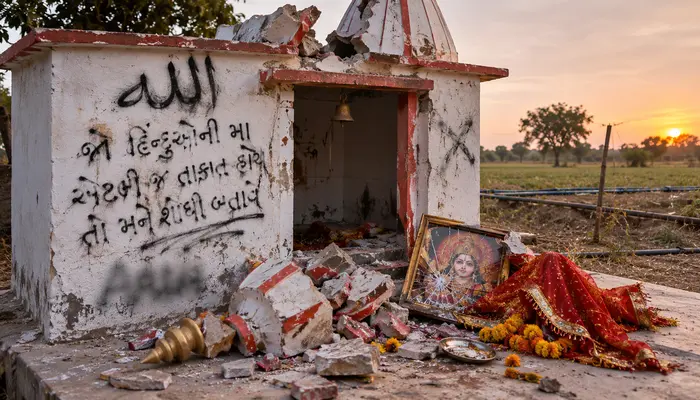
In the Bileshwar Kampa village, Talod, of Sabarkantha district, Gujarat, a shrine dedicated to Mataji was vandalised and desecrated by unidentified miscreants. According to reports, the shrine’s spire was smashed to pieces, while Mataji’s photograph, chunri, garland and other articles used for worship were thrown outside. The perpetrators also defaced the shrine and its floor by scrawling writings in charcoal, including the word ‘Allah’, obscene words and a derogatory challenge directed at the mother of Hindus. One of the inscriptions read, ‘If the mother (goddess) of Hindus is so tough, let her find me.’ The shrine stood beside a road in the agricultural fields of Bileshwar Kampa, opposite the Edison industrial unit. Devotees from Kampa village had constructed it approximately four years earlier. Some people were believed to have approached the shrine during the night and carried out the vandalism. In addition to desecrating the shrine, the perpetrators damaged a nearby agricultural field belonging to farmer Rudrabhai Bhailalbhai Patel by cutting more than 100 drip-irrigation pipes. The farmer subsequently submitted a written complaint at Harsol police station. Harsol police registered the complaint, visited the scene and initiated an investigation into the incident. The incident also prompted demands for increased police patrolling in Talod, Harsol and the surrounding villages of the taluka.
Why it is Hate Crime ?
This incident has been added to the tracker under the primary category of: Attack on Hindu religious representations. Within it, the sub-category selected here is: Desecration of Hindu religious symbol. Icons and symbols or a religious representation of a spiritual ideal are widely revered in Hinduism. Iconography is of vital significance in the Hindu milieu. It helps connect people’s spiritual beliefs with the real world. Iconography within the Hindu faith takes several shapes and forms. Murtis are of most significance to Hindus, to which daily rituals, prayers and offerings are done. Besides the murtis, there are several other symbols which have deep significance in the Hindu faith – the Om and Swastika for example. Since these Hindu religious symbols hold paramount importance in Hinduism, any desecration of symbols, icons, murtis, religious representations and manifestations, is driven by animosity towards the faith itself which manifests itself through these murtis, icons and symbols. Therefore, any desecration of these Hindu religious symbols and representations is considered religiously motivated hate crimes under this category. The other sub-category selected here is: Violence against religious structures or centres. In Hinduism, a religious structure is also considered divine. Hindus believe that not just the Deity but the religious structure itself is sacred. In this sub-category, we would document attacks against religious structures which are not consecrated temple spaces. Such religious spaces could be temporary in nature – for example – the religious spaces erected specifically for festivals like Durga Puja etc. This category would also document cases of attacks against religious centres. These spaces in their own right may not be ‘sacred’ per se, however, are often spaces where religious gurus live, religious teaching is imparted, or belong to religious institutions. Any attack against religious structures is a result of animosity towards the religion itself, which manifests itself through the religious spaces and therefore, such attacks are considered religiously motivated hate crimes. Religious centres are also manifestations of the religion, its teachings or gurus and therefore, attacks against such centres would be considered religiously motivated hate crimes This incident has been added to the tracker because it involved the deliberate desecration of a shrine dedicated to Mataji, where the perpetrators defaced the shrine and its floor with charcoal inscriptions, including the word ‘Allah’ and obscene remarks directed at the mother of Hindus. In Hinduism, temples and shrines serve as sacred spaces where devotees worship deities, offer prayers and perform religious rituals. Even a small shrine established by devotees holds religious significance as a place dedicated to a particular deity and provides a space for the continued observance of faith and devotional practices. The Mataji shrine was therefore not merely a physical structure but a place of religious reverence for the devotees who worshipped there. The destruction of its spire, the displacement of Mataji's photograph, chunri, garland and other articles used in worship, and the defacement of its structure and floor constituted a direct desecration of this sacred space. By damaging the shrine and disturbing the objects associated with worship, the perpetrators showed contempt for a place dedicated to Mataji and undermined the sanctity of a Hindu place of worship. The inscriptions left at the site further strengthened the religious dimension of the incident. The word ‘Allah’ was written in charcoal on a broken section of the shrine's spire, introducing an explicit Islamic religious reference into a sacred Hindu place of worship. Its inscription in this setting, alongside the destruction of the shrine and the displacement of objects used for worship, was not an isolated act of writing or ordinary graffiti. It represented an assertion of Islamic religious identity within a Hindu place of worship, in a manner that challenged the sanctity of the space and showed disregard for the religious beliefs of its devotees. The deliberate placement of this religious reference amid the desecration of a Hindu shrine demonstrated religious animosity towards Hindu places of worship and their sacred character. The act therefore carried significance beyond the mere defacement of property, as it involved the imposition of a religiously provocative expression within a space dedicated to Hindu worship. Furthermore, the obscene inscriptions on the floor, particularly the statement, ‘If the mother of Hindus is so tough, let her find me’, also demonstrated the religiously provocative nature of the incident. The reference to the mother of Hindus invoked Mataji, who is revered as the Divine Mother and occupies a central place in Hindu religious belief and worship. Directing an obscene challenge at a figure held sacred by Hindus, particularly within a shrine dedicated to Mataji herself, amounted to an expression of contempt towards Hindu religious reverence. The statement was not simply abusive language but specifically targeted a figure central to Hindu devotion, thereby insulting the religious sentiments of Hindu devotees and demonstrating hostility towards their faith. The desecration of the shrine also had significance beyond the physical damage caused to its structure and worship articles. Hindu devotees had established the shrine as a place where they could offer prayers and worship Mataji. Such places provide a setting for the continued observance of religious traditions and the expression of collective faith. Defacing the premises with obscene and religiously provocative inscriptions, while destroying objects used in worship, interfered with that sacred environment. It communicated contempt for the religious practices of the devotees and subjected a place of worship to deliberate humiliation. The deliberate desecration of a Hindu place of worship, destruction of religious articles, inscription of ‘Allah’ and obscene challenge directed at the mother of Hindus constituted an expression of religious hatred towards Hindus and their religious beliefs. The perpetrators targeted a sacred Hindu space, defaced it with an Islamic religious reference and used provocative language to insult a figure revered in Hinduism. These acts went beyond ordinary vandalism and demonstrated hostility towards Hindu religious worship, sacred representations and sentiments. Therefore, this incident has been added to the tracker. Disclaimer: The Hinduphobia Tracker records incidents based on when an event occurred or when the victim's ordeal began. It is important to clarify that none of the media sources covering this case has specified the exact date when the incident occurred. Therefore, for documentation purposes, we have recorded the date based on when the incident was reported in the media, 28 November 2026.


Case Status
Complaint filed


Perpetrators Details
Perpetrators
Unknown
Perpetrators Range
Unknown
Perpetrators Gender
unknown
 Sources





