Hindu students denied classroom entry for wearing Ayyappa Deeksha attire and malas at a school in Madurai, Tamil Nadu
 Madurai, Tamil Nadu, India
 26 November, 2026
Case Summary
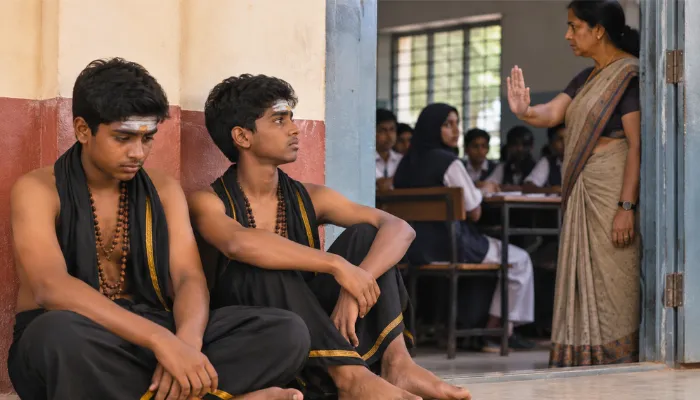
In Madurai, Tamil Nadu, two Hindu brothers were prevented from entering their classrooms for wearing Ayyappa diksha attire, Ayyappa malas and applying tilak on their foreheads. The students were made to sit outside their classrooms for three consecutive days. The victims, 12-year-old Darshan and 11-year-old Nivin Sai, studied in Classes VII and VI respectively at a private higher secondary school on Pillar Road in Nagamalai Pudukottai, near Thirupparankundram. The boys were observing the traditional Ayyappa vratham along with their father, Sathish Pandian, a lift operator, who had made his sons wear Ayyappa malas and Ayyappa diksha attire as part of their religious observance ahead of their planned pilgrimage to the Sabarimala Ayyappa Temple in Kerala. Notably, the Ayyappa vratham is a period of religious discipline, fasting and observances followed by devotees preparing for the Sabarimala pilgrimage. As part of the religious observance, the boys attended school wearing Ayyappa diksha attire and Ayyappa malas, with vibhuti, kumkum and sandalwood paste on their foreheads, and without footwear. However, the school management and teachers objected to their religious attire, malas, religious markings and attending school barefoot. They cited school rules requiring students to wear footwear and prohibiting religious symbols, including vibhuti and sandalwood paste. The students were consequently denied entry into their classrooms and made to sit outside instead. The parents stated that their sons were made to sit outside their classrooms for three consecutive days. After being informed about the matter, they visited the school and were shocked to find their children sitting outside. They raised the issue with the school management, following which the students were subsequently allowed to enter their classrooms. The parents then approached Nagamalai Pudukottai Police Station and lodged a formal complaint against the school administration. The parents further stated that a similar incident had occurred the previous year when their sons had worn Ayyappa malas and observed the religious practices associated with the vratham. They added that the same restrictions had resurfaced this year. They also brought to the authorities' attention complaints from other families concerning similar restrictions on religious practices at the school, stating that their earlier complaints to the school management had not resulted in appropriate action. The complaint prompted a police investigation into the treatment of the two students. When questioned about the incident, school principal Jayapaul denied that the students had been excluded from their classrooms on religious grounds. He stated that the boys had been asked to bring their parents to school because they had not completed their homework and wanted to take leave. He maintained that the parents had misunderstood the situation. Meanwhile, school correspondent Reverend Father Jayapal issued a statement denying that the institution had imposed restrictions affecting the religious freedom of its students. He stated that the parents had merely been asked to wait until they could meet the school principal. He maintained that the teachers' instructions formed part of the school's regular procedures, general guidelines and student-welfare measures. Jayapal further stated that students observing religious fasts were generally advised to consider alternatives that would not affect their health or regular attendance in classes. He maintained that the parents had misunderstood these instructions. He also stated that more than 99% of the school's students belonged to the Hindu community and that no similar incident had occurred during the institution's 25-year history. The correspondent added that the school operated without any financial assistance from the government and was committed to providing quality education to underprivileged children. He maintained that all students were treated with equal affection and respect, irrespective of caste or religion. The school management categorically denied imposing disciplinary restrictions or taking any action that would infringe upon the religious beliefs or freedom of its students. Meanwhile, District Educational Officer (DEO) Karmegam enquired with the school principal after learning about the incident and instructed the school not to allow such incidents to recur. Police continued investigating the complaint lodged by the parents.
Why it is Hate Crime ?
In this case, the two Hindu brothers were observing Ayyappa vratham and wearing Ayyappa diksha attire, Ayyappa malas and religious markings as part of their preparation for the Sabarimala pilgrimage. The school management prevented them from entering their classrooms, citing rules concerning footwear and restrictions on religious markings and attire. This is not the first time controversies have erupted over religious attire and symbols in educational institutions. In 2022, in Karnataka, a heated debate erupted when Muslim girls insisted on wearing burqas and hijabs in schools and classrooms. At that time, politicians, social commentators, Hindu activists and even the judiciary argued that schools had the right to enforce uniform rules. Uniformity was presented as a means of promoting harmony and equality within classrooms. Consequently, restrictions on wearing hijabs were defended as the enforcement of a uniform policy rather than religious discrimination. A similar argument can be made in the present case. It is possible that the school was not attempting to discriminate against Hindu students or restrict their religious expression but was instead enforcing its prescribed uniform and dress-code requirements. The two brothers were attending school in complete black Ayyappa diksha attire rather than the prescribed school uniforms. They were also wearing Ayyappa malas, sporting religious markings such as vibhuti and tilak, and attending school without footwear as part of their religious observance. However, if the school permitted students belonging to other religious communities to express their faith by wearing their respective religious attire and symbols without adhering to the prescribed uniform, while selectively restricting Hindu students observing Ayyappa diksha, it would amount to discriminatory treatment rooted in anti-Hindu hostility. At present, there is no evidence establishing that students belonging to other faiths were permitted such exemptions while Hindu students were selectively prohibited from doing so. Therefore, religiously selective enforcement of the school's rules has not been established. However, this incident does raise concerns when viewed in the context of several similar incidents documented by the Hinduphobia Tracker. The Tracker has recorded multiple instances in which educational institutions, under the pretext of enforcing uniform policies, restricted or penalised Hindu students for wearing even small and benign religious symbols such as tilak, kalava (sacred thread) and janeu (sacred thread worn by Hindu men), which is usually concealed beneath clothing and does not alter or disrupt the prescribed school uniform. When Hindu students are selectively targeted even for displaying such minor expressions of their religious identity, which do not interfere with uniform requirements, it demonstrates religious bias against Hinduism. Such incidents, where religious hostility is established, can be classified as hate crimes. Nevertheless, the present case involves two students wearing complete Ayyappa diksha attire instead of their prescribed school uniforms, along with Ayyappa malas and religious markings, while observing the religious practices associated with their planned Sabarimala pilgrimage, including abstaining from wearing footwear. The available information does not establish whether the school was selectively restricting the expression of Hindu religious identity or merely enforcing its general uniform and dress-code policy. There is also no conclusive evidence that students belonging to other religious communities were allowed to wear their respective religious attire while Hindu students were denied the same accommodation. Consequently, although the incident raises concerns, the available evidence does not establish a religious motive behind the school's actions. The Hinduphobia Tracker follows strict parameters when classifying an incident as a hate crime. Since the present incident does not conclusively meet these parameters, it is being added to the ‘Undecided’ database rather than being classified as a Hate Crime. If further evidence emerges establishing that the school selectively targeted the Hindu students or that its actions were rooted in anti-Hindu hostility, the case will be reassessed and moved to the Hate Crime database of the Hinduphobia Tracker. Disclaimer: The Hinduphobia Tracker records incident dates based on when the crime occurred rather than when it was reported by the media. In the present case, media reports did not specify the exact date of the incident. Hence, 27 November 2026, the date when the incident was first reported in the media, has been selected as the indicative incident date for documentation purposes only.
Victim Details
Total Victim
2
Deceased
0
Gender
- Male 2
- Female 0
- Third Gender 0
- Unknown 0
Caste
- SC/ST 0
- OBC 0
- General 0
- Unknown 2
Age Group
- Minor 2
- Adult 0
- Senior Citizen 0
- Unknown 0


Case Status
Complaint filed


Perpetrators Details
Perpetrators
Christian Extremists
Perpetrators Range
One Person
Perpetrators Gender
male
 Sources





