Blatant Hinduphobia on display: Muslim woman threatens Hindus with violence and expulsion for practising their religion in Bangladesh
 Bangladesh
 18 June, 2026
Case Summary
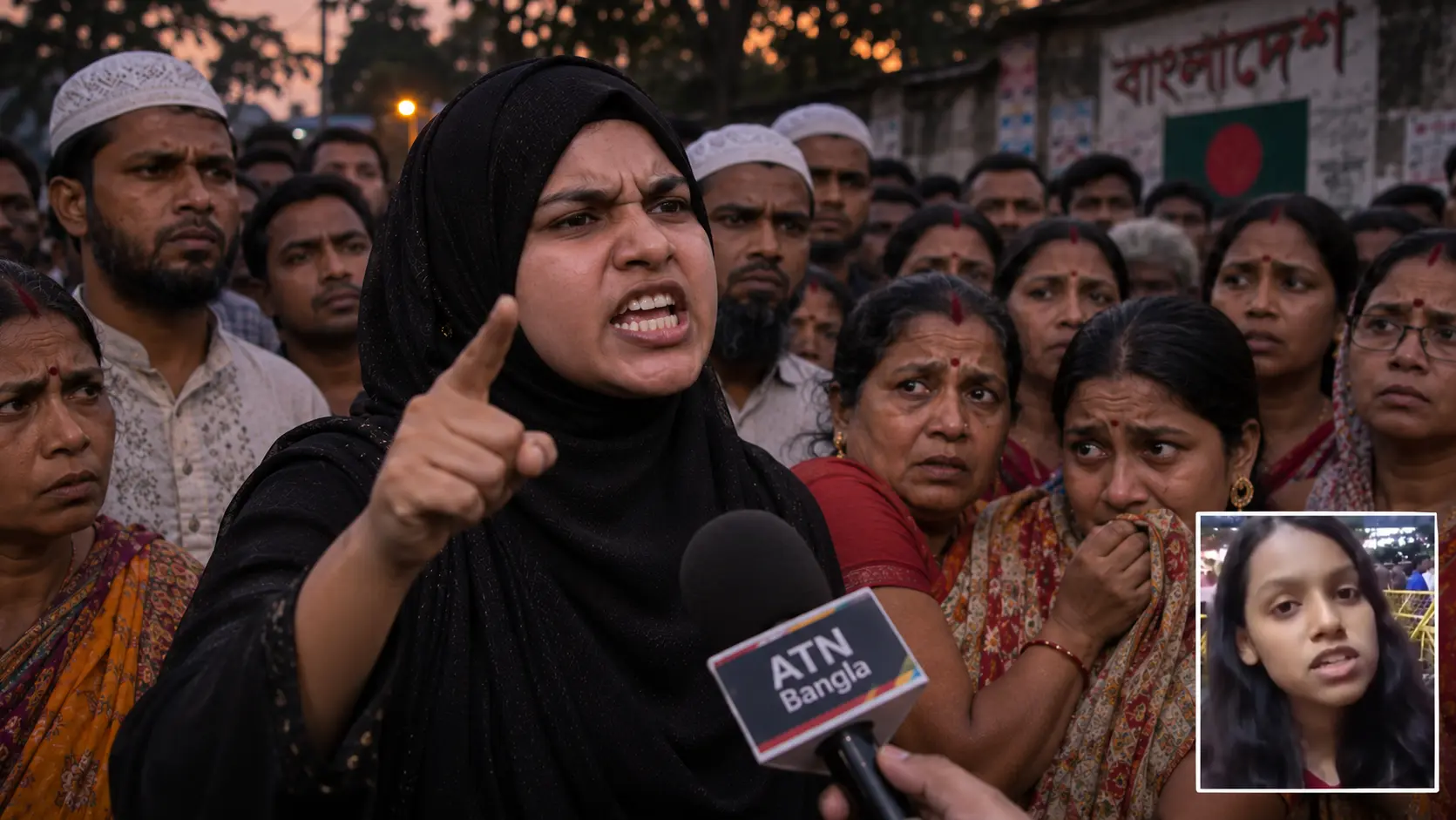
In Bangladesh, a Muslim woman made violent and provocative remarks targeting the Hindu community and their right to practise their faith. She declared that Hindus would not be allowed to practise Hinduism in the country and called for their forcible and violent expulsion if they wished to exercise their religious freedoms. The incident came to light after a video of the perpetrator went viral on social media, in which she openly advocated banning Hindus from practising their religion in Bangladesh. She argued that if Hindus wished to practise Hinduism, they should go to India, invoking Bangladesh’s Muslim-majority status to justify denying them their religious freedoms. Drawing a comparison with India, which she described as a Hindu-majority country, she made false claims that Muslims in India were not permitted to offer namaz or practise their religion freely and were instead told to go to Pakistan. Using these assertions as a pretext, she argued that Hindus in Bangladesh should similarly be denied the right to practise their religion. She further demanded that no Hindu puja, religious ceremony, festival celebration, gathering or meeting should be permitted anywhere in Bangladesh. She stated that Hindus could continue living in the country but should not be allowed to practise their faith. She repeatedly invoked Bangladesh’s Muslim-majority status to justify this demand and incited hostility against the Hindu community by insisting that Hindus had no right to conduct religious activities in the country. She then escalated her remarks into direct threats of violence and expulsion, declaring that Hindus who wished to practise their faith should be forcibly driven out of Bangladesh. She threatened that Hindus would be grabbed by the neck and violently thrown out of the country if they continued to perform pujas or exercise their religious freedoms. Notably, some social media handles identified the perpetrator as a leader of the National Citizen Party (NCP). However, at the time of documentation, Hinduphobia Tracker could not independently verify this identification. This incident occurred against the broader backdrop of the historical persecution faced by Hindus in Bangladesh. While the Hindu minority has endured discrimination, targeted violence, and religious hostility over decades, such persecution has intensified in distinct spurts during periods of political and social instability. The latest major escalation began after the ouster of Sheikh Hasina’s government in August 2024, continued after the death of Sharif Osman Bin Hadi in December 2025, and resurfaced in the immediate aftermath of the 13th National Parliamentary Election in 2026. Following the ouster of Sheikh Hasina, multiple incidents involving attacks on Hindu homes, temples and religious institutions were documented, alongside intimidation, arson and mob violence targeting Hindu localities. The Hinduphobia Tracker recorded 336 incidents involving the Hindu minority during this period, reflecting the scale of the escalation and the continuing vulnerability of Hindus in Bangladesh. A further spurt of violence followed the death of Sharif Osman Bin Hadi, a Muslim political activist and student leader known for his anti-Hindu and anti-India rhetoric, in December 2025. In the aftermath, Hindu communities were subjected to retaliatory violence, with Hindu homes and properties selectively attacked and several families forced to flee. Among the victims was Dipu Chandra Das, who was lynched by a Muslim mob over false blasphemy allegations, after which his body was set ablaze. The Hinduphobia Tracker documented 51 incidents of anti-Hindu violence in the period following Hadi’s death alone, further illustrating how existing hostility towards the Hindu minority intensified during moments of communal mobilisation. During the same period, posters and written material calling for the extermination of Hindus were also displayed in public spaces. Such rhetoric, when viewed alongside incidents of arson, vandalism, assault and targeted intimidation, reflected an environment in which hostility towards Hindus was not merely episodic but repeatedly resurfaced in more intense forms during periods of unrest. The most recent escalation followed the 13th National Parliamentary Election in 2026. In the immediate aftermath of the election results, Hindu families in districts including Noakhali, Rangpur, Nilphamari, Sylhet, Thakurgaon and Dinajpur faced attacks involving arson, looting, assault and vandalism of Hindu homes and temples. In several instances, Hindu properties were selectively targeted, and families were threatened with displacement. The present incident therefore occurred within a much longer history of persecution of Hindus in Bangladesh, where hostility towards the community has persisted over time and intensified in repeated spurts. The latest cycle began after the ouster of Sheikh Hasina and continued through subsequent periods of political and communal upheaval, leaving the Hindu minority increasingly vulnerable to targeted violence, intimidation and religious hostility.
Why it is Hate Crime ?
This incident is being added to the tracker under the primary category: Hate Speech against Hindus. The subcategory selected is: Violent Threats. Violent threats, explicit, implicit or implied, is the most dangerous form of hate speech since it goes beyond discriminatory and prejudicial language to express the intent of causing harm to an individual or a group of people based on their religious identity and faith. There could be several different kinds of threats that are issued to Hindus based on religious animosity. An explicit threat would mean the direct threat of violence towards an individual Hindu, a group of Hindus or Hindus at large. Physical violence, death threats, threats of destruction of property belonging to Hindus and threats of genocide would mean explicit threats against Hindus for their religious identity. Implicit threats may not be a direct threat but implied through the use of symbols of actions – for example – in the Nupur Sharma case, other than explicit threats, there were also implicit threats when Islamists took to the streets to burn and beat her effigies. It implies that they want to do the same to Nupur Sharma – thereby is considered an implicit threat. Violent threats can be delivered in person, through letters, phone calls, graffiti, or increasingly through social media and other online platforms. It would be important to understand that a threat – explicit or implicit, online or offline – to an individual who happens to be a Hindu does not qualify as a religiously motivated threat. Such a threat, while vile and dangerous, could be owing to non-religious reasons and/or personal animosity. To qualify as a religiously motivated threat, it would need to exhibit an indication that the individual is being targeted for religious reasons and/or owing to his/her religious identity as a Hindu. In this incident, the perpetrator's remarks demonstrated deep-rooted hostility towards Hinduism and the Hindu community. By threatening Hindus with violence, calling for their forcible expulsion from Bangladesh simply for practising their faith, and declaring that they would not be allowed to celebrate their religious festivals or conduct religious gatherings, she openly advocated denying an entire religious community its fundamental religious freedoms. Her statements went beyond religious prejudice and displayed explicit anti-Hindu hatred by seeking to exclude Hindus from exercising their faith in the country. The perpetrator repeatedly invoked the supposed persecution of Muslims in India to justify her demand that Hindus should not be allowed to practise their religion in Bangladesh. However, this comparison was based on a false narrative. India does not prohibit Muslims from practising Islam, offering namaz, celebrating Islamic festivals or conducting religious gatherings. The Indian Constitution guarantees freedom of religion to all citizens, irrespective of their faith. Moreover, the Muslim population in India increased from approximately 9.8% in 1951 to 14.2% in the 2011 Census. With approximately 172 million Muslims recorded in 2011, India has one of the largest Muslim populations in the world. The country has also had Muslim Presidents, Union Ministers, elected representatives, judges and other prominent public officials. Therefore, the assertion that Muslims in India are prohibited from practising their religion or categorically denied religious freedoms is false.  In contrast, Hindus in Bangladesh have faced decades of religious discrimination, persecution and communal violence. Hindus constituted approximately 28% of the population of the region that is now Bangladesh in 1941, before Partition. Their share declined to approximately 22% in 1951 and further to 7.96% in the 2022 Census. This stark demographic decline, alongside a prolonged history of targeted violence and discrimination, highlights the vulnerability of Bangladesh's Hindu minority. By falsely portraying Muslims in India as victims of systematic religious exclusion while disregarding the persecution faced by Hindus in Bangladesh, the perpetrator demonstrated a deliberate distortion of religious realities to justify hostility towards the Hindu community. She then used this false comparison as a pretext to justify stripping Hindus of their right to practise their faith, celebrate their festivals and conduct religious ceremonies and gatherings. By suggesting that Hindus should be denied these freedoms because Muslims in India supposedly faced similar restrictions, she attempted to legitimise religious discrimination and exclusion. Her remarks also sought to incite hostility among the Muslim population in Bangladesh by portraying the religious practices of Hindus as something that should not be tolerated. This deliberate use of false narratives to justify restrictions on Hindu religious expression demonstrated religiously motivated fearmongering and deep-seated animosity towards Hinduism. Her insistence that Bangladesh's Muslim-majority status entitled the country to prohibit Hindu religious practices further exposed the exclusionary nature of her remarks. The right to practise a religion does not depend on whether its followers constitute a majority or minority in a country. Nevertheless, she demanded that Hindu pujas, festivals, religious ceremonies, meetings and gatherings be prohibited throughout Bangladesh simply because Muslims constituted the majority. By making religious freedoms conditional on demographic strength, she advocated the subordination of the Hindu minority to the religious preferences of the majority. This reflected a religiously supremacist mindset that denied Hindus equal standing and portrayed their religious identity as incompatible with Bangladesh's national and religious character. The perpetrator subsequently escalated her rhetoric into explicit threats of violence and forcible expulsion. She declared that Hindus who wished to practise their religion should go to India and threatened that they would be caught by their necks and violently thrown out of Bangladesh if they continued to perform pujas or exercise their religious freedoms. These remarks constituted direct threats of physical violence and advocated the forcible removal of an entire religious community simply for following its faith. By threatening to seize and expel Hindus from their own country, she displayed extreme religious bigotry and hostility towards their very existence as a Hindu community in Bangladesh. Such threats sought to intimidate Hindus into abandoning their religious practices or leaving the country altogether. The incident was particularly alarming given Bangladesh's prolonged history of persecution and violence against its Hindu minorities. Hindu temples and places of worship have repeatedly been attacked and vandalised, while Hindu homes and businesses have been looted, damaged and set ablaze. Members of the community have faced killings, mob violence, physical assaults, sexual violence against women and girls, and forced religious conversions. The situation deteriorated further following the fall of Sheikh Hasina's government in August 2024, when widespread attacks were carried out against Hindu minorities across Bangladesh. Hindu temples, homes and businesses were targeted by Muslim mobs, while Hindus were assaulted, killed and subjected to sexual violence. Several members of the community also faced intimidation and coercion, including attempts at forced conversion. Against this backdrop, publicly advocating the violent expulsion of Hindus for practising their religion was particularly inflammatory. Such rhetoric risked emboldening those who targeted the Hindu minority and further legitimising violence against them. It demonstrated a dangerous disregard for the safety of Hindus and added to the climate of hostility and persecution they continued to face in Bangladesh. The perpetrator's remarks ultimately reflected an exclusionary and religiously supremacist mindset that treated Hindu religious identity and practices as illegitimate and sought to deny Hindus the right to live according to their faith. Her demands for the prohibition of Hindu religious activities, coupled with threats of violence and expulsion, demonstrated that her hostility was directed not merely at particular religious practices but at the Hindu community itself. By advocating the subjugation and exclusion of Hindus on account of their religious identity, she displayed deep-rooted anti-Hindu bigotry and religious animosity. Therefore, the incident was included in the Hinduphobia Tracker's hate crime database. Disclaimer: Hinduphobia Tracker records incident dates based on when the crime occurred rather than when it was reported in the media or went viral on social media. In this case, although the video went viral on social media on 25 November 2026, the incident was first covered by the media on 19 June 2026. However, the media reports did not specify the exact date on which the incident occurred. Therefore, 19 June 2026 has been selected as the indicative incident date for documentation purposes only.


Case Status
Unknown


Perpetrators Details
Perpetrators
Muslim Extremists
Perpetrators Range
One Person
Perpetrators Gender
female
 Sources





