Tribal Hindu women targeted for religious conversion by Christian missionaries through false promises of healing and curing illnesses
 Korba, Chhattisgarh, India
 21 November, 2022
Case Summary
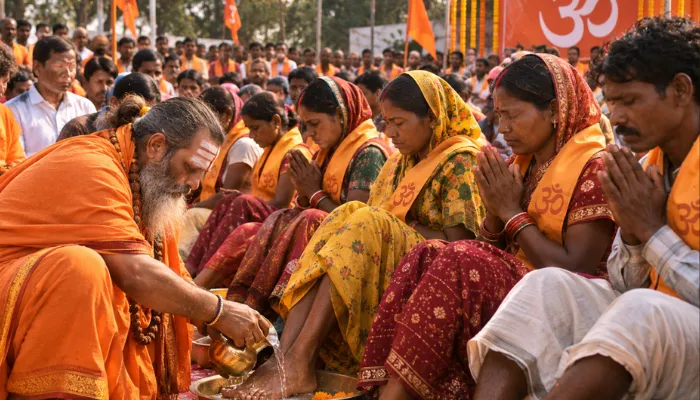
In Korba, Chhattisgarh, approximately 500 members of 100 families who had converted from Hinduism to Christianity returned to Sanatan Dharma during a Ghar Wapsi programme. Two Hindu women who participated in the programme recounted how they had been persuaded to convert to Christianity through promises that their ailing husbands would be cured through prayers and healing services. The Hindu families subsequently returned to Sanatan Dharma during a Ghar Wapsi programme held at the Ghantaghar Open Theatre. The Hindu families, belonging to tribal communities from the forest areas of Korba and neighbouring Sakti district, were welcomed back amid religious chants at the Hindutva Rakshak Samman ceremony. Their return was marked by a traditional welcome in which their feet were washed. Mahamandaleshwar Swami Anilananda Maharaj and Prabal Pratap Singh Judev, head of the All India Homecoming Campaign, attended the programme along with a large number of Dharmasena members. During the programme, two women shared their personal experiences of converting to Christianity after being persuaded by missionaries who promised that their family members' illnesses would be cured through prayers and healing services. Samreen Bai Satnami, a resident of Jajang village in Sakti district, recounted that her husband was a daily wage labourer who frequently remained unable to work because of his illness. This had created a financial crisis and made it difficult for the family to sustain itself. She stated that around four years earlier, she was convinced to convert to Christianity by missionaries after being falsely promised that her husband's illness would be cured. She attended healing services and resorted to prayers, holy water and oil, but her husband's illness remained unresolved. After her husband passed away, she lost faith in these prayers and returned to Sanatan Dharma. She described her conversion under the missionaries' influence as a lifelong mistake. Another Hindu woman, Lata Sahu of Bagbuda village in Sakti district, recounted a similar experience. She stated that her husband had been suffering from poor health when, approximately three years earlier, a pastor assured her that attending a healing service would cure him. Hoping for his recovery, she converted to Christianity. Following prayers at the healing meeting, she was given holy water and oil, but these did not cure her husband's illness, and his health continued to remain poor. Lata also stated that she had since recovered from her own illness and was receiving treatment at a hospital. Reflecting on her experience, she described accepting the missionaries' teachings and converting as the biggest mistake of her life. She said that she had converted because she had lost faith but had since learnt from the experience and returned to her original religion. During the ceremony, Prabal Pratap Singh Judev reiterated his commitment to continuing the Ghar Wapsi campaign initiated by his late father, Dilip Singh Judev. He stated that his campaign against religious conversions and for bringing converted families back to Sanatan Dharma would continue until every family was connected with the Ghar Wapsi movement. The programme also emphasised the importance of strengthening religious and cultural unity within Hindu society. Mahamandaleshwar Swami Anilananda Maharaj stated that honouring those working to protect Hindu society and strengthen religious traditions was a matter of good fortune. He attributed the increase in religious conversions to the protection extended by officials under the previous government and praised the present BJP government for taking effective steps to stop conversions. Comparing the need to protect Sanatan Dharma to securing one's belongings against theft, he observed that even after valuables were locked away, thieves continued attempting to steal them. He stressed that society needed to remain prepared to give a befitting response to anyone attempting to undermine its religion and traditions.
Why it is Hate Crime ?
The primary category selected in this case is: Predatory Proselytisation. Within this, the subcategory selected is: Conversion/ attempts to convert by inducement. Predatory Proselytisation is not just limited to threat, harassment, force and violence, but it also has contours of stealth. In several cases, the Hindu victim is exploited to convert, with non-Hindus taking advantage of their poverty. In such cases, the Hindu victim who is suffering financially is offered monetary benefits, including lucrative offers for jobs, health treatment, education, etc, to induce the victim into changing his/her religion. In such cases, the religious identity of the victim and the aim to disenfranchise him from his faith form the heart of the crime. Also, taking advantage of and exploiting an individual’s economic vulnerabilities is widely acknowledged as exploitation, forms of which are often penalised by law. Such cases therefore are considered religiously motivated hate crimes since the victim’s religious identity forms the very heart of the crime itself. This incident is a clear example of Predatory Proselytisation, as two Hindu women were induced to convert to Christianity through promises that their ailing husbands would be cured through Christian prayers and healing services, exploiting their medical and personal vulnerabilities to influence their religious choices. This showcases a classic tactic of exploiting people's vulnerabilities to facilitate religious conversion, as the Hindu victims were drawn into Christian healing meetings under the promise of curing illnesses and providing relief from their suffering, rather than out of any genuine interest in or voluntary conviction towards Christianity. Conversion can only be considered valid when it stems from one's own free will, genuine conviction, or sincere interest in adopting a particular faith; however, using personal hardships, illnesses, and the promise of divine relief to influence people's religious beliefs amounts to a manipulative and coercive means of facilitating conversion. Such targeted practices violate the victims' religious autonomy and their fundamental right to practise their faith freely, while demonstrating disregard for their religious identity and Hinduism. Targeting Hindus through such coercive and manipulative conversion tactics constitutes a clear instance of a religiously driven hate crime. The act of promising that attending Christian healing meetings would cure illnesses and provide relief amounted to religious inducement, as these assurances were used to exploit the suffering and vulnerabilities of Hindus to facilitate their conversion to Christianity rather than as acts of genuine compassion. Using illness, hardship, and the promise of divine relief to influence Hindus into abandoning their faith constitutes coercive religious targeting, violates their religious autonomy, and reflects hostility towards Hinduism, making this a clear instance of a religiously driven hate crime. The Christian faith, by its very theological foundations, places a strong emphasis on proselytisation. In pursuit of conversion objectives, Christian evangelists often employ unethical means, ranging from psychological pressure and misinformation to inducements such as money or jobs. In such cases, Christian missionary groups often target and brainwash socially and economically vulnerable Hindus to further their agenda of religious conversions. This form of coercion strips Hindus of their agency and dignity and enforces forced conversions. These are not random or isolated incidents, but rather premeditated efforts to undermine the Hindu faith, persuade Hindus to discard their own faith, and convert to Christianity. Such acts were deeply rooted in religious animosity towards Hindu victims, and thus, this case was added to the tracker. Disclaimer: The Hinduphobia Tracker records the date of the incident based on when the ordeal began. The media report published this case on 23rd November 2026. However, the report does not specify the exact date on which the victim was persuaded to convert to Christianity. Samreen Bai Satnami stated that she had converted approximately four years earlier, around November 2022, after missionaries assured her that her ailing husband would be cured through prayers and healing services. Considering this information, we are using an indicative date of 22nd November 2022 as the date of the incident, aligning with the victims' return to Sanatan Dharma on 22nd November 2026 during a Ghar Wapsi programme in Korba. This date is used for documentation purposes only and represents the estimated beginning of the victim's ordeal.
Victim Details
Total Victim
2
Deceased
0
Gender
- Male 0
- Female 2
- Third Gender 0
- Unknown 0
Caste
- SC/ST 2
- OBC 0
- General 0
- Unknown 0
Age Group
- Minor 0
- Adult 2
- Senior Citizen 0
- Unknown 0


Case Status
Unknown


Perpetrators Details
Perpetrators
Christian Extremists
Perpetrators Range
Unknown
Perpetrators Gender
unknown
 Sources