Idols of revered Hindu deities desecrated at a Hindu temple in Chitrakoot, Uttar Pradesh
 Chitrakoot, Uttar Pradesh, India
 19 November, 2026
Case Summary
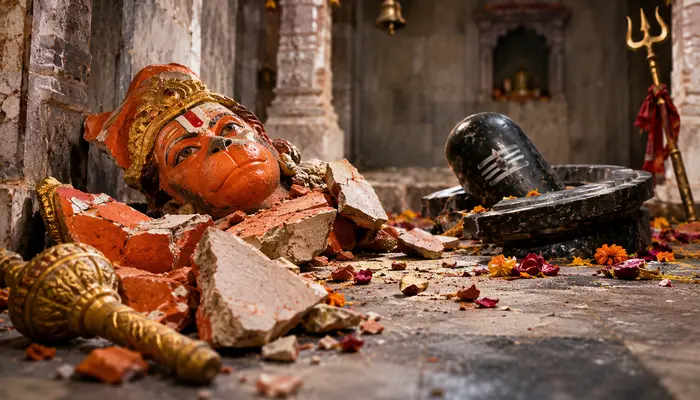
At Ganesh Ashram Temple in Chitrakoot, Uttar Pradesh, sacred idols of Hindu deities were desecrated by unidentified miscreants. The perpetrators broke an idol of Lord Hanuman into two pieces and also desecrated a Shivling by uprooting it from its position and throwing it onto the ground. This was the third such incident at the temple within a period of nine months. According to media reports, the temple is situated near Ramghat, close to the Moksh Dham (cremation ground), along the banks of the Mandakini River, in the Sitapur Police Outpost area. The incident came to light on 20 November 2026, when temple priest Ramkrishna Tripathi and Sabarmal Shastri arrived at the premises to perform their daily worship. They found the idol of Lord Hanuman shattered into two pieces and the Shivling lying on the ground. They immediately informed the police.  Subsequently, Kotwal Balram Singh and Sitapur Police Outpost In-charge Yaduvendra Singh reached the temple, inspected the premises and arranged to place both damaged religious objects to one side of the temple. Following the desecration, workers and office-bearers of the Vishwa Hindu Parishad (VHP) reached the temple at approximately 3 PM and expressed their anger over the incident. The delegation included VHP Department Organisation Minister Vikas, District President Rajendra Trivedi, District Minister Neeraj Kesharwani, Dharma Prasar Aayam Sant Sampark Chief Ramsharan, District Co-Minister Siddharth Pandey, District Treasurer Jamuna Agrawal, District Gau Raksha Chief Vimal Tripathi, City Organisation Minister Manoj and City Chief Shivank, who also held the position of City Gau Raksha Chief. Several other VHP office-bearers and workers were also present. The representatives inspected the temple premises and demanded the identification and arrest of those responsible for the desecration. Temple priest Ramkrishna Tripathi subsequently submitted a written complaint against unidentified persons at the Kotwali police station, seeking action against those responsible. VHP representatives also brought the incident to the attention of the government and the district administration, demanding strict action against the perpetrators and preventive measures to safeguard other temples across Chitrakoot district. VHP Department Organisation Minister Vikas stated that such incidents at religious places should not be allowed to recur and demanded that the administration identify and arrest those responsible. During the visit, VHP District Minister Neeraj Kesharwani stated that similar incidents had also occurred at different temples across Chitrakoot district. He announced that representatives of the organisation would visit temples throughout the district to gather information about such incidents. The organisation also urged the administration to strengthen security arrangements at Hindu religious sites to prevent further incidents. Responding to the incident, Kotwal Balram Singh stated that the police were searching for those responsible and that arrests would be made soon. He also stated that efforts would be undertaken to arrange for the installation of new idols at the temple.
Why it is Hate Crime ?
The primary category selected in this case is: Attack on Hindu religious representations. The subcategory selected is: Desecration of Hindu religious symbols. Icons and symbols or a religious representation of a spiritual ideal are widely revered in Hinduism. Iconography is of vital significance in the Hindu milieu. It helps connect people’s spiritual beliefs with the real world. Iconography within the Hindu faith takes several shapes and forms. Murtis are of most significance to Hindus, to which daily rituals, prayers and offerings are done. Besides the murtis, there are several other symbols which have deep significance in the Hindu faith – the Om and Swastika for example. Since these Hindu religious symbols hold paramount importance in Hinduism, any desecration of symbols, icons, murtis, religious representations and manifestations, is driven by animosity towards the faith itself which manifests itself through these murtis, icons and symbols. Therefore, any desecration of these Hindu religious symbols and representations is considered religiously motivated hate crimes under this category. The other subcategory selected in this case is: Attack on Temples. In Hinduism, a temple is the abode of the Deity. The Deity in the Temple is consecrated, thereby, making it a real, breathing entity. Hindus believe that not just the Deity but the temple premises itself are sacred to Hindus since Hindus hold the faith that the entire Temple space is an amalgamation of the divine energy of the deity. Given the central significance of Temples in Hindu Dharma, any attack against a Hindu Temple or its peripheral premises is an attack on the faith itself and is born out of animosity towards the faith, of which, the Temple is a central tenet. Any manner of attack against a Temple and/or its premises would therefore be considered a religiously motivated hate crime. This incident constitutes a clear example of a hate crime, as the perpetrators vandalised and desecrated sacred idols of Hindu deities inside a Hindu temple. The fact that this was the third such incident at the temple within a period of nine months demonstrates deep-seated hostility towards Hinduism and Hindu places of worship. Hindu temples hold immense religious and spiritual significance as sacred spaces dedicated to the worship of deities, prayer and religious observances. Idols installed in temples are revered as sacred representations of deities and serve as focal points of worship, devotion and prayer. Lord Hanuman is one of the most revered deities in Hinduism and is worshipped as the embodiment of strength, courage, devotion, loyalty and protection. His idols are held sacred by devotees, who offer prayers and seek his blessings and protection. Similarly, the Shivling is a sacred representation of Lord Shiva, symbolising his divine and infinite nature. It is worshipped with profound reverence through prayers, rituals and offerings by devotees. Therefore, the deliberate act of entering a Hindu temple and desecrating these sacred symbols, by breaking the idol of Lord Hanuman into two pieces and uprooting the Shivling from its position before throwing it onto the ground, demonstrates utter disregard for their religious significance and the sentiments of Hindu devotees. Targeting sacred objects of Hindu worship in this manner showcases hostility towards Hindu religious traditions, beliefs and the community that reveres them. It also demonstrates a mentality of contempt towards Hindu sentiments and a disregard for the sanctity of Hindu places of worship. The desecration of these sacred symbols therefore constitutes an act of religious hostility directed towards Hinduism and the Hindu community. Furthermore, the fact that this was the third such incident at the temple within nine months, as highlighted by the Vishwa Hindu Parishad (VHP) during the time of documentation, demonstrates a repeated pattern of targeting the same Hindu place of worship rather than an isolated occurrence. Repeated desecration of sacred idols undermines the sanctity of the temple and creates fear and insecurity among the local Hindu community. Devotees are left fearing for the safety of their temples, idols and religious practices, as repeated attacks demonstrate that their sacred places of worship remain vulnerable to desecration. Such incidents inflict emotional and religious distress on the community, whose faith and sentiments are directly affected by the repeated targeting of their sacred symbols and places of worship. Overall, although the identities of the perpetrators remained unknown at the time of documentation, the nature of their actions demonstrates hostility towards Hinduism and the Hindu community. The deliberate desecration of Hindu religious objects, coupled with the repeated targeting of the temple, establishes the religiously hostile nature of the incident. Therefore, this case is being documented in the hate crime database of the Hinduphobia Tracker.


Case Status
Complaint filed


Perpetrators Details
Perpetrators
Unknown
Perpetrators Range
Unknown
Perpetrators Gender
unknown
 Sources