Anti-Hindu hostility on display; social media account mocks sacred Hindu rituals and uses derogatory slurs against Brahmin community
 India
 21 November, 2026
Case Summary
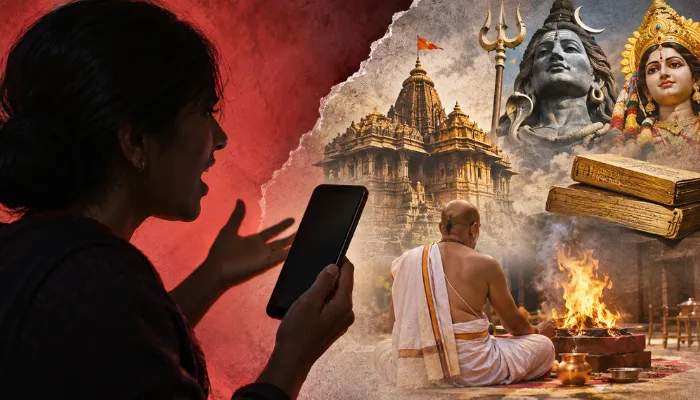
A social media account named Balbir Narwal repeatedly shared derogatory videos targeting Hindus belonging to the Brahmin community and denigrating Hindu religious customs, traditions and practices. The Hinduphobia Tracker team came across the account on social media and investigated its content. The team found that the account had 189 followers on Instagram and had shared several videos containing derogatory remarks against the Brahmin community, repeatedly using the religious slur “Ponga Pandit” and ridiculing Hindu customs and rituals. Three of these videos were particularly notable. In one video, the account shared a recording featuring a Hindu Katha Vachak (religious preacher) speaking about the religious significance of donating to Brahmins and showing them respect in accordance with Hindu customs. In response, a woman in the video referred to Brahmins as “Ponga Pandits” and mocked Hindu religious practices, particularly Yajna and Havan. She mockingly questioned how India could become prosperous and developed through the performance of such rituals. She further contrasted India with countries such as Japan and other foreign nations, questioning how they had achieved development without “Ponga Pandits” performing Yajnas and Havans. In another video, the account shared content featuring a social media influencer who used the term “Ponga Pandits” to ridicule Brahmin priests. The video showed an incident in which a few villagers offered obeisance to a Hindu priest and allowed him to walk over them as part of a local practice. The influencer used this incident to denigrate the entire Brahmin community and described Hindu religious customs as “pakhand” (superstition or religious hypocrisy). He further stated that if the “pakhand of Ponga Pandits” did not exist, India too would have become a “Vishwaguru”, thereby portraying Hindu religious traditions as an obstacle to India's progress and development. In a third video, the account shared an AI-generated clip depicting Brahmin priests as hostile towards Buddhism. The video showed them desecrating a Buddha idol and transforming its appearance to resemble the Hindu deity Shiva by placing snakes on it and applying Tripundra, the three horizontal ash markings traditionally associated with Lord Shiva, on its forehead. The clip portrayed the transformation of the Buddha idol into a Shiva idol as an act of desecration and presented the Hindu community as antagonistic towards Buddhism and other faiths. Apart from these three videos, the account had shared several other posts containing derogatory content directed at the Hindu community, its religious beliefs and practices.
Case Images

Why it is Hate Crime ?
This case is being added to the tracker under the primary category: Hate Speech against Hindus. The subcategory selected is: Anti-Hindu slurs, mocking faith. Anti-Hindu slurs and the deliberate mocking of the Hindu faith owing to religious animosity involve the usage of derogatory terms, stereotypes, or offensive references to religious practices, symbols, or figures. One of the common anti-Hindu slurs used against Hindus is “cow-worshipper” and “cow piss drinker”. The intention of using this term is to demean and mock Hindus as a group and their religious beliefs since Hindus consider the cow holy. Additionally, some symbols and the slurs attached to them have a historical context that exacerbates the insult, hate, stereotyping, dehumanisation and oppression against Hindus. Cow worship has been used for centuries to denigrate Hindus, insult their faith and oppress Hindus specifically as a religious group. There has been overwhelming documentation about how cow slaughter has been used to persecute Hindus with cow meat being thrown in temples and places of worship. There has also been overwhelming documentation where cow meat (beef) has been force-fed to Hindus to either forcefully convert them to Islam or denigrate their faith. Apart from cow worship, the Swastika – which holds deep religious significance for the Hindus – has also been misinterpreted and distorted to use as a slur against Hindus. Similarly, the worship of the Shivling has been used by supremacist ideologies and religions to denigrate Hindus owing to religious animosity. Such slurs and denigration stem out of inherent animosity and hate towards Hindus and their faith, therefore, it is categorised as hate speech targeted at Hindus specifically owing to their religious identity. This incident is a clear example of religiously driven hate speech, as the social media account shared several derogatory videos denigrating Hindu faith, customs, traditions and religious practices while repeatedly using derogatory slurs against Hindus belonging to the Brahmin community. The content went beyond criticism of individual practices and sought to ridicule Hindu religious traditions and demean a section of the Hindu community on the basis of its religious and cultural identity. Brahmin priests have historically occupied an important position in Hindu religious and spiritual life. They have served as custodians of sacred knowledge, Vedic traditions, religious learning and ritual practices, and have played a significant role in preserving and transmitting Hindu scriptures, philosophy and spiritual teachings across generations. Through the performance of Yajnas, Havans, Pujas, religious ceremonies and the teaching of sacred texts, they have contributed to the continuity of Hindu religious traditions and the preservation of Sanatan Dharma. They have also played an important role in guiding devotees in matters of religious observance and spiritual practice. Consequently, repeatedly ridiculing Brahmin priests through slurs such as “Ponga Pandit”, portraying them as dogmatic and deceitful, and blaming them for India's lack of development amounted to more than mockery of a particular section of society. It demonstrated hostility towards an important religious institution and one of the intellectual and spiritual pillars of Hindu civilisation. Such portrayals sought to vilify those associated with the preservation and practice of Hindu religious traditions and cast them in a deliberately derogatory light. It is important to recognise that hostility towards Brahmins, in such instances, cannot be viewed merely through the lens of caste-based prejudice, as it also stems from and contributes to anti-Hindu hostility. The repeated targeting of Hindus belonging to the Brahmin community serves as a means of creating divisions within Hindu society along caste lines, by portraying 'upper caste' Hindus as oppressors and 'lower caste' Hindus as victims of an inherently discriminatory religious system. Narratives of this nature are often presented as exposing caste-based oppression within Hindu society; however, when constructed through deliberate distortion and generalisation, they serve to discredit Hindu society and the faith itself by branding Sanatan Dharma as inherently oppressive and tyrannical. The underlying intention is to suggest that Hinduism is a faith meant only for a particular section of Hindus, while portraying other sections as systematically discriminated against by the religion itself. Such disinformation seeks to delegitimise the faith, dehumanise its followers and alienate sections of the Hindu community from their religious identity. Therefore, the repeated vilification of Brahmins through such narratives cannot be viewed in isolation from the broader attempt to denigrate Hinduism and create divisions within the Hindu community. Furthermore, the video mocking the religious significance of Vedic Yajnas and Havans performed by Brahmin priests also demonstrated hostility towards Hindu religious traditions. Vedic Yajnas and Havans hold profound significance in Hinduism and are among its ancient sacred rituals, rooted in the Vedas. They involve the offering of oblations into the sacred fire accompanied by the chanting of Vedic mantras and are performed as acts of worship, devotion, purification and spiritual observance. These rituals are deeply embedded in Hindu religious practice and have been observed for centuries as an expression of reverence towards the divine. Mocking these sacred practices and questioning their relevance by contrasting them with the economic and technological development of foreign nations amounted to denigrating an integral aspect of Hindu religious life. Portraying Vedic rituals as irrational or as an impediment to India's progress and development also sought to undermine the religious beliefs of Hindus and ridicule the traditions through which they express their faith. Such remarks went beyond ordinary criticism and demonstrated hostility towards Hinduism and its religious practices. Furthermore, another social media influencer denigrated Hindu religious traditions by describing them as “pakhand” (superstition or religious hypocrisy) and stating that if the “pakhand of Ponga Pandits” did not exist, India too would have become a “Vishwaguru” (a global leader or teacher). This statement ridiculed the religious practices and customs associated with Brahmin priests, dismissing their participation in Hindu rituals and religious observances as superstition and hypocrisy. Brahmin priests have traditionally played an important role in conducting temple ceremonies, performing religious rituals and preserving sacred traditions. Dismissing these activities as superstition and suggesting that their absence would have enabled India's progress amounted to disparaging Hindu religious practices and those who uphold them. By portraying Hindu religious observances as superstitious practices and an obstacle to national development, the influencer sought to discredit Hindu customs and undermine their religious significance. Such characterisation demonstrated deep-seated hostility towards Hinduism, its religious traditions and the community that practises and preserves them. Considering all these details, the incident met the parameters of religiously motivated hate speech. Although the derogatory statements and remarks featured in the videos were made by individuals whose content was shared by the account, the repeated decision to circulate such material through its own social media handle demonstrated an endorsement of, or agreement with, the content being disseminated. By repeatedly sharing videos that ridiculed Hindu religious customs, denigrated Brahmin priests through religious slurs and portrayed Hindu traditions as regressive and detrimental to India's development, the account amplified content that demonstrated hostility towards Hinduism and the Hindu community, particularly the Brahmin community. The repeated dissemination of such material reflected a pattern of religious denigration rather than an isolated instance of criticism. Therefore, this case was included in the Hinduphobia Tracker's hate crime database. Disclaimer: The Hinduphobia Tracker records incident dates based on when the act occurred rather than when it was reported in the media. In this case, the social media account had repeatedly shared anti-Hindu content. Of the three documented instances, the earliest was dated 22 November 2026. This date has therefore been selected as the indicative incident date for documentation purposes only.


Case Status
Unknown


Perpetrators Details
Perpetrators
Others
Perpetrators Range
One Person
Perpetrators Gender
unknown
 Sources