Land belonging to two Hindu temples illegally occupied by encroachers in Chandauli, Uttar Pradesh
 Chandauli District, Uttar Pradesh, India
 22 November, 2026
Case Summary
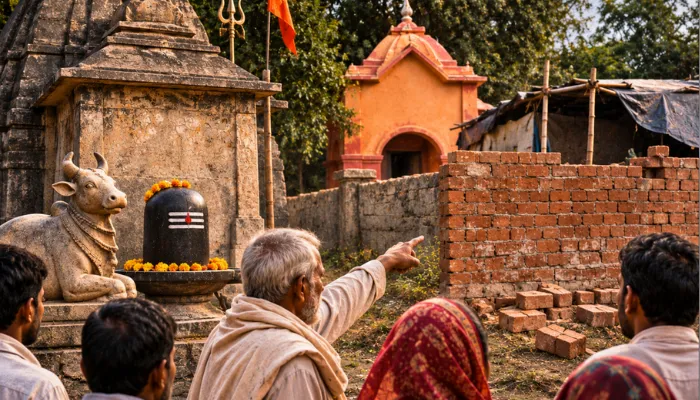
In Mainpur village of Chandauli district, Uttar Pradesh, land belonging to Tarkeshwar Mahadev Temple and Maa Mundeshwari Temple was targeted for encroachment. Portions of the temple complexes had been illegally occupied by some miscreants, while attempts were being made to encroach upon the remaining land. According to media reports, the matter came to light when Hindu villagers raised concerns over the encroachment, stating that the temple properties were religiously significant to the local Hindu community and demanding administrative intervention to protect the land belonging to the two temples. The villagers had already submitted a complaint to officials at Chakia tehsil regarding the occupation of the temple property. On 23 November 2026, a delegation of Hindu villagers comprising Gagan Raj Singh, Shripal Singh, Chandrabhan Singh, Rajesh Singh, Udaynath Singh and Raj Singh met District Magistrate Shailesh Kumar at the Collectorate and demanded an investigation into the encroachment. During the meeting, they stated that the revenue inspector and regional accountant were misleading officials by submitting false reports concerning the temple land. They demanded that a competent officer inspect the temple properties, investigate the matter and ensure that the remaining land was protected from further encroachment. Following their complaint, District Magistrate Shailesh Kumar directed the Sub-Divisional Magistrate (SDM) of Chakia to visit the site along with a team from the Revenue Department and conduct an investigation. He assured the villagers that action would be taken against those found guilty. The intervention followed the Hindu villagers' demand for administrative action to investigate the illegal occupation of temple land, hold those responsible accountable and safeguard the remaining property belonging to the two Hindu temples.
Why it is Hate Crime ?
In this incident, the land belonging to two Hindu temples, Tarkeshwar Mahadev Temple and Maa Mundeshwari Temple, was illegally occupied by encroachers. This raises questions about whether the act was motivated by religious animosity or hostility towards Hinduism and Hindu places of worship. Hindu temples hold immense religious and spiritual significance for the Hindu community. They are sacred spaces where devotees worship their deities, offer prayers, perform religious rituals, observe traditional practices and celebrate festivals. The religious sanctity of a Hindu temple is not confined to its physical structure but extends to the land and premises associated with it. Temple land is an integral part of the sacred space revered by Hindu devotees, where religious activities are conducted, and devotees gather to practise their faith. Therefore, the illegal occupation of land belonging to Hindu temples not only violates the sanctity of these sacred spaces but also hurts the religious sentiments of the Hindu community. Such encroachments can obstruct the functioning of temples, restrict devotees' access to sacred spaces and interfere with the performance of religious rituals, ceremonies and festivals. There have also been several instances of Hindu temple lands being illegally occupied amid deep-rooted hostility towards Hinduism and Hindu places of worship. Against this backdrop, the encroachment upon land belonging to the two Hindu temples in this incident raises serious suspicions about whether the act was rooted in religious hostility. At the same time, it is equally plausible that the encroachment was not motivated by religious animosity but was an opportunistic attempt to occupy temple property for financial gain or other non-religious interests. The available information does not establish that the encroachers acted out of hatred towards Hinduism or Hindu places of worship. Therefore, although the illegal occupation of land belonging to the two Hindu temples raises suspicions of a possible religious motive, it cannot be established beyond reasonable doubt that the act was driven by religious hatred. In the absence of conclusive evidence establishing such a motive, this case is being categorised under the Undecided database of the Hinduphobia Tracker. If any further information emerges demonstrating that the encroachment was rooted in hostility towards Hinduism or Hindu places of worship, the case will be reassessed and moved to the Hate Crime database of the Hinduphobia Tracker. Disclaimer: Hinduphobia Tracker records incident dates based on when the crime occurred rather than when it was reported in the media. In this case, the media reported the incident on 23 November 2026. Hence, 23 November 2026 is being selected as the indicative incident date for documentation purposes only.


Case Status
Complaint registered


Perpetrators Details
Perpetrators
Unknown
Perpetrators Range
Unknown
Perpetrators Gender
unknown
 Sources





