Hindu Dalit youths assaulted by Muslim men for bursting Diwali crackers in a Muslim-majority village; victims also subjected to casteist and communal slurs
 Banas Kantha, Gujarat, India
 7 November, 2026
Case Summary
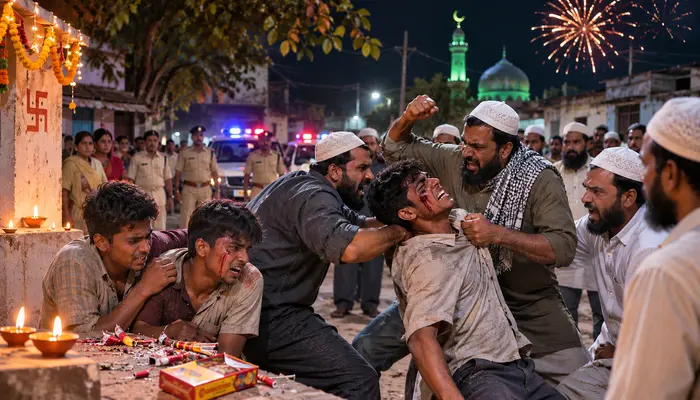
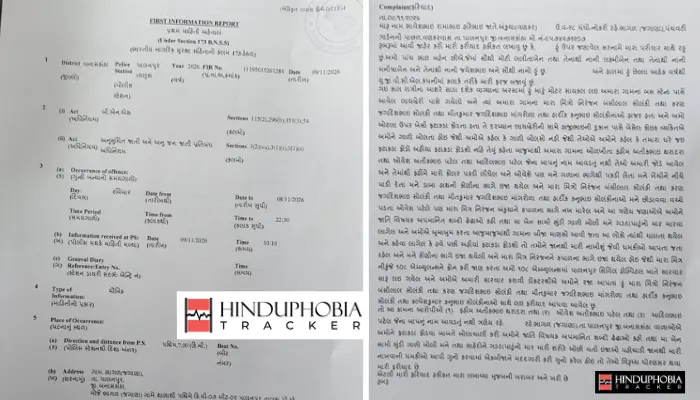
In the Muslim-majority village of Bhagal, located in Palanpur taluka of Banaskantha district, Gujarat, Hindu Dalit youths were assaulted by Muslim men during Diwali celebrations after they burst firecrackers in an open public square. The youths were subjected to casteist abuses and insults targeting their Hindu religious identity before being physically attacked. Notably, the Hinduphobia Tracker team managed to obtain a copy of the First Information Report (FIR) registered in connection with the incident at Palanpur Taluka Police Station on 9 November 2026. The complaint was filed by a 28-year-old Hindu Dalit man identified as Bhaveshbhai Ramabhai, who worked as a clerk with the Uttar Gujarat Vij Company Limited (UGVCL). The FIR named three accused persons: Faheem Atikbhai Dharadra, Owais Atikbhai Patel and Adilbhai Patel, alias Anush Patel. The FIR also named five Hindu victims: the complainant, Bhaveshbhai Ramabhai, and his four companions, Niranjan Bansilal Solanki, Karan Jagdishbhai Solanki, Mitkumar Jagdishbhai Mangrolia and Hardik Kanubhai Solanki. The complaint was registered under Sections 115(2), 296(b), 351(3) and 54 of the Bharatiya Nyaya Sanhita (BNS), along with Sections 3(2)(va), 3(1)(r) and 3(1)(s) of the Scheduled Castes and Scheduled Tribes (Prevention of Atrocities) Act. According to the FIR and media reports, the incident took place on 8 November 2026, at around 10:00 pm, when Hindu youths were bursting firecrackers in an open public space near the village bus stand and library. The complainant was accompanied by his four friends, Niranjan Bansilal Solanki, Karan Jagdishbhai Solanki, Mitkumar Jagdishbhai Mangrolia and Hardik Kanubhai Solanki. During the celebrations, some Muslim men sitting near a tailor's shop objected to the bursting of firecrackers and told the Hindu youths that if they wanted to burst crackers, they should do so at their homes instead of in the public space. The youths responded that the location was a public space and that they had the same right to celebrate Diwali as Muslims had to celebrate Eid. The disagreement soon escalated when the Muslim men began hurling casteist abuses and insults targeting the Hindu religious identity of the youths. According to the FIR, Faheem Atikbhai Dharadra, Owais Atikbhai Patel and Adilbhai Patel, alias Anush Patel, caught hold of the complainant by his collar, dragged him down and assaulted him. Owais also caught hold of him from behind. When his friends intervened to rescue him, they too were assaulted. The complainant specifically stated that Owais caught hold of his friend Niranjan by the collar and punched him. The accused also subjected the youths to caste-based insults, used obscene language and assaulted them with punches and kicks, causing injuries to the complainant and his companions. The complainant sustained injuries around his face and cheek, while Niranjan also sustained injuries to his face. The accused further threatened the Hindu youths that they would be beaten and harmed if they burst firecrackers again. The FIR also recorded that the accused acted together and assisted one another in committing the offence. According to the complainant, an ambulance was called at approximately 10:08 pm, following which the injured youths were taken to Palanpur Civil Hospital for medical treatment. The complaint was subsequently registered at Palanpur Taluka Police Station, and the police arrested the accused in connection with the incident. Videos of the altercation also surfaced following the incident. An exclusive ground report by OpIndia Gujarati, published on 21 November 2026, brought forward further details about the assault and the sustained intimidation faced by Hindu residents. The reporter visited Bhagal village and spoke directly to the victims, who described a prolonged atmosphere of pressure and intimidation against the Hindu community. During the ground report, the victim stated that the incident was not an isolated dispute over bursting firecrackers but part of a recurring pattern of pressure on Hindu residents, particularly during weddings and religious festivals. He explained that Hindu families repeatedly faced objections to bursting firecrackers and were told not to speak openly in front of members of the Muslim community. The victim attributed this atmosphere of intimidation to the numerical majority of Muslims in the village. The victim further stated that the intimidation continued even after the police registered the complaint. On the following day, when Hindu residents gathered to burst firecrackers in the presence of police personnel deployed in the village, some miscreants switched off the lights in the area and prepared to create a disturbance and attack them. He stated that the presence of a police convoy prevented the assault from taking place. He also stated that Hindu residents continued to face threats and pressure, including threats of being implicated in false criminal cases. The victims also expressed dissatisfaction with the response of their elected representative, Jignesh Mevani, the Congress Member of the Legislative Assembly (MLA) from the Vadgam Assembly constituency. They stated that despite the incident being reported in the media, the MLA had neither visited them nor taken any concrete action concerning the assault on Dalit Hindu youths in his constituency. They questioned his silence despite his public advocacy of Dalit rights and social justice. Notably, in July 2026, the Gujarat Anti-Terrorist Squad (ATS) arrested eight suspected terrorists associated with the Jaish-e-Mohammed (JeM) terrorist organisation from different parts of Gujarat, three of whom were apprehended from Bhagal village.
Case Images
Why it is Hate Crime ?
This case has been added to the tracker under the primary category of: Attack not resulting in death. Within it, the selected subcategory is: Attacked for Hindu identity. In several cases, Hindus are attacked merely for their Hindu identity without any perceived provocation. A classic example of this category of religiously motivated hate crime is a murder in 2016. 7 ISIS terrorists were convicted for shooting a school principal in Kanpur because they got ‘triggered’ seeing the Kalava on his wrist and the tilak that he had put. In this case, the Hindu victim had offered no provocation except for his Hindu religious identity. The motivation for the murder was purely religious, driven by religious supremacy. Such cases where Hindus are targeted merely for their religious identity would be documented as a hate crime under this category. The other sub-category selected in the case is: Attacked for crossing a 'Muslim area' One of the reasons that Hindus get attacked unprovoked specifically by Islamists is for crossing ‘Muslim areas’. Essentially, Muslim mobs often attack Hindus crossing or present in certain areas which have a majority Muslim population. It has often been cited as one of the reasons to blame Hindus for attacks against themselves, signalling that Hindus displaying religious symbols, taking our religious processions, or crossing any area which Muslim residents dominate is a provocation in and of itself. These areas are mostly ghettoized areas where mobs mobilize quickly to attack Hindus for a variety of reasons,s like playing music during a religious procession, crossing a mosque, wearing a tilak or any other religious symbol in a Muslim-dominated area, praying at a local temple in that area, ea etc. There have been cases where the few local Hindus of that area have been attacked on their way to the Temple for prayers as well, simply because the area is considered a Muslim-dominated area. Several times, it is entirely possible that the immediate trigger for the violence against Hindus was non-religious in nature; re, however, the violence became religiously motivated in nature because the area was Muslim-dominated and the residents, on the whole, harboured animosity towards Hindus, as evidenced by the actions of the mob, the slogans, and the nature of the attack. Such crimes are motivated by the religious identity of the victims and are therefore classified as hate crimes under this category. The other primary category selected for the case is: Hate Speech against Hindus. The subcategory selected under it is: Anti-Hindu slurs, mocking faith. Anti-Hindu slurs and the deliberate mocking of the Hindu faith owing to religious animosity involve the usage of derogatory terms, stereotypes, or offensive references to religious practices, symbols, or figures. One of the common anti-Hindu slurs used against Hindus is “cow-worshipper” and “cow piss drinker”. The intention of using these terms is to demean and mock Hindus as a group and their religious beliefs, since Hindus consider the cow holy. Additionally, some symbols and the slurs attached to them have a historical context that exacerbates the insult, hate, stereotyping, dehumanisation, and oppression against Hindus. Cow worship has been used for centuries to denigrate Hindus, insult their faith,h and oppress Hindus specifically as a religious group. There has been overwhelming documentation about how cow slaughter has been used to persecute Hindus, with cow meat being thrown in temples and places of worship. There has also been overwhelming documentation that cow meat (beef) has been force-fed to Hindus to either forcefully convert them to Islam or denigrate their faith. Apart from cow worship, the Swastika – which holds deep religious significance for the Hindus – has also been misinterpreted and distorted to be used as a slur against Hindus. Similarly, the worship of the Shivling has been used by supremacist ideologies and religions to denigrate Hindus owing to religious animosity. Such slurs and denigration stem out of inherent animosity and hate towards Hindus and their faith, therefore, it is categorised as hate speech targeted at Hindus specifically owing to their religious identity. This incident is a clear example of a religiously driven hate crime, as Hindu Dalit youths were brutally assaulted and subjected to casteist abuses and communal remarks by Muslim perpetrators for merely celebrating Diwali by bursting firecrackers in a public space. The assault and religiously motivated abuses directed at the victims for celebrating their festival demonstrated hostility towards Hindus for practising their faith, making this an instance of a religiously driven hate crime. Diwali is one of the most important festivals in Hinduism, celebrating the triumph of light over darkness, good over evil, and the return of Bhagwan Ram to Ayodhya following his exile and victory over Ravana. Lighting lamps, decorating homes, performing Lakshmi Puja and bursting firecrackers are traditional ways in which Hindus celebrate the festival. Bursting firecrackers is an integral part of Diwali celebrations, symbolising joy, festivity and the celebration of the victory of righteousness. It is an established religious and cultural expression through which Hindu families and communities participate in the festivities. The Muslim perpetrators first attempted to restrict the Hindu youths from celebrating Diwali in the public square by telling them to burst firecrackers inside their homes instead. However, a public space is meant to be shared by people of all religious communities, and every community has the right to celebrate its festivals in such spaces without intimidation or interference. The Hindu victims stated that Muslims celebrated Eid at the same location without facing any objections. Why, then, should Hindus be expected to confine their Diwali celebrations to their private homes? The demand that Hindu youths restrict their religious celebrations to their homes, despite having the same right to use the public square, demonstrated religious exclusion and an attitude of entitlement over shared public spaces. It reflected an attempt to deny Hindus the freedom to express their religious identity publicly and expected them to accommodate the objections of the Muslim community. Such discriminatory restrictions demonstrated religious animosity towards Hindu practices and celebrations. Furthermore, the physical assault on Hindu youths for merely bursting firecrackers during Diwali demonstrated the religious hostility driving the offence. Attacking members of a religious community for participating in the customary celebrations of their festival goes beyond an ordinary disagreement and reflects deep-seated hostility towards their religious identity and practices. The violence served not only to punish the victims for celebrating Diwali but also to create fear among the wider Hindu community, conveying the message that they could not freely celebrate their religious festivals in public without risking intimidation or physical harm. Such acts of violence create an atmosphere in which Hindus are discouraged from openly practising their traditions and are pressured into limiting the public expression of their faith. The victims were also subjected to anti-Hindu communal slurs and caste-based abuses by the Muslim perpetrators while the assault was being carried out. The fact that anti-Hindu communal slurs were hurled while Hindu youths were being attacked leaves no room for doubt that hostility towards their Hindu identity was a motivating factor behind the violence. Hurling communal slurs during an assault not only demonstrates that the attack was religiously motivated but also showcases the perpetrators' deep-rooted hatred towards Hinduism and Hindus. Such remarks, directed at the victims while they were being physically attacked for celebrating their religious festival, further hurt their Hindu religious sentiments, making this a clear instance of a religiously driven hate crime. In regard to the casteist slurs, it can be argued by some people that a caste-specific slur is aimed at the victims' micro-identity of belonging to the Dalit section of the Hindu community and not their Hindu identity itself. However, as far as Abrahamic religions are concerned, the micro-identities of caste, region and language are secondary. It is the religious identity that drives the animosity of the perpetrator against the Hindu victim. In this case, while the Muslim perpetrators hurled caste-based abuses at the Hindu Dalit youths, the animosity was driven by their hostility towards Hinduism and Hindus. While the immediate trigger for the violence was the bursting of firecrackers during Diwali, the fact that casteist slurs were hurled at the victims by the perpetrators, alongside anti-Hindu communal remarks, further demonstrated the religious hostility underlying the attack and established it as a religiously motivated hate crime against the victims. The fact that the incident occurred in a Muslim-majority village further demonstrated the deep-rooted religious hostility underlying the attack. It is crucial to note that Muslims often consider areas near mosques, dargahs, or places where their community is in the majority as "Muslim areas". This reveals a disturbing sense of Islamic supremacy among the perpetrators, who viewed the public square in the village as an exclusive zone where non-Muslims, particularly Hindus, were unwelcome. This sense of entitlement and superiority reflects deep-seated prejudice and an attempt to assert religious dominance over public spaces. The assault on the Hindu victims for bursting firecrackers during Diwali was motivated by this Islamic supremacist ideology, with the Muslim perpetrators seeking to assert control over who could celebrate their festivals and exercise their religious freedoms in 'their area'. Such an act illustrates a dangerous mindset rooted in exclusion, intolerance and religious animosity, making this case a clear example of a crime motivated by religious hostility. The Hindu victims further revealed that the incident was not an isolated occurrence, as they had repeatedly faced intimidation and restrictions from members of the Muslim community in the village. They stated that, because Muslims formed the majority in the village, they were repeatedly asked not to burst firecrackers or engage in celebrations during weddings and festivals. They also described being intimidated and told not to speak openly in front of Muslims. This repeated targeting demonstrated how Hindu residents were being subjected to territorial control and religious dominance simply because they were a minority in the village. The expectation that Hindus should restrict their celebrations and limit their public expression of faith to accommodate the objections of the Muslim majority reflected deep-seated religious hostility towards the Hindu community. This wider pattern of intimidation and exclusion further demonstrated the religious hostility underlying the assault, making it a clear case of a religiously driven hate crime. Overall, the details of the incident demonstrated the perpetrators' deep-rooted hatred and intolerance towards Hinduism, the Hindu community and Hindu religious celebrations. Therefore, the case was added to the Hinduphobia Tracker's hate crime database.
Victim Details
Total Victim
5
Deceased
0
Gender
- Male 5
- Female 0
- Third Gender 0
- Unknown 0
Caste
- SC/ST 5
- OBC 0
- General 0
- Unknown 0
Age Group
- Minor 0
- Adult 5
- Senior Citizen 0
- Unknown 0


Case Status
Arrested

Perpetrators Details
Perpetrators
Muslim Extremists
Perpetrators Range
From 2 To 5
Perpetrators Gender
male
 Sources