Hindu neighbours targeted by Muslim man who raises pro-Pakistan, pro-terrorist and anti-India slogans in Faridabad, Haryana
 Faridabad, Haryana, India
 21 November, 2026
Case Summary
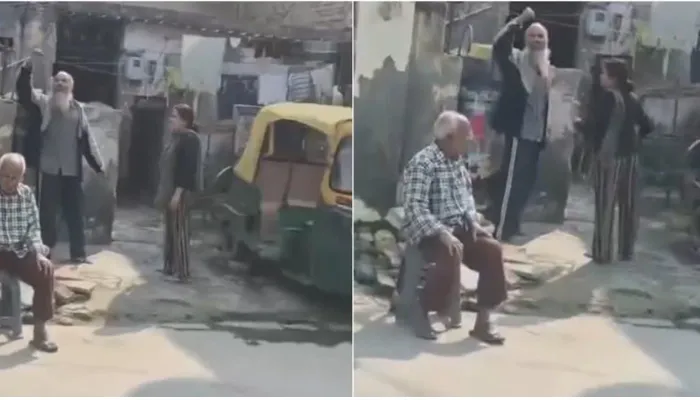
In Faridabad, Haryana, a Muslim man, Sunni Khan, raised slogans in support of Pakistan, the ISI, Al-Qaeda and terrorist Hafiz Saeed during a dispute outside the Senior Citizen Club. He also raised anti-India slogans, including “Hindustan Murdabad”, and challenged people present at the spot to record him, stating that no one could harm him. A person at the scene recorded a video of the incident, which later circulated on social media. The incident took place at around 12:50 pm on Sunday, November 22, 2026, during a dispute over pipe installation work outside the Senior Citizen Club. Charan Singh Yadav, the club's General Secretary, was carrying out the work with his associates Ramesh Nagar, Indresh Sharma, Govind, DP Sharma, Khyali Ram, and Sahab Singh when Sunni Khan arrived and began abusing them. When the dispute escalated, he threatened to assault them and started raising slogans. In the video, he is heard repeatedly shouting “Pakistan Zindabad”, “ISI Zindabad”, “Al-Qaeda Zindabad” and “Hafiz Saeed Zindabad”, along with anti-India remarks. Following the incident, Charan Singh Yadav submitted a complaint to the Sector-3 police outpost. Based on the complaint and the video, police registered a case under provisions relating to promoting enmity between communities and disturbing communal harmony and arrested Sunni Khan on Sunday night. Police produced him before a court on Monday, November 23, and sent him to judicial custody. Police subsequently searched Sunni Khan’s residence and recovered a world map. Police found no other suspicious material during the search. Police also examined whether he had any connection with Pakistan. The preliminary investigation found no Pakistan connection, and he did not possess a passport. Police began examining his and his family’s bank accounts and questioning his family members as part of the investigation. The dispute that preceded the sloganeering stemmed from work being carried out outside the Senior Citizen Club. Another account stated that Sunni Khan’s family frequently parked vehicles in front of the club, which had previously led to objections from elderly people using the premises. During the November 22 dispute, the disagreement escalated, and Sunni Khan began raising pro-Pakistan and pro-terrorist slogans. Residents also described him as someone who frequently misbehaved and suddenly became agitated. Sunni Khan, originally from Kangra district in Himachal Pradesh, had lived in Sector-3, Ballabhgarh, for several decades. He remained unmarried and lived with his father and sister; one account also mentioned a brother. Sunni Khan was originally born into a Hindu family and was named Anoj Kumar. He had converted to Islam and adopted the name Sunni Khan. He was the only member of his family who changed his religion. After his conversion, he kept a long beard, offered namaz and visited mosques, madrasas and Islamic religious gatherings. His father, Brijlal, was a retired government employee associated with the District Town Planner department, while his mother had died around four years earlier. Sunni Khan held an MA degree and worked as an auto-rickshaw driver. Neighbours and persons associated with the Hindu Jagran Manch said that he had been practising Islam for around 15 years and had previously made derogatory remarks about Hindus. Reports also said he changed his name to Sunni Khan before coming to Faridabad from Himachal Pradesh. Police spokesperson Yashpal, however, said the police had no information about his religious conversion and that the investigation was examining all aspects of the case. The case remained under investigation, with police examining the circumstances of the confrontation, Sunni Khan’s background, his financial accounts and family members, and whether there was any connection with Pakistan or other organisations. He remained in judicial custody following his production before the court.
Why it is Hate Crime ?
The primary category here for this case is "Hate speech against Hindus". The sub-category for this case is "Violent threats". Violent threats, explicit, implicit or implied, is the most dangerous form of hate speech since it goes beyond discriminatory and prejudicial language to express the intent of causing harm to an individual or a group of people based on their religious identity and faith. There could be several different kinds of threats that are issued to Hindus based on religious animosity. An explicit threat would mean the direct threat of violence towards an individual Hindu, a group of Hindus or Hindus at large. Physical violence, death threats, threats of destruction of property belonging to Hindus and threats of genocide would mean explicit threats against Hindus for their religious identity. Implicit threats may not be a direct threat but implied through the use of symbols of actions – for example – in the Nupur Sharma case, other than explicit threats, there were also implicit threats when Islamists took to the streets to burn and beat her effigies. It implies that they want to do the same to Nupur Sharma – thereby is considered an implicit threat. Violent threats can be delivered in person, through letters, phone calls, graffiti, or increasingly through social media and other online platforms. It would be important to understand that a threat – explicit or implicit, online or offline – to an individual who happens to be a Hindu does not qualify as a religiously motivated threat. Such a threat, while vile and dangerous, could be owing to non-religious reasons and/or personal animosity. To qualify as a religiously motivated threat, it would need to exhibit an indication that the individual is being targeted for religious reasons and/or owing to his/her religious identity as a Hindu. Here, a Muslim man raised slogans supporting Pakistan, the ISI, Al-Qaeda and Hafiz Saeed, along with “Hindustan Murdabad”, during a confrontation involving Hindu neighbours. He raised the slogans openly in their presence, accompanied by aggressive and threatening conduct, turning the confrontation into an intimidating display directed at those around him. The slogans' significance lay in their combination. “Pakistan Zindabad” and “Hindustan Murdabad” expressed hostility towards India, while the simultaneous praise of the ISI, Al-Qaeda and Hafiz Saeed invoked organisations and individuals associated with Islamist militancy and terrorism. Al-Qaeda in particular represents an extremist Islamist organisation whose ideology and activities have involved violence against civilians, while Hafiz Saeed is associated with Lashkar-e-Taiba and terrorism. Bringing such references into a confrontation with Hindu neighbours gave the slogans a threatening character beyond an ordinary political disagreement. It may be said that these slogans can be considered anti-India and pro-Pakistan, but not anti-Hindu. However, raising slogans such as Pakistan Zindabad not only shows pro-Pakistan sentiments, but also anti-Hindu sentiments. It is pertinent to note that Muslim extremists harbour specific animosity towards Hindus and their faith and also view India as a Hindu collectivity. The very basis of the partition of India was that the Muslims believed that Islam was a nation unto itself, which could not survive with a Hindu collectivity like India. Further, this would also mean that the slogan Pakistan Zindabad is about hailing a Muslim collectivity and an expression of transnational loyalty and anti-Hindu sentiments. For that reason, any slogan which expresses transnational loyalty and faith in the Ummah is automatically a slogan against Hindus and the Hindu collectivity. Sunni Khan had converted to Islam and adopted Islamic religious practices, including offering namaz and participating in mosque and Islamic religious gatherings. In this context, his simultaneous praise of Pakistan, the ISI and Islamist extremist figures, coupled with “Hindustan Murdabad”, reflected an ideological identification extending beyond the territorial and civic identity of India. The significance was not merely that he expressed support for another country; he invoked a foreign Muslim state, its intelligence establishment and Islamist terrorist figures together while denigrating India. This combination reflected a transnational conception of identity in which affinity with a wider Muslim collectivity could be expressed through hostility towards the Indian national identity and, by extension, the Hindu collectivity. This transnational orientation acquired a direct threatening dimension because the expressions were made during a confrontation with Hindu neighbours rather than in an abstract political discussion. In this setting, such expressions revealed his profound animosity toward Hindus, which is why this incident deserves to be included in the tracker.
Victim Details
Total Victim
6
Deceased
0
Gender
- Male 6
- Female 0
- Third Gender 0
- Unknown 0
Caste
- SC/ST 0
- OBC 0
- General 0
- Unknown 6
Age Group
- Minor 0
- Adult 0
- Senior Citizen 6
- Unknown 0


Case Status
Case sub-judice


Perpetrators Details
Perpetrators
Muslim Extremists
Perpetrators Range
One Person
Perpetrators Gender
male
 Sources





