Hindu woman pressured to convert to Islam after being sexually exploited and impregnated under false promise of marriage; threatened with death for refusing conversion
 Sonbhadra, Uttar Pradesh, India
 22 November, 2026
Case Summary
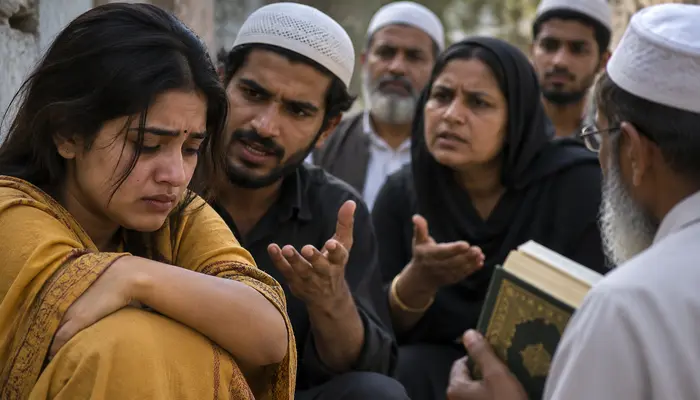
In Anpara, Sonbhadra district, Uttar Pradesh, a Hindu woman was pressured to convert to Islam and marry a Muslim man after being sexually exploited and impregnated on the false promise of marriage. The man’s brother, sisters and a relative pressured her to abandon her religion and threatened to kill her if she refused to convert. She was also pressured to accept Islam during visits to the man in jail, and the family members discussed taking her to a Maulvi (Muslim cleric) for religious conversion. The woman resided in the Shaktinagar Police Station area, while the man, identified as Salim Qureshi, was a resident of Renusagar, Anpara. Over several months, Salim Qureshi had established a physical relationship with her on the promise of marriage, resulting in her pregnancy. After learning about the matter, the woman's mother lodged a complaint against him at Anpara Police Station. Salim Qureshi was subsequently arrested in connection with the case and remained in jail. After Salim Qureshi's arrest, four of his family members and relatives repeatedly contacted the woman, purportedly to coerce her to convert. They were identified as his brother, Kalim Qureshi, his sisters, Rizwana and Afreen, and his relative, Nurul Afreen, associated with the Noorul Afreen locality. They pressured her to convert to Islam and marry Salim. The woman also visited Salim several times in jail, where he continued to pressure her to convert and marry him. She was also told that she would be taken to a Maulvi for conversion. However, she made it clear that she did not wish to change her religion. On 23 November 2026, the woman submitted a written complaint at Anpara Police Station, detailing the pressure to convert and the threats to her life. That night, the police registered a case against the four named individuals under the Uttar Pradesh Prohibition of Unlawful Conversion of Religion Act and other relevant legal provisions. Anpara Police Station House Officer Rajesh Chaubey confirmed that the police registered the case based on her complaint and said an investigation was underway.
Why it is Hate Crime ?
The primary category selected in this case is: Crimes against women in relationships and other sexual crimes. Within this, the subcategory selected is: Forced conversion before marriage. In such cases, a non-Hindu man is in a relationship with a Hindu woman when the pressure to convert her religion begins to manifest. In such cases, typically, two patterns emerge. First, when the relationship is consensual, and the religious identity of the perpetrator is known to the Hindu woman in the relationship, however, at some point during the relationship, the non-Hindu man starts to force the victim to convert her religion and give up her Hindu religious identity. The second is when the woman gets into a marriage with the man pretending to share her faith. Later, when the truth is revealed, the man starts pressuring the woman to convert her religion and give up her religious identity. In both the situations, the methods used to force the victim to convert her religion often revolve around force-feeding beef, forcing her to wear hijab, forcing her to read the Kalma or even pressurizing the victim to do ‘Nikah’, which is marriage under Islamic law, with a prerequisite being conversion to Islam. Cases where a Hindu woman consensually converts to Islam in a relationship will be left out of the hate crime database, even though it could be argued in several cases that the conversion was a result of religious brainwashing. The other subcategory selected is: Assault or threat upon refusal to convert. When Hindu women are in a relationship with non-Hindu men, there are cases where the woman faces threats or assault after she refuses to convert and change her religious identity owing to pressure/force by the non-Hindu man. Such relationships may be consensual with the religious identity of the non-Hindu man known to the victim. Somewhere along the relationship, the non-Hindu man starts pressurizing the Hindu woman to convert to Islam and upon her refusal, assaults or threatens the victim. Such cases are driven by specific religious motivations and against the religious identity of the victim and are therefore qualified as hate crimes. Cases where the Hindu woman converts to Islam and does not file a complaint about the force or threat, are not considered a part of the hate tracker, even though, it may be argued that the woman was brainwashed or threatened to convert to Islam. This case qualified as a religiously motivated hate crime because the relationship was used as a means to subject a Hindu woman to pressure to abandon her faith and convert to Islam. The Hindu woman was sexually exploited and impregnated under a false promise of marriage, after which she was pressured to convert. The religious element extended beyond the relationship itself, as the accused, Salim Qureshi, continued to pressure her to convert and marry him even after his arrest, while his brother, sisters and a relative also repeatedly contacted her to coerce her to accept Islam. The pressure was accompanied by threats to kill her if she refused to convert. The attempt to make her abandon her Hindu religious identity and adopt Islam therefore formed a central part of the coercion exercised over her. In this instance, the Muslim accused did not hide his identity. In such cases, the woman is likely made to believe that her faith would not stand in the way of their relationship. Here too, taking the accused’s word for it, the Hindu woman entered into a romantic relationship with the Muslim man. Taking advantage of this trust, the Muslim perpetrator sexually exploited her. Gradually, the true intentions of the perpetrator became clear to the victim when he started forcing her to convert to Islam. The repeated sexual exploitation further aggravated the religious coercion. The accused established a physical relationship with the woman on the false promise of marriage, resulting in her pregnancy. Subsequently, she was subjected to pressure to convert to Islam. This meant that the sexual abuse and the religious pressure were not operating in completely separate spheres; both arose within the same relationship of control and manipulation. Her refusal to comply with the accused’s demands was followed by increasingly aggressive behaviour, demonstrating the coercive nature of the relationship. The repeated pressure to abandon Hinduism was central to the religious coercion faced by the woman. Salim Qureshi, along with his family members and relatives, repeatedly pressured her to give up her faith and convert to Islam. Their continued attempts directly targeted her Hindu religious identity and sought to make her abandon the religion she wished to follow. Instead of respecting her choice to remain Hindu, they kept pressing her to embrace Islam. Even her refusal to change her religion did not stop these efforts, and she continued to face pressure to give up her faith. This amounted to a direct attack on her religious freedom and her right to retain her Hindu identity. The demand for conversion as a condition of marriage further intensified the pressure on the Hindu woman. Making conversion to Islam a condition for marrying Salim Qureshi turned the promise of marriage into a means of pressuring her to abandon her faith. She was expected to give up Hinduism before she could marry him, effectively forcing her to accept Islam as a condition of the proposed marriage. Her own religious beliefs and identity were not considered in this demand. Instead of accepting her as a Hindu woman, Salim and his relatives sought to make her change her religion to fulfil the proposed marriage. This placed the Hindu woman in a position where she was being pressured to choose between retaining her Hindu identity and marrying the man who had promised to marry her and impregnate her. The threats against her life for refusing conversion made the religious coercion even more serious. She was threatened with death and dire consequences simply for refusing to abandon Hinduism. Her decision to remain Hindu was met not with respect but with intimidation and threats to her life. Such threats sought to frighten her into giving up her faith and accepting Islam against her wishes. This showed the perpetrators' willingness to use fear, intimidation and threats of violence to force the Hindu woman to abandon her religious identity and submit to conversion to Islam. The involvement of Salim Qureshi's family members and relatives extended the pressure beyond Salim himself. His family members repeatedly contacted the woman and coerced her to convert to Islam and marry Salim. This showed that the pressure to make the Hindu woman abandon her faith was not an isolated attempt by Salim but involved the active participation of his family members and relatives. Even his imprisonment did not bring an end to the pressure, as his relatives continued approaching her while he himself kept pressing her during jail visits. The repeated involvement of several people in the effort to secure her conversion further intensified the pressure on her and made it clear that her refusal to give up Hinduism was not being respected. It demonstrated how the demand for her religious conversion continued despite Salim's arrest, leaving her repeatedly confronted with attempts to make her abandon her Hindu identity. The proposed involvement of a Maulvi in her conversion further demonstrated the extent of the efforts to make her abandon Hinduism. Despite clearly stating that she did not wish to change her religion, she was told that she would be taken to a Maulvi (Muslim cleric) for conversion to Islam. This went beyond verbal persuasion, as it involved discussing taking her to a religious figure to facilitate the conversion. Her wishes and her decision to remain Hindu were disregarded, while the focus remained on getting her to accept Islam. This indicated that the efforts had progressed to the point where arrangements for a formal religious conversion were being discussed, despite the woman's firm opposition to abandoning Hinduism. It is also important to address a question that often arises in such cases: if the woman discovered the accused's real intention, why did she remain in the relationship for several years? Such questions overlook the realities faced by many women in abusive or deceptive relationships. Walking away from a relationship is rarely an immediate or straightforward decision, especially once a family has been established or when the woman is pregnant with the accused's child. Emotional attachment, financial dependence, fear of social stigma, pressure from family, uncertainty about rebuilding one's life, and concerns over the future and custody of children often leave women feeling trapped. Many hope the situation will improve or fear that leaving will expose them and their children to even greater hardship. A victim's staying in the relationship for years should not be interpreted as acceptance of the deception or as evidence that the initial fraud became irrelevant. Instead, it reflects the difficult personal, social, and economic realities that often prevent victims from leaving relationships founded on deception. This incident is a glaring example of how deep-seated intolerance can manifest in violent and coercive actions, with the ultimate goal of religious subjugation and domination. Such acts are carried out by Muslim perpetrators due to indoctrination by Islamic theology, which advocates that all non-Muslims (referred to as kafirs) are inferior and subject to subjugation unless they convert to Islam or live under Islamic rule (dhimmitude). These ideas are not mere abstractions; they manifest in actions where non-Muslims, especially Hindus in India, are seen as targets for religious domination, coercion, or humiliation. This theological framework fosters an "us versus them" mindset, in which any assertion of Hindu identity or religious freedom is seen not only as undesirable but as a threat to Islamic supremacy. As a result, perpetrators who are shaped by such teachings feel justified, even morally obligated, to harass, suppress, or violently attack Hindus, particularly when Hindus assert their religious rights or resist conversion. As a result, Muslim perpetrators invoke such doctrines to justify coercive attempts to convert non-Muslims, particularly Hindus, portraying conversion as a means of abandoning Kufr (a state of disbelief in Islam or disbelief in Islam) and attaining salvation. Such acts, therefore, are not isolated but driven by a broader ideological hostility towards Hindus as non-believers and reflect an attempt to impose religious dominance. Since this case was also not a random isolated incident of conversion but a premeditated attack motivated by bias and hatred against the Hindu community, which is a defining feature of hate crimes, this has been added to the tracker. Disclaimer: The tracker records incident dates based on when the crime occurred, rather than when it was reported or published. In this case, since the exact date on which the Hindu woman and the Muslim accused first came into contact was not specified in the available sources, the date on which the FIR was registered, i.e. 23 November 2026, has been used as the incident date. This date has been recorded solely for documentation purposes.
Victim Details
Total Victim
1
Deceased
0
Gender
- Male 0
- Female 1
- Third Gender 0
- Unknown 0
Caste
- SC/ST 0
- OBC 0
- General 0
- Unknown 1
Age Group
- Minor 0
- Adult 0
- Senior Citizen 0
- Unknown 1


Case Status
Arrested


Perpetrators Details
Perpetrators
Muslim Extremists
Perpetrators Range
From 2 To 5
Perpetrators Gender
both
 Sources





