Hindu home attacked, women assaulted by Muslim mob of 400 in a Muslim-majority village of Gujarat; victims reveal prolonged harassment aimed at driving Hindus out
 Banas Kantha, Gujarat, India
 17 November, 2026
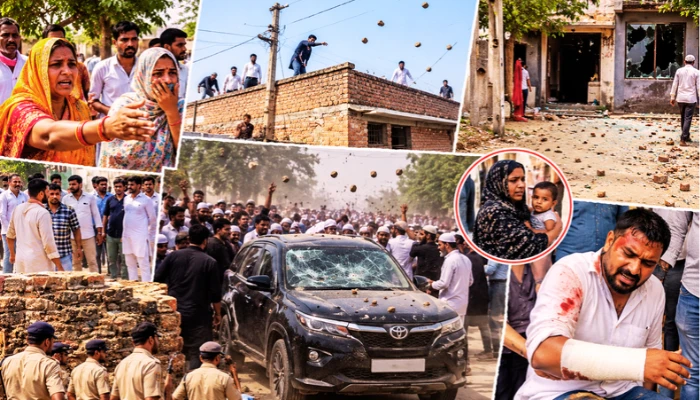
Case Summary
In the Muslim-majority village of Teniwada, located in Vadgam taluka of Banaskantha district, Gujarat, a Hindu home was attacked, and multiple Hindu women were assaulted and sexually harassed by a mob of approximately 250–400 Muslim men. The victims were subjected to stone-pelting, which left the Hindu family members injured and caused damage to their property. Local Hindu residents also described a prolonged pattern of harassment and intimidation directed at Hindu families, aimed at terrorising the community and forcing its members to leave the village. The incident began following a verbal altercation between a man travelling in a tractor and another man riding a motorcycle over an issue of overtaking. The disagreement escalated after people from both Hindu and Muslim communities gathered at the spot, resulting in physical assaults and stone-pelting between the two groups. The violence created panic across the village. Following the incident, a police team from Chhapi Police Station, accompanied by senior police officials, reached the village. Complaints were registered from both sides, with one side naming 11 individuals and the other naming 13 individuals. Both complaints also mentioned unidentified individuals. The police registered cases against a total of 24 people and initially detained 12 of them. Police personnel were subsequently deployed in the village to maintain law and order. Teniwada village falls within the Vadgam Assembly constituency, represented by Congress MLA Jignesh Mevani. However, an exclusive ground report by OpIndia, published on 23 November 2026, brought to light further details about the violence, including the circumstances preceding the attack and the prolonged harassment faced by Hindu residents. Hindu residents interviewed during the ground report described a sustained pattern of harassment and intimidation targeting their community. They recounted instances of garbage being dumped around Hindu households and on roads near their homes, Hindu women being sexually harassed by Muslim men near shops, and Hindu families being repeatedly pressured to leave the village. Residents stated that Hindu families were particularly vulnerable because of their small numbers in the Muslim-majority village and that they were routinely told to leave. According to the Hindu women, on the day of the incident, the men in their family had left for agricultural work or their respective jobs, leaving only women and children at home. At around 10:00 am, five Muslim men initially arrived near their house and began confronting the women. The women stated that the men made provocative remarks about entering Hindu households and sexually assaulting Hindu women. The confrontation subsequently escalated, and the women present in the house were physically attacked. The victims recounted that they were pushed to the ground, their saris and blouses were torn, and attempts were made to strangle them. The clothes of their daughters, who intervened to protect them, were also torn during the assault. One of the women stated that the attack and the resulting trauma left her unable to speak for two days. The women further stated that a Muslim man identified as Imran Doctor and the village's former sarpanch, identified as Ilyasbhai, arrived at the scene after the initial confrontation. According to their account, the two initially appeared to intervene and pacify the situation. However, the women stated that Muslim residents first moved their own vehicles, which were parked in the village square, to a safer location to ensure that they would not be damaged in the ensuing violence. This was done under the pretext of restoring peace. After the Muslim-owned vehicles had been moved away, a much larger crowd of Muslim men gathered, following which the violence against the Hindu family escalated. The residents described the subsequent gathering as a mob of approximately 250–400 Muslim men. They stated that the crowd climbed onto rooftops and began pelting stones at the Hindu family's house. The women further stated that Imran Doctor instigated the crowd and encouraged the attackers to assault and sexually violate them. During the attack, stones were hurled at the house, windowpanes were smashed, and household belongings were damaged. The violence also endangered an infant who was sleeping in a cradle inside the house. Stones were thrown around the cradle while the child was still inside. According to the ground report, one of the family's daughters managed to pick up the infant and move the child to safety, preventing a potentially serious injury. Hindu family members stated that they made emergency calls seeking assistance during the violence. After receiving information about the attack, their relatives rushed back to the village. Several male members of the Hindu family also sustained injuries. The ground report highlighted the case of an injured resident identified as Sureshbhai, who was undergoing treatment at a private hospital in Palanpur. He stated that his brother called him while he was away and informed him that their family had been attacked. When he returned to the village on his motorcycle to help his family, he was attacked with weapons, including a hatchet and a spade. He sustained a fracture in his hand and subsequently underwent surgery, during which a metal plate was inserted. He further stated that his treatment cost approximately ₹1.5–2.5 lakh. He maintained that the attack was not a spontaneous confrontation but had been carried out with prior planning. The Hindu residents stated that the violence had been pre-planned. They pointed to the removal of Muslim-owned vehicles from the village square before the large-scale stone-pelting as an indication of prior preparation. The victims specifically raised questions about the roles of Imran Doctor and former sarpanch Ilyasbhai in the events preceding the attack and the subsequent violence. Hindu residents also expressed dissatisfaction with the police response, stating that adequate action had not been taken against those responsible for the assaults and stone-pelting. They further stated that Hindu youths who had been attacked were also being implicated through counter-complaints filed by the other side, while the principal perpetrators visible in videos of the violence had not faced adequate action. The victims demanded strict action against those responsible, particularly the individuals they had identified as leading and instigating the attack. In an update published on 23 November 2026, OpIndia contacted the Police Inspector of Chhapi Police Station, who confirmed that complaints had been registered from both sides. While the initial police account had recorded 12 detentions, the subsequent update stated that a total of 19 people from both sides had been detained. Police personnel continued to be deployed in the village, and the situation was stated to be peaceful. Two days after the incident, the OpIndia team revisited the affected house and documented visible signs of vandalism and stone-pelting, including broken windowpanes, stones scattered around the premises and damaged household belongings. The affected family demanded a thorough investigation into the incident and strict action against those they had identified as responsible for the attack.
Why it is Hate Crime ?
This case has been added to the tracker under the primary category: Attack not resulting in death. Within it, the sub-category selected is: Attack for Hindu identity. In several cases, Hindus are attacked merely for their Hindu identity without any perceived provocation. A classic example of this category of religiously motivated hate crime is a murder in 2016. 7 ISIS terrorists were convicted for shooting a school principal in Kanpur because they got ‘triggered’ seeing the Kalava on his wrist and the tilak that he had put. In this, the Hindu victim had offered no provocation except for his Hindu religious identity. The motivation for the murder was purely religious, driven by religious supremacy. Such cases where Hindus are targeted merely for their religious identity would be documented as a hate crime under this category. The other subcategory selected is: Attacked for crossing 'Muslim area'. One of the reasons that Hindus get attacked unprovoked specifically by Islamists is for crossing ‘Muslim areas’. Essentially, Muslim mobs often attack Hindus crossing or present in certain areas which have a majority Muslim population. It has often been cited as one of the reasons to blame Hindus for attacks against themselves, signalling that Hindus displaying religious symbols, taking our religious processions or crossing any area which is dominated by Muslim residents is a provocation in and of itself. These areas are mostly ghettoized areas where mobs mobilize quickly to attack Hindus for a variety of reasons like playing music during a religious procession, crossing a mosque, wearing a tilak or any other religious symbol in a Muslim-dominated area, praying at a local temple in that area etc. There have been cases where the few local Hindus of that area have been attacked on their way to the Temple for prayers as well, simply because the area is considered a Muslim-dominated area. Several times, it is entirely possible that the immediate trigger for the violence against Hindus was non-religious in nature, however, the violence became religiously motivated in nature because the area was Muslim dominated and the residents on the whole harboured animosity towards Hindus, evidenced from the actions of the mob, the slogans, and the nature of the attack. Such crimes are motivated by the religious identity of the victims and are therefore classified as hate crimes under this category. The other subcategory selected is: Attacked to induce migration from non-Hindu dominated area. There have been cases where the Hindus living in an area, often with a majority dwelling belonging to non-Hindus or those harbouring animosity towards the Hindu faith, the Hindu residents experience threats and violence. The violence is employed with the aim of making the Hindus leave the area and relocate, so the area could be turned into an exclusive ghetto for adherents of the non-Hindu faith or those who harbor animosity towards the Hindu faith. In several cases, the aim of exodus is explicit. However, in several cases, the demand for exodus of Hindu residents is not explicit, however, violence by non-Hindu residents leaves the Hindu residents no option but to leave the area, thereby, turning the area into an exclusive ghetto of non-Hindu residents. In such cases, there are instances violence against the Hindu residents explicitly. For example, in the Hauz Qazi case of 2019, the Muslim residents claimed that mob violence against the Hindu residents had been triggered by a parking dispute. However, the violence did turn religious with a temple being desecrated and was directed specifically against the Hindu residents. The Hindu residents of the area were clear that the violence was religiously motivated and one of the motives was to affect an exodus of the Hindu residents. In such cases, even though the perpetrators have not explicitly expressed the aim of affecting exodus, the given circumstances and violence and precedent point to the intention of exodus and therefore would be categorized under this sub-category. Such crimes are religiously motivated and therefore are hate crimes. The other subcategory selected is: Attacked for opposing radicals or trying to save victim. In several cases, Hindus are attacked for opposing religiously motivated crimes being committed against a fellow Hindu or simply for voicing an opinion opposing radical elements, who either have in the past or continue to persecute Hindus. In such cases, the initial attack against the victim, against which the Hindu was trying to defend the victim, would also need to be classified as a religiously motivated hate crime. Since the initial crime itself was religiously motivated and the subsequent crime of attempting to save the victim or speaking against the radical elements ends up inviting a violent attack, it would also be classified as a religiously motivated hate crime under this category. The other subcategory selected is: Communal Clash/ Attack. Communal clash is a form of collective violence that involves clashes between groups belonging to different religious identities. For a communal clash between Hindus and non-Hindus to qualify as a religiously motivated hate crime, the trigger of the violence itself would have to be anti-Hindu in essence. For example, if there is a Hindu religious procession that comes under attack from a non-Hindu mob and after the initial attack, Hindus retaliate in self-defence, leading to a communal clash between the two religious communities. While at a later stage, both communities are involved in the clash/violence, the initial trigger of the violence was by the non-Hindu mob against the Hindus and therefore, it could safely be termed as an anti-Hindu violence. Further, the trigger would also have to be religiously motivated. In the cited example, the attack by the non-Hindu mob was against religious processions and therefore, can be concluded to be religiously motivated. In some cases, the trigger may be non-religious, however, it develops into religious violence against Hindus at a later stage. In such cases too, the foundational animosity towards Hindus becomes the motivating factor of the crime and therefore, it would be classified as a religiously motivated hate crime against Hindus under this category. This case had been included in the Hinduphobia Tracker because it reflects a disturbing instance of collective hostility against Hindus, where violence and intimidation were directed at Hindu families with the stated objective of making them feel unsafe in their own homes and forcing them to leave the village. The central concern was not merely the outbreak of communal violence but the deliberate use of hostility against the Hindu community to undermine its security, dignity and continued presence in the locality. The disproportionate scale of violence directed at the Hindu family over a minor road-related altercation between a tractor and a motorcycle is particularly significant. A disagreement over overtaking could in no manner justify the large-scale aggression that followed, including the assault on Hindu women, the attack on a Hindu household and stone-pelting by a mob of approximately 250–400 Muslim men. The scale and nature of the violence, when viewed alongside the repeated targeting of Hindus in the village, demonstrated that the attack was not simply an escalation of an ordinary traffic-related dispute. The Hindu victims described a sustained atmosphere of hostility against the Hindu community, with repeated intimidation and harassment aimed at making Hindu families feel unwelcome and forcing them to leave the locality. The violence following the minor road dispute was inseparable from this established pattern of anti-Hindu hostility. The initial disagreement became the occasion for a much larger collective attack against Hindu families, reflecting the religious hostility that had already been directed at the community. The disproportionate aggression against Hindus, in the context of their repeated persecution in the village, made this a clear instance of a religiously motivated hate crime. More importantly, the selective targeting of Hindu families in a Muslim-majority village demonstrated that their religious identity was central to the hostility directed against them. Hindu residents recounted how they had been subjected to sustained harassment and intimidation by members of the Muslim community, including garbage being dumped around their homes and on nearby roads, Hindu women being sexually harassed near shops, and families being repeatedly told to leave the village. These instances of persecution predated the present attack and exposed an established pattern of anti-Hindu hostility in the locality. The fact that Hindu families were repeatedly subjected to such treatment, while being made to feel unwelcome and unsafe in their own homes, demonstrated that the hostility was directed at them as members of a religious community. Their faith had become the basis for their exclusion, humiliation and persecution. Such systematic intimidation, coupled with physical violence against Hindu households and women, reflected deep-rooted hostility towards the continued presence of Hindus in the village. It is also important to note that the incident occurred in a Muslim-majority village. Muslims often treat areas near mosques, dargahs or localities where their community forms the majority as ‘Muslim areas’. This reflects a disturbing sense of Islamic supremacy among the attackers, who view the Muslim-majority locality as an exclusive zone where non-Muslims, particularly Hindus, are unwelcome and have no place. This sense of entitlement and superiority reflects deep-seated prejudice and an attempt to assert religious dominance over public spaces and localities. The assault on Hindu victims and their repeated persecution in the village stemmed from this Islamic supremacist ideology, with Muslims in the area looking down upon Hindus and believing that they have the right to decide who could live in ‘their area’ and move freely within it. Such conduct illustrated a dangerous mindset rooted in exclusion, intolerance and religious animosity, making this a clear instance of a religiously motivated hate crime. Furthermore, the sustained harassment and intimidation faced by Hindu families, coupled with repeated pressure to leave the village, demonstrated an attempt to drive the community out on account of its religious identity. Such coercion threatened to uproot Hindu families from their homes, sever their longstanding social ties and deprive them of their right to live in the locality without fear or discrimination. The deliberate use of intimidation and violence to compel a religious community to abandon its homes amounted to coercive displacement rooted in religious hostility. It reflected deep-seated anti-Hindu animosity and an attempt to deny Hindus their rightful place in the village simply because of their faith. The present attack, when viewed against the established pattern of persecution faced by Hindus in the village, further demonstrated the deep-rooted communal hostility directed at them on account of their religious identity. The provocative remarks made by Muslim men about entering Hindu households and sexually assaulting Hindu women were particularly revealing of this hostility. Such statements were not ordinary verbal provocations but explicit expressions of contempt towards Hindu women and the dignity of Hindu families. They reflected a disturbing sense of religious animosity in which Hindu households and women were singled out for humiliation and sexual intimidation because of their Hindu identity. The subsequent removal of Muslim-owned vehicles from the village square, followed by the mobilisation of a mob of approximately 250–400 Muslim men against a single Hindu household, further exposed the organised and premeditated nature of the communal aggression. The fact that the attackers secured their own vehicles before directing large-scale violence against the Hindu family demonstrated a calculated disregard for the safety and property of the Hindu victims. Such collective mobilisation against a Hindu household, particularly in a village where Hindu families had already faced sustained hostility, reflected an assertion of communal dominance and a deliberate targeting of Hindus. The attack was therefore not simply an escalation of a local disagreement but an expression of the wider anti-Hindu animosity that had made the community vulnerable to collective violence. Furthermore, the role of Imran Doctor, who instigated the crowd and encouraged Muslim men to assault and sexually violate Hindu women, exposed an especially disturbing dimension of the religious hostility driving the attack. The use of sexual violence and threats of sexual assault against Hindu women was not merely an act of physical aggression but an attack on their dignity and bodily autonomy, directed at women belonging to a particular religious community. The provocative remarks about entering Hindu households and sexually assaulting Hindu women, followed by encouragement to carry out such acts, reflected an abhorrent sense of entitlement over Hindu women's bodies and dignity. This demonstrated how religious animosity was expressed through the humiliation, intimidation and sexual targeting of Hindu women, treating their identity as Hindus as no barrier to subjecting them to such degrading violence. Such conduct reflected deep-rooted anti-Hindu hatred, in which even the most intimate aspects of a Hindu family's safety and dignity became targets of communal aggression. Furthermore, the targeting of Hindu women and the exposure of children to such hostility carried consequences beyond immediate physical harm. A home is the safest space for a family. When Hindu women are made to feel vulnerable even within their homes, and children are exposed to communal aggression, the psychological impact extends to the entire household. It creates a persistent fear that no place is entirely safe and that even the most ordinary aspects of family life can be disrupted by hostility directed towards their community. Particularly disturbing was the fact that Hindu women who intervened to protect other women from sexual assault were themselves subjected to physical and sexual violence. This demonstrated that even those who resisted the perpetrators and attempted to prevent the sexual targeting of other Hindu women were not spared. Their intervention to protect fellow Hindu women was met with similar violence, exposing the perpetrators' utter disregard for the dignity and safety of Hindu women. Subjecting women to sexual harassment and assault even when they attempted to defend other victims reflected the depth of the anti-Hindu hostility driving the attack. Such intimidation also risks passing a sense of insecurity to the next generation, making children grow up questioning whether their Hindu identity and their family's presence are accepted. The collective nature of the hostility was equally important. The fear was not confined to one individual or one family; it affected the wider Hindu community. When aggression is directed at households and residents belonging to the same religious community, it creates a shared sense of vulnerability. Families begin to measure their actions, avoid confrontation and remain apprehensive about what might happen next. This is precisely how intimidation acquires a wider social impact: it makes an entire community feel that its security depends on remaining silent and accommodating hostility. Although the incident involved a communal confrontation between Hindus and Muslims, and complaints were registered against individuals from both communities, the registration of counter-complaints did not make the violence or the responsibility for it equal on both sides. The accounts of the Hindu victims established that Muslim men first approached their household, made sexually provocative threats against Hindu women and subsequently mobilised a large mob that attacked the Hindu family with stones and weapons. The Hindu family members were subjected to physical assaults while attempting to protect their homes and women from the aggression. Their efforts to defend themselves and their families could not be equated with the organised violence directed against them. The existence of a confrontation between two communities did not erase the distinction between those who initiated and instigated the attack and those who were subjected to it. The primary responsibility for the large-scale assault lay with those who mobilised the mob and targeted the Hindu household. The violence, therefore, could not be dismissed as an ordinary two-sided communal clash; it reflected the anti-Hindu hostility that had already manifested itself through repeated intimidation, sexual harassment and attempts to drive Hindu families out of the village. Overall, the perpetrators' actions reflected deep-rooted hatred towards Hinduism and hostility towards the Hindu community on account of its religious identity. This incident was therefore included in the Hinduphobia Tracker's hate crime database. Disclaimer: The incident involved several women, men and children who were assaulted or otherwise harmed during the violence. However, the exact number of victims was not specified in the available ground report, except for one victim, identified as Sureshbhai, who sustained a fracture. Therefore, a conservative victim count of one has been recorded for documentation purposes only. Regarding the number of attackers, the ground report provided an approximate estimate of 250–400 individuals. Accordingly, the highest figure of 400 attackers has been recorded in accordance with the Hinduphobia Tracker's documentation standards. This figure represents the upper estimate provided in the report and does not necessarily reflect the exact number of perpetrators involved. The Hinduphobia Tracker records incidents based on the date on which the event or crime occurred, rather than the date on which it was reported by the media. However, the available report did not specify the exact date of the incident. Therefore, for documentation purposes, the date of the media report, 18 November 2026, has been recorded as the indicative incident date.
Victim Details
Total Victim
1
Deceased
0
Gender
- Male 1
- Female 0
- Third Gender 0
- Unknown 0
Caste
- SC/ST 0
- OBC 0
- General 1
- Unknown 0
Age Group
- Minor 0
- Adult 1
- Senior Citizen 0
- Unknown 0


Case Status
Case sub-judice


Perpetrators Details
Perpetrators
Muslim Extremists
Perpetrators Range
From 10 to 100
Perpetrators Gender
male
 Sources