Hindu devotees attacked, Lord Ganesh idol desecrated by Muslim men during immersion procession in Basti, Uttar Pradesh
 Basti, Uttar Pradesh, India
 25 October, 2026
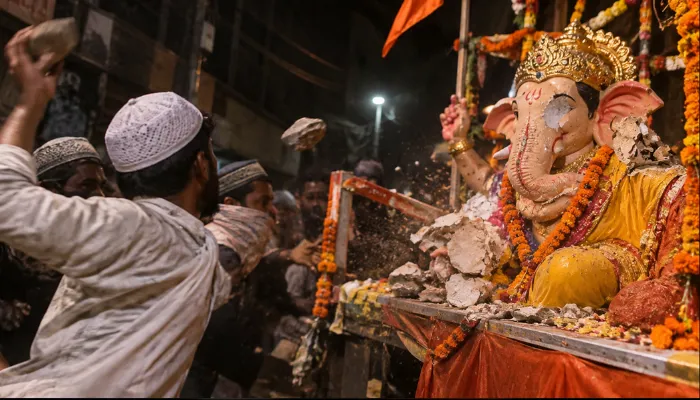
Case Summary
A Hindu religious procession carrying an idol of Bhagwan Ganesh for immersion was disrupted after members of the Muslim community pelted it with stones and damaged the sacred idol in Basti, Uttar Pradesh. The incident took place at around 11 pm on 26 October 2026, near Surya Hospital in the Hospital Chauraha area, under the Purani Basti police station limits. The procession had started from Pipra Ramkishun when a stone struck a girl participating in it. Bricks and stones were subsequently pelted during a confrontation by members of the Muslim community. Furthermore, the idol of Bhagwan Ganesh was also damaged during the violence. According to the Vishwa Hindu Mahasangh, members of the non-Hindu community were responsible for vandalising the idol and breaking the arms of two girls. Following the desecration of the idol, the Hindu devotees and organisers became enraged and refused to proceed with the immersion. They demanded the immediate arrest of those responsible and registration of a police case. The protesters raised slogans against the police administration and blocked the roads at Hospital Chauraha and subsequently at Roadways Chauraha. Akhilesh Singh, district president of the Vishwa Hindu Mahasangh, reached the spot along with other members and workers. Leaders associated with the Vishva Hindu Parishad (VHP) and Bajrang Dal also arrived after receiving information about the incident. The police attempted to pacify the protesters, but they remained firm on their demand for action against the perpetrators. Additional Superintendent of Police Shyamkant eventually took charge of the situation and assured the organisers that a case would be registered. Following this assurance, the procession resumed, and the damaged idol was taken to Amhat Ghat for immersion. The police struggled to bring the situation under control, with the disruption continuing until approximately 2 am. On the morning of 27 October, at 9:07 am, police registered an FIR based on a complaint filed by Bhola Jaiswal, a member of the Durga Puja organising committee. The FIR named ten persons: Salman Qureshi, Anees, Irfan, Fazal, Nafees, RDX, Arman, Mantu Pathan, Sameer and Rehan. In addition to these ten named accused, 20 unidentified persons were also booked. The named accused were residents of Parsa Takiyawa, Pipra Ramkishun, Station and Pathan Tola localities in the Purani Basti area. Superintendent of Police Omveer Singh claimed that during the immersion ceremony on the 26th, a fight broke out between the organizing committee and another group from the same village over an old rivalry. Superintendent of Police Omveer Singh suspended six police personnel for negligence in handling the incident. Those suspended included Sub-Inspector Sudhir Kumar Tripathi, in-charge of the Plastic Complex police outpost, Amit Kumar, in-charge of the South Gate police outpost, two head constables and two constables. Six persons were detained for questioning, while police teams conducted raids to trace the remaining accused. The police also examined CCTV footage and electronic records to investigate the incident and establish the circumstances surrounding the damage to the idol.
Why it is Hate Crime ?
This case is being added to the tracker under the first primary category: Attack not resulting in death. The subcategory selected is: Attack on Hindu religious procession. The outward celebration and display of religious symbols in an intrinsic part of Hinduism. Religious processions on various festivals are age-old traditions and a way to manifest faith and form a part of the religious practices of Hindus. On several occasions, such religious processions come under attack by non-Hindu mobs, in a manifestation of their animosity towards Hinduism and their practices. The reasons cited for such violent attacks are many and range from crossing a non-Hindu resident-dominated area to playing loud music, crossing from an area where there is a religious structure of another faith etc. The violent attacks are triggered by the outward display of religiosity by Hindus. The attacks are mainly a manifestation of religious supremacist doctrine which believes that idolatry, essentially the Hindu faith, is one that deserves to be annihilated since the very tenets of Hinduism, its practices and traditions are considered a sin in those doctrines. Since these attacks emanate from intrinsic and doctrinal animosity towards Hindus and Hinduism, it is considered a religiously motivated hate crime under this category. The other subcategory selected is: Attack against Hindu devotees. Hindu devotees are a few of the easiest targets of religiously motivated hate crimes because during the festival/procession/puja etc, for non-Hindus it is easy to profile their victims on the basis of religion. Hindu devotees come under attack on several occasions by individual non-Hindus or mobs of non-Hindus owing to their animosity against Hinduism, its symbols and tradition/practices. There are several instances of Hindu devotees being attacked while they worship in temples or temporary religious structures, during religious processions, doing bhajan/kirtan/puja in their own homes, in the residential society etc. These attacks are perpetrated by non-Hindus primarily because of their animosity towards Hindus and their faith. In some cases, the trigger for the violence may be non-religious, however, there are two elements that make these hate crimes. First, the Hindus who come under attack are attacked violently while indulging in religious activity. Whether they are in a place of worship or not is immaterial to the crime. When individuals are attacked while indulging in religious practices, the attack in itself is a hindrance to their freedom to practice religion and therefore constitutes a hate crime. Secondly, religious supremacist doctrines and ideologies deem religious practices of Hindus to be offensive ab initio since they are considered “sinful” by these ideologies, worthy to be annihilated by force or coercion. Driven by these religious supremacist ideologies and doctrines, the attacks against Hindu devotees stem from intrinsic animosity towards Hinduism. In some cases, the trigger for the violence may be non-religious, however, it develops into a religiously motivated crime during the course of the violence. Since these attacks stem from animosity towards Hindus and Hinduism, they are considered religiously motivated hate crimes under this category. The second primary category selected is: Attack on Hindu religious representations. The subcategory selected is: Desecration of Hindu religious symbol. Icons and symbols or a religious representation of a spiritual ideal are widely revered in Hinduism. Iconography is of vital significance in the Hindu milieu. It helps connect people’s spiritual beliefs with the real world. Iconography within the Hindu faith takes several shapes and forms. Murtis are of most significance to Hindus, to which daily rituals, prayers and offerings are done. Besides the murtis, there are several other symbols which have deep significance in the Hindu faith – the Om and Swastika for example. Since these Hindu religious symbols hold paramount importance in Hinduism, any desecration of symbols, icons, murtis, religious representations and manifestations, is driven by animosity towards the faith itself which manifests itself through these murtis, icons and symbols. Therefore, any desecration of these Hindu religious symbols and representations is considered religiously motivated hate crimes under this category. This case constituted a clear example of religiously driven violence, as a group of Muslim men targeted a Hindu idol immersion procession, vandalised an idol of the Hindu deity being carried for immersion and attacked Hindu devotees participating in the procession with swords, bricks and stones. The perpetrators' actions targeted both a sacred Hindu religious observance and the devotees gathered to practise their faith, demonstrating hostility towards Hindu traditions, sacred symbols and the public expression of Hindu identity. To understand the gravity of the incident, it is essential to recognise the religious significance of Bhagwan Ganesh in Hinduism and the importance of the idol immersion procession. Bhagwan Ganesh, also revered as Ganapati and Vighnaharta, is one of the most widely worshipped deities in Hinduism. He is revered as the remover of obstacles, the deity of wisdom and knowledge, and the harbinger of auspicious beginnings. His worship occupies an important place in Hindu religious traditions, with devotees invoking his blessings before undertaking important activities, ceremonies and religious observances. The immersion procession was an integral part of this devotional tradition, in which devotees carried the worshipped idol to perform the concluding immersion ritual. Such processions are collective expressions of faith and devotion, allowing Hindus to publicly celebrate and honour their deity while observing established religious customs. The deliberate desecration of Bhagwan Ganesh's idol during this religious procession constituted a direct affront to Hindu faith and religious sentiments. An idol is not regarded by Hindu devotees as an ordinary physical object but as a sacred representation of the deity and the focal point of their worship and devotion. The idol being carried in the procession had been worshipped with reverence and was being taken for immersion as part of an established religious ritual. Damaging it in the midst of this sacred observance therefore went beyond the destruction of a physical object; it violated the sanctity of the ritual and showed contempt for the religious beliefs of the devotees gathered there. The desecration of an idol of one of Hinduism's most revered deities, in the presence of worshippers participating in a religious procession, demonstrated hostility towards Hindu religious traditions and sentiments. Attacking a Hindu religious procession and physically assaulting its participants constituted an attack on their Hindu identity and their right to express their faith publicly. Such processions are sacred expressions of Hindu devotion, bringing devotees together to honour their deities and participate in religious observances. By disrupting the procession and attacking Hindu devotees with swords, bricks and stones, while vandalising the Hindu idol, the Muslim perpetrators violated the sanctity of the religious gathering, hurt Hindu religious sentiments and inflicted fear and insecurity upon the community. Such violence sends a disturbing message to Hindu devotees that the public expression of their religious identity may expose them to intimidation and physical harm. When devotees are attacked while participating in sacred religious observances, the violence targets not only the individuals but also the faith and religious identity they are expressing. Such acts demonstrate religious animosity towards Hinduism and the Hindu community, making this incident a clear example of a hate crime. Such attacks on Hindu idols, processions and devotees cannot be seen as random incidents. Such acts are calculated and ideologically rooted expressions of religious hatred. In Islamic theology, idol worship, referred to as Shirk, is regarded as the gravest sin. The Qur'an strictly condemns it, and Islamic teachings emphasise the complete rejection of any practice associated with idol worship. Muslims are taught from a young age that idolatry is an unforgivable sin. While this belief is central to Islamic faith, it has also led, historically and in contemporary times, to intolerance and hostility towards idol-worshipping religions, especially Hinduism. When Muslim individuals deliberately desecrate Hindu idols and attack Hindu devotees and religious processions, it demonstrates contempt for Hindu religious beliefs, traditions and practices. Such actions target the religious identity, faith and dignity of Hindus, reflecting hostility towards their sacred symbols and public expressions of devotion, making this an instance of a religiously motivated offence. Overall, since this case meets the parameters of a religiously driven hate crime, it is being added to the hate crime database of the Hinduphobia Tracker. Disclaimer: In this case, the total number of perpetrators has been recorded as 25–30, comprising 10 named Muslim perpetrators and 15–20 unidentified perpetrators. This figure has been recorded for documentation purposes only.


Case Status
Complaint registered


Perpetrators Details
Perpetrators
Muslim Extremists
Perpetrators Range
From 10 to 100
Perpetrators Gender
male
 Sources





