Hindu residents targeted for Christian conversion through 'healing' meetings in Chhattisgarh
 Gaurela, Chhattisgarh, India
 21 November, 2026
Case Summary
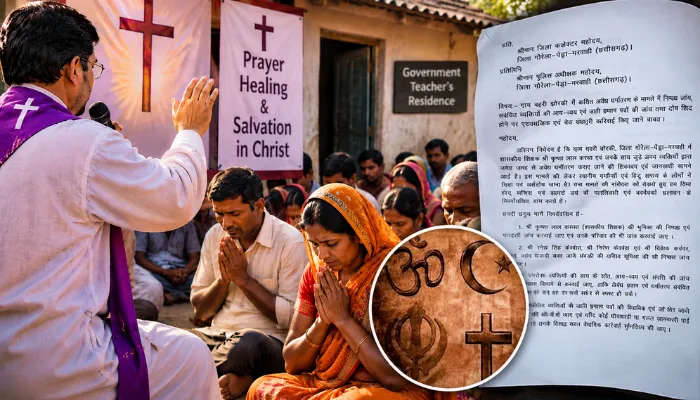
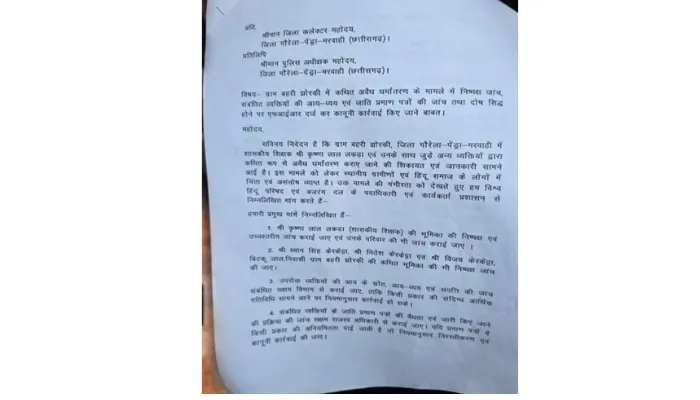
In Chhattisgarh's Gaurela-Pendra-Marwahi district, Hindu residents were targeted for religious conversion to Christianity by Christian missionaries through supposed 'healing' meetings, also known as 'Changai Sabhas'. The incident took place on Sunday, 22 November 2026, in Bahri Jhorki, an associated village under Gram Panchayat Tilora. A Changai Sabha was organised at the residence of government schoolteacher Krishna Lal Lakra, located near the village primary school. A pastor and several other individuals were present at the gathering. The healing prayer meeting was used to approach local Hindu residents and influence them towards Christianity. The individuals identified in connection with the conversion activities included Krishna Lal Lakra, Dhyan Singh Kerketta, Nitesh Kerketta, Vijay Kerketta and Bitku Lal, all connected to Bahri Jhorki. The pastor present at the gathering was not identified by name. After receiving information about the conversion activities, members of the Vishwa Hindu Parishad (VHP), Bajrang Dal and Bhagwati Manav Kalyan Sangathan reached the location along with police personnel. Subsequently, the organisations submitted a formal memorandum to the District Collector and Superintendent of Police on 23 November 2026, seeking an investigation into the conversion activities in the village and the involvement of the individuals concerned. Through the memorandum, the organisations demanded an investigation into the role of government schoolteacher Krishna Lal Lakra and his family, along with the involvement of Dhyan Singh Kerketta, Nitesh Kerketta, Vijay Kerketta and Bitku Lal. They also called for an examination of the complaints and available evidence concerning the conversion activities in the village. The memorandum further demanded an investigation into the sources of income, bank transactions, income and expenditure, and total assets of the individuals concerned. The organisations also sought verification of their caste certificates and an examination of the administrative procedures through which these certificates had been issued. They demanded that the concerned revenue authorities conduct the verification and cancel the certificates, along with initiating legal action, if any irregularities were established. Furthermore, the organisations demanded the constitution of a joint investigation team comprising officials from the relevant departments to ensure a comprehensive investigation. They also sought registration of an FIR and strict legal action against those responsible if illegal religious conversion or any other violation of law was established. Additionally, they requested regular updates on the progress of the investigation and stressed the need to maintain peace, law and order, and social harmony in the area.
Case Images
Why it is Hate Crime ?
The primary category selected for this case is: Predatory Proselytisation. The subcategory selected is: Conversion/attempts to convert by inducement. Predatory Proselytisation is not just limited to threat, harassment, force and violence, but it also has contours of stealth. In several cases, the Hindu victim is exploited to convert, with non-Hindus taking advantage of their poverty. In such cases, the Hindu victim who is suffering financially is offered monetary benefits, including lucrative offers for jobs, health treatment, education, etc, to induce the victim into changing his/her religion. In such cases, the religious identity of the victim and the aim to disenfranchise him from his faith form the heart of the crime. Also, taking advantage of and exploiting an individual’s economic vulnerabilities is widely acknowledged as exploitation, forms of which are often penalised by law. Such cases therefore are considered religiously motivated hate crimes since the victim’s religious identity forms the very heart of the crime itself. The other subcategory selected is: Proselytisation by grooming, brainwashing, manipulation or subtle indoctrination. Religious brainwashing essentially means the often subtle and forcible indoctrination to induce someone to give up their religious beliefs to accept contrasting regimented ideas. Religious grooming or brainwashing also involves propaganda and manipulation. It involves the systematic effort, driven by religious malice and indoctrination, to persuade “non-believers’ to accept allegiance, command, or doctrine to and of a contrasting faith. Cases of such grooming or brainwashing are far more nuanced than direct threats, coercion, inducement and violence. In such cases, it is often seen that there is repeated, subtle and continual manipulation of the victim to induce disaffection towards their own faith and acceptance of the contrasting faith of the perpetrator. While subtle indoctrination is widely acknowledged as predatory, an element which is often understated in such conversions or the attempts of such conversion is the role of loyalty and trust which might develop between the perpetrator and the victim. Fiduciary relationships are often abused to affect such religious conversion. For example, an educator transmitting religious doctrine of a competing faith to a Hindu student. The Hindu student is likely to accept what the teacher is transmitting owing to existence of the fiduciary relationship. The exploitation of the fiduciary relationship to religiously indoctrinate victims would also be included in this category. Since the underlying animosity towards the victim’s faith forms the basis of predatory proselytization, such cases are considered religiously motivated hate crimes. In this case, Hindu residents were targeted for conversion to Christianity by Christian missionaries through healing meetings (Changai Sabhas). The meeting was used as a means to approach local Hindu residents and influence them towards Christianity. The nature of the conversion efforts and the wider impact on the Hindu community all indicate a targeted action against Hindus as a collectivity. When individuals or groups focus their efforts on converting members of a particular religion, in this case, Hindus, then it demonstrates a fundamental disregard for the Hindu faith. Conversion, especially when not based on personal conviction but rather on external persuasion or pressure, is not simply about sharing a different belief system. It is an attempt to undermine the values, traditions, and identity of the Hindu community. In this context, the Christian perpetrators specifically targeted Hindus, which suggests a lack of respect for Hinduism and its followers. Such actions are carried out to strip Hindu victims of their faith, making it a religiously motivated crime. The use of prayer meetings and 'healing' meetings as a method of conversion further showcases a calculated and manipulative strategy disguised as a spiritual practice. These gatherings are presented as spaces for prayer, emotional support and miraculous healing, creating the impression that they exist solely for religious worship and community care. In reality, they function as platforms through which Hindu attendees are gradually exposed to Christian teachings and influenced to embrace Christianity. The healing meetings, popularly known as 'Changai Sabhas', promote the belief that conversion can cure illnesses, resolve financial and family problems, and transform lives. By exploiting hope, desperation, suffering and faith in divine intervention, Christian missionaries use promises of miraculous healing as inducements to influence vulnerable Hindu individuals into abandoning their existing faith. Such gatherings are therefore not merely religious meetings but calculated instruments of proselytisation that manipulate the vulnerabilities of Hindu attendees, undermine their religious autonomy and strip them of their faith and identity, reflecting deep-seated hostility towards Hinduism. Furthermore, the organised nature of the conversion efforts indicates that this was not merely an isolated or spontaneous religious gathering. The involvement of a pastor and several other individuals in organising and conducting the prayer meeting, with local Hindu residents being approached through the gathering, points towards a coordinated effort to advance Christian proselytisation among Hindus. Christian theology places considerable emphasis on evangelism and the propagation of Christianity, with exclusionary theological interpretations treating non-Christian faiths, including Hinduism, as inferior or incompatible with Christian beliefs. Driven by the objective of expanding their religious following, Christian missionaries employ unethical proselytisation methods, including inducements, psychological manipulation, brainwashing and promises of miraculous healing, to influence Hindu individuals into embracing Christianity. The use of such tactics in this instance further underscores the religiously motivated nature of the conversion efforts and the targeted attempt to undermine Hindu religious identity by persuading individuals to abandon their faith. Such acts of targeted proselytisation are a result of doctrinal hostility and disregard towards Hinduism. They constitute an attack on the faith, traditions and religious identity of the Hindu community. Therefore, this incident is being added to the hate crime database of the Hinduphobia Tracker.


Case Status
Complaint registered


Perpetrators Details
Perpetrators
Christian Extremists
Perpetrators Range
From 5 to 10
Perpetrators Gender
male
 Sources





