Poor and sick Hindu villagers targeted for Christian conversion through false promises of 'healing' and inducements in West Bengal's Midnapore
 Paschim Medinipur district, West Bengal, India
 22 November, 2026
Case Summary
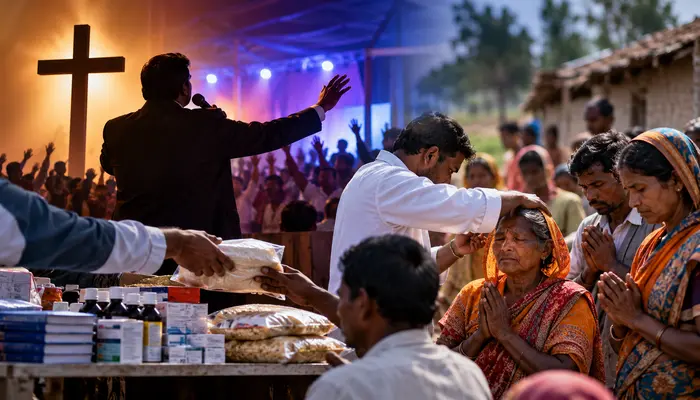
In Barsijua village, West Midnapore, West Bengal, Hindu residents were targeted for religious conversion by Christian missionaries under the pretext of prayer meetings and healing programmes. The villagers were lured with promises of curing illnesses and various inducements in exchange for abandoning their Hindu faith and embracing Christianity. According to media sources, the missionaries were repeatedly organising Christian religious gatherings in the village in the name of healing illnesses and providing relief from financial and mental distress. They primarily targeted poor and sick villagers, claiming that special prayers would cure serious diseases and restore financial stability and mental peace to their families. Several families were brought together to attend these purported healing programmes. During these gatherings, the missionaries persuaded Hindu families to abandon their existing faith and embrace Christianity. The families were also lured with promises of various benefits in exchange for changing their religion. On the day of the incident, while a prayer meeting was underway at a location in the village, some local Hindu youths and elders questioned the outsiders about the purpose of the gathering. When the missionaries failed to provide satisfactory answers, an altercation broke out, following which news of the incident spread across the village and a large number of residents gathered at the spot. The Hindu villagers objected to attempts at religious conversion through inducements and the exploitation of people's medical and financial vulnerabilities, making it clear that they would not tolerate such activities in the village. As tensions escalated, the villagers informed the local police station and detained the missionaries. Police personnel from Medinipur Kotwali police station subsequently reached Barsijua village and brought the situation under control by pacifying the agitated crowd. Acting on written and verbal complaints lodged by villagers, the police arrested the Christian missionaries and took them to the police station for questioning. Several religious booklets and pamphlets were also recovered from their possession. The police initiated an investigation to establish the purpose of the gathering, ascertain where the detained individuals resided, identify the organisations with which they were associated, and determine whether they had obtained the requisite administrative permission to conduct the meeting. Police patrolling was also increased in the area to prevent any untoward incident.
Why it is Hate Crime ?
This case has been added to the tracker under the primary category of: Predatory Proselytisation. Within it, the sub-category selected is: Conversion/ attempts to convert by inducements. Predatory Proselytisation is not just limited to threats, harassment, force,e and violence, but it also has contours of stealth. In several cases, the Hindu victim is exploited to convert, with non-Hindus taking advantage of their poverty. In such cases, the Hindu victim who is suffering financially is offered monetary benefits, including lucrative offers for jobs, health treatment, education, etc., to induce the victim to change his/her religion. In such cases, the religious identity of the victim and the aim to disenfranchise him from his faith form the heart of the crime. Also, taking advantage of and exploiting an individual’s economic vulnerabilities is widely acknowledged as exploitation, forms of which are often penalised by law. Such cases therefore are considered religiously motivated hate crimes since the victim’s religious identity forms the very heart of the crime itself. The other subcategory selected is: Proselytisation by grooming, brainwashing, manipulation or subtle indoctrination. The tertiary category selected is: Pattern of targeting Hindus. Religious brainwashing essentially means the often subtle and forcible indoctrination to induce someone to give up their religious beliefs to accept contrasting regimented ideas. Religious grooming or brainwashing also involves propaganda and manipulation. It involves the systematic effort, driven by religious malice and indoctrination, to persuade “non-believers’ to accept allegiance, command, or doctrine to and of a contrasting faith. Cases of such grooming or brainwashing are far more nuanced than direct threats, coercion, inducement and violence. In such cases, it is often seen that there is repeated, subtle and continual manipulation of the victim to induce disaffection towards their own faith and acceptance of the contrasting faith of the perpetrator. While subtle indoctrination is widely acknowledged as predatory, an element which is often understated in such conversions or the attempts of such conversion is the role of loyalty and trust which might develop between the perpetrator and the victim. Fiduciary relationships are often abused to affect such religious conversion. For example, an educator transmitting religious doctrine of a competing faith to a Hindu student. The Hindu student is likely to accept what the teacher is transmitting owing to existence of the fiduciary relationship. The exploitation of the fiduciary relationship to religiously indoctrinate victims would also be included in this category. Since the underlying animosity towards the victim’s faith forms the basis of predatory proselytization, such cases are considered religiously motivated hate crimes. This incident is a clear example of a religiously driven hate crime, as poor and sick Hindu villagers were targeted for religious conversion to Christianity by Christian missionaries through false promises of 'healing' and various inducements. The use of prayer meetings and healing programmes as a means of facilitating religious conversion amounted to a manipulative tactic that exploited the victims' religious, medical and personal vulnerabilities. The missionaries targeted villagers suffering from serious illnesses and financial hardships, promising that participation in Christian prayers would cure diseases, alleviate ailments and restore peace and prosperity to their families. By presenting Christian religious practices as a means of obtaining relief from illness and personal distress, they sought to manipulate vulnerable Hindu families into associating their recovery and well-being with abandoning their existing faith and embracing Christianity. Such tactics exploited the victims' suffering and hopes of recovery to influence decisions concerning their religious identity. A religious conversion can be considered voluntary only when it stems from an individual's genuine conviction and freely exercised choice, rather than manipulation or the exploitation of personal vulnerabilities. Using the promise of healing as a means of persuading Hindu families to abandon their faith therefore amounted to religious coercion and an attempt to strip the victims of their religious identity through manipulative proselytisation. The victims were also offered various inducements in exchange for converting to Christianity. This demonstrated that the efforts were not simply an act of goodwill or charitable assistance, but involved exploiting the socio-economic vulnerabilities of poor Hindu families to influence and arm-twist them into changing their religion. Offering material benefits in exchange for religious conversion constitutes an attempt to compromise the victims' freedom of conscience by making their religious choices contingent upon promised assistance. Such inducements undermine their religious autonomy and their fundamental right to freely practise and preserve their faith. Using economic vulnerability as leverage to secure religious conversion amounts to an act of religious coercion rather than genuine religious persuasion, reflecting hostility towards the victims' Hindu religious identity. It is important to note that the Christian missionaries repeatedly organised such healing meetings, promising cures for illnesses, wealth, prosperity and other benefits to persuade Hindu families to embrace Christianity. The repeated use of such manipulative tactics demonstrated a pattern of coercive conversion activity rather than an isolated incident, reflecting deep-seated religious animosity and hostility towards Hinduism through systematic attempts to erode the religious identity of Hindu victims. The incident further demonstrated how seemingly charitable or faith-based gatherings could be used by Christian missionaries to advance religious conversion objectives. By exploiting illness, poverty and personal distress under the guise of healing and assistance, the missionaries used the victims' vulnerabilities as leverage to persuade them to abandon their Hindu faith. Such practices reflected a disregard for the victims' religious freedom and dignity, amounting to coercive proselytisation rather than genuine religious persuasion. The Christian faith, by its very theological foundations, places a strong emphasis on proselytisation. In pursuit of conversion objectives, Christian evangelists often employ unethical means, ranging from psychological pressure and misinformation to inducements such as money or jobs. This systematic attempt to erode the religious foundation of individuals and replace it with allegiance to another faith reflects deep religious malice and animus against the Hindu identity. Because the core motivation of the act stems from hostility toward the victim's religion, it meets the threshold of a hate crime. Hence, it is being added to the hate crime database of the Hinduphobia Tracker. Disclaimer: The Hinduphobia Tracker records incidents based on when an event occurred or when the victim's ordeal began, rather than when it is reported by the media. The report does not specify the exact date the accused lured the villagers. Therefore, for documentation purposes, we recorded the date as the date the incident was reported in the media: 23 November 2026.


Case Status
Arrested


Perpetrators Details
Perpetrators
Christian Extremists
Perpetrators Range
Unknown
Perpetrators Gender
unknown
 Sources





