Hindu couple brutally assaulted and sexually harassed by Muslim minor boys in Muslim-majority area; attackers threaten "This is our area. What will you do?"
 Mumbai, Maharashtra, India
 19 November, 2026
Case Summary
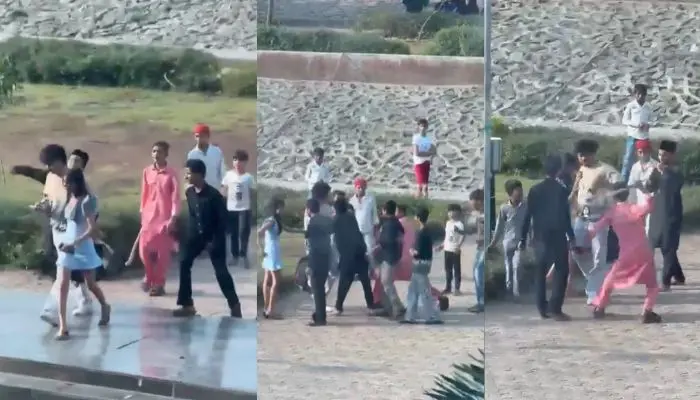
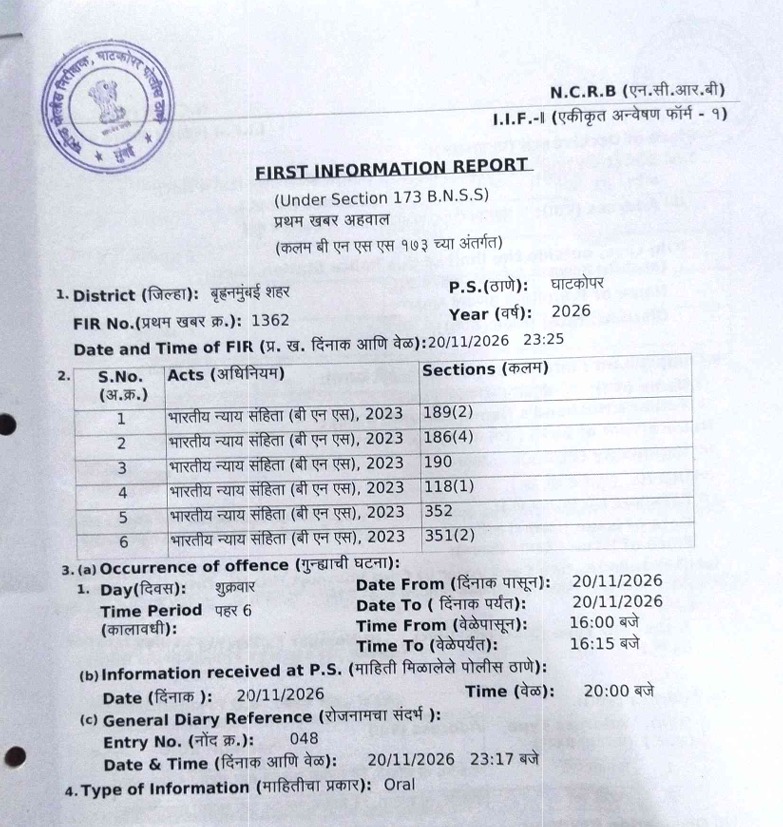
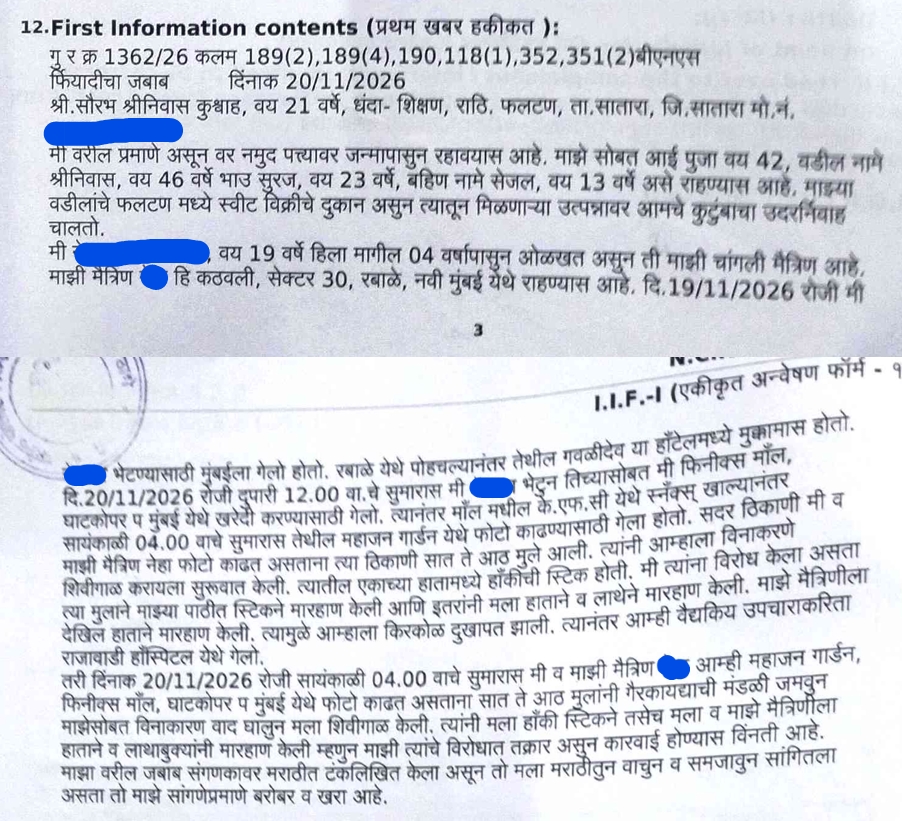
A young Hindu couple was abused and assaulted by a group of eight to ten Muslim boys at Pramod Mahajan Garden, located behind Phoenix Marketcity Mall in Kurla West, Mumbai, Maharashtra. The boys asserted territorial dominance over the area, telling the couple, “This is our area. We will do what we want, say what we want. What can you do?” before viciously attacking them. The attackers also threatened to shoot the couple with a katta, a country-made pistol. The incident took place on the afternoon of 20 November 2026, after the couple visited the mall for shopping. According to reports, the male victim, a 21-year-old student originally from Satara district, had arrived in Navi Mumbai on 19 November to meet his girlfriend, who lived in Rabale. The next day, the couple visited Phoenix Marketcity Mall, where they shopped and had snacks before going to the nearby Pramod Mahajan Garden around 4 pm to take photographs. While the couple were taking photographs in the garden, a group of seven to eight Muslim boys approached them. The boys were reportedly carrying hockey sticks, wooden sticks and iron knuckles. They objected to the couple's presence and their taking photographs. They also made sexually explicit and vulgar remarks towards the Hindu girl and touched her inappropriately. When the couple objected to their behaviour and the male victim attempted to reason with them, the group turned violent and surrounded them. Social media account Treeni contacted the victims, and the male victim, identified as Saurabh, son of Srinivas Kushwar, described how the boys began making vulgar remarks and behaving inappropriately towards his female companion. When he questioned them about their conduct, they responded, “This is our area. What can you do here?” They continued abusing the couple. Saurabh said the situation escalated when one of the boys suddenly approached them carrying a stick. He also noticed that two of the boys were carrying iron knuckle-type weapons, commonly known as knuckle fighters. He suspected that the group had come prepared to attack them and may have been anticipating the arrival of a couple at the garden. According to him, one of the attackers struck him near the eye with a knuckle weapon, causing him to lose consciousness. He further stated that another boy struck him on the back with a hockey stick, while the others assaulted him with wooden sticks, fists and kicks. The girl was also attacked when she attempted to intervene. Saurabh said the attackers touched her private parts during the assault and continued behaving in a sexually abusive and degrading manner towards her. The attackers continued hitting the couple and chased them as they attempted to escape. Saurabh said that when he took out his mobile phone to record the assault, the group became even more aggressive. Towards the end of the confrontation, one of the attackers picked up a large stone and hurled it in the couple's direction. People present in the garden recorded the assault on their mobile phones, and footage of the incident subsequently circulated on social media. The female victim also spoke to Treeni and described the threats made during the confrontation. She said some of the attackers threatened to bring a firearm, saying, “Bring the katta, we will shoot these people right here.” She further disclosed that a group of adult men, reportedly above 25 years of age and associated with the minors, were standing outside the garden. According to her, their presence created an additional threat. She feared that if the couple retaliated against the boys, the older men would intervene and assault them, questioning how they could have hit a child. She described the attackers as behaving like terrorists and said they appeared intent on killing the couple. During their conversation with Treeni, the victims also described the locality as Muslim-majority. Saurabh estimated that Muslims constituted around 80 to 90 per cent of the area's population. He further identified the attackers as children from a madrasa. Questioning what they were being taught, he expressed dismay at their behaviour and compared it to that of Pakistanis. Both victims sustained injuries and went to Rajawadi Hospital for medical treatment. They subsequently approached Ghatkopar Police Station and lodged a complaint. After the video of the assault circulated on social media, Ghatkopar police took cognisance of the incident, identified the minors involved and registered an FIR against eight Children in Conflict with Law (CCLs). The police invoked Sections 189(2) (unlawful assembly), 189(4) (being a member of an unlawful assembly while armed with a weapon or an object that could be used as a weapon and was likely to cause death), 190, 118(1) (voluntarily causing hurt using dangerous weapons or means), 352 (intentional insult with intent to provoke a breach of peace) and 351(2) (criminal intimidation) of the Bharatiya Nyaya Sanhita (BNS), 2023. Six of the eight minors, aged between 12 and 15, were detained and produced before the Juvenile Justice Board (JJB). The Board directed that they be sent to a juvenile observation home until 4 December 2026. Police also issued notices to their parents and summoned them as part of the investigation. A subsequent report stated that the remaining two minors were below 11 years of age and had not been traced. Police teams were deployed to locate them. BJP leader and former Member of Parliament Kirit Somaiya identified the victims as Hindus and described the attackers as Muslim fanatics. In a post on X on 21 November 2026, Somaiya stated, “Young Hindu friends were attacked by Muslim fanatics near Phoenix Mall in Ghatkopar.” He also confirmed that police had registered an FIR and served notices on the parents of five of the boys. The incident also drew a response from Shiv Sena (UBT) leader Intekhab Farooqui, who strongly condemned the assault and described such incidents as reprehensible. Meanwhile, Bajrang Dal activists visited Pramod Mahajan Garden and staged a protest against the incident. They criticised the garden's watchman and questioned why the premises were kept open if adequate security could not be ensured for visitors. The activists warned that if the Brihanmumbai Municipal Corporation (BMC), which manages the garden, failed to address the security concerns in the coming days, they would take matters into their own hands. Police continued recording statements from the couple and the minors involved to establish the precise circumstances that led to the assault and determine whether the two groups had any prior dispute.
Case Images
Why it is Hate Crime ?
This case has been added to the tracker under the primary category of - Attack not resulting in death. Within it, the sub-category selected here is - Attacked for Hindu identity. In several cases, Hindus are attacked merely for their Hindu identity without any perceived provocation. A classic example of this category of religiously motivated hate crime is a murder in 2016. 7 ISIS terrorists were convicted for shooting a school principal in Kanpur because they got ‘triggered’ seeing the Kalava on his wrist and tilak that he had put. In this, the Hindu victim had offered no provocation except for his Hindu religious identity. The motivation for the murder was purely religious, driven by religious supremacy. Such cases where Hindus are targeted merely for their religious identity would be documented as a hate crime under this category. The other sub-category selected here is - Attacked for crossing 'Muslim area'. One of the reasons that Hindus get attacked unprovoked specifically by Islamists is for crossing ‘Muslim areas’. Essentially, Muslim mobs often attack Hindus crossing or present in certain areas which have a majority Muslim population. It has often been cited as one of the reasons to blame Hindus for attacks against themselves, signalling that Hindus displaying religious symbols, taking our religious processions or crossing any area which is dominated by Muslim residents is a provocation in and of itself. These areas are mostly ghettoized areas where mobs mobilize quickly to attack Hindus for a variety of reasons like playing music during a religious procession, crossing a mosque, wearing a tilak or any other religious symbol in a Muslim-dominated area, praying at a local temple in that area etc. There have been cases where the few local Hindus of that area have been attacked on their way to the Temple for prayers as well, simply because the area is considered a Muslim-dominated area. Several times, it is entirely possible that the immediate trigger for the violence against Hindus was non-religious in nature, however, the violence became religiously motivated in nature because the area was Muslim dominated and the residents on the whole harboured animosity towards Hindus, evidenced from the actions of the mob, the slogans, and the nature of the attack. Such crimes are motivated by the religious identity of the victims and are therefore classified as hate crimes under this category. The incident demonstrated characteristics of a hate crime because the victims were not merely subjected to an isolated physical assault. The group of Muslim boys asserted territorial and communal dominance over the Hindu couple, treated their presence in the garden as an intrusion into an area they considered their own, and used intimidation and violence to enforce that perceived authority. The statement, “You have come into our area. We will do what we want, say what we want,” was particularly significant. It demonstrated that the attackers believed they had the right to decide who could use a public space and how others were expected to behave there. A public garden was being treated as though it belonged exclusively to a particular group, with the victims expected to submit to the attackers' authority. Such conduct went beyond an ordinary disagreement between individuals. It reflected an attempt to establish communal control over a shared public space and intimidate those perceived as outsiders. It is important to note that this incident occurred in a Muslim-majority area, which shaped how the Muslim perpetrators understood the space. Muslims often treat areas around mosques, dargahs, or zones where their community is in the majority as “Muslim areas” where non‑Muslims, particularly Hindus, are expected to be unobtrusive or even unwelcome. The physical location of the attack revealed a clear attempt to enforce territorial dominance over the Hindu couple. This mindset reflects a disturbing sense of Islamic supremacy in which public space is treated as belonging to one religious community, and any assertion or even presence of Hindus is framed as an intrusion. Thus, the assault on the Hindu couple, combined with the explicit threat of violence, was motivated by this supremacist ideology, under which Muslims in the neighbourhood looked down upon Hindus and believed they had the right to control who could move freely and express their faith in “their area”. This transforms the space into one where Hindus are not tolerated, and the act of crossing such a space becomes a trigger for communal violence. The assault therefore represented an infringement not only of the victims' physical safety but also of their ability to move through a locality without being subjected to hostility or violence because of their faith. Religious identity functioned as a marker that exposed the victims to differential treatment and violence. Such an attitude is rooted in exclusion, intolerance, and religious animosity, making this case a clear illustration of a crime motivated by religious hatred. The territorial assertion, considered alongside the assault and threats, therefore provided significant evidence of Hinduphobic hostility and an attempt to enforce communal dominance over Hindu individuals in a shared public space. The violence, sexual assault and threats to kill the couple reflected the religious animosity underlying the attackers' conduct. The Muslim boys threatened to bring a katta and shoot the couple, declaring, “Bring the katta, we will shoot these people right here.” This was not an ordinary threat made during a minor altercation. It was a direct death threat made while the Hindu couple were already being physically assaulted and sexually violated. The attackers used violence, sexual humiliation and the threat of lethal force to terrorise the victims and assert their dominance over them. These acts, alongside their earlier claim that the couple had entered “their area”, showed that the hostility went beyond a personal disagreement and was rooted in religious animosity and communal territorial dominance. The attackers sought to make the Hindu couple feel that they had no right to challenge their authority or even occupy the public space without facing violence. Such threats and violence also served as a warning to others who might challenge the attackers' authority or enter an area they considered exclusively Muslim, conveying that Hindus who opposed their dominance or crossed into such spaces could face assault, sexual humiliation and even death threats. These actions reflect a dangerous mindset of Islamic supremacy that demands dominance and submission through violence. The willingness to resort to collective violence against Hindus over a routine altercation demonstrates that the victims were not merely targeted as individuals involved in a dispute, but also because of their visible religious identity as Hindus. This disproportionate reaction is rooted in a mindset of Islamic supremacy, wherein Muslims view Hindus as socially and religiously inferior. This supremacist attitude fosters disdain and aggression, especially when a Hindu does not submit or “yield” in a dispute or an argument. The belief that Hindus lack equal standing leads to violent enforcement of dominance, often under the pretext of minor disagreements. The attackers demonstrated religious animosity, with the Muslim attackers using violence, sexual assault and death threats to assert communal dominance and intimidate a Hindu couple for entering a public space they considered their own. Their conduct sought to instil fear among Hindus and deter them from freely entering or using public spaces in areas they considered to be Muslim areas. The incident has therefore been added to the Hate Crime database as an instance of religiously motivated hate crime.
Victim Details
Total Victim
2
Deceased
0
Gender
- Male 1
- Female 1
- Third Gender 0
- Unknown 0
Caste
- SC/ST 0
- OBC 0
- General 0
- Unknown 2
Age Group
- Minor 0
- Adult 2
- Senior Citizen 0
- Unknown 0


Case Status
Case sub-judice


Perpetrators Details
Perpetrators
Muslim Extremists
Perpetrators Range
From 5 to 10
Perpetrators Gender
male
 Sources





