Hindus, predominantly women and children, lured with inducements to convert to Christianity at prayer meeting in Amethi, Uttar Pradesh
 Amethi, Uttar Pradesh, India
 21 November, 2026
Case Summary
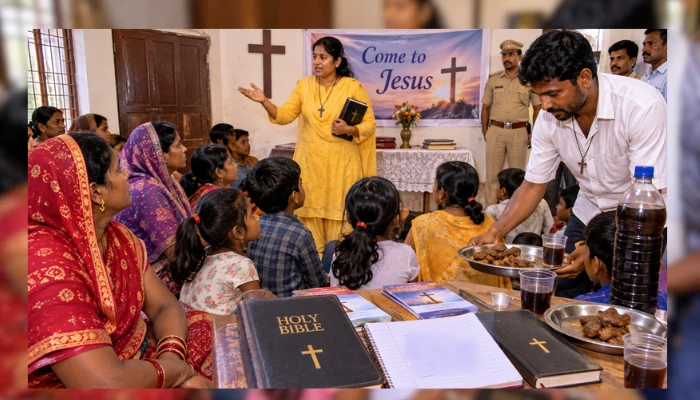
In Amethi, Uttar Pradesh, Hindus from economically vulnerable families, including those belonging to Scheduled Caste communities, were targeted for religious conversion by Christian missionaries. The victims were offered inducements during a Christian prayer meeting organised under the guise of religious worship. Around 35 people, predominantly women and children, attended the gathering, where meat and alcohol were served, and Christian religious material was distributed. The incident came to light on Sunday, 22 November 2026, after Mahant Gurubaksh Das of Baba Ganga Das Kuti and members of the Rashtriya Swayamsevak Sangh received information around 1 pm about a prayer meeting being held at a house on Sindurwa Road. The residence belonged to Rajkumar and his wife, Suryakala. Upon reaching the location, they found people who had arrived from Maharashtra, Uttarakhand, Odisha and Azamgarh. The gathering took place around 3 pm under the jurisdiction of Kamarouli Police Station. Mahant Gurubaksh Das subsequently informed the police and lodged a complaint. The Christian organisers targeted Hindus from Scheduled Caste communities and other economically vulnerable families, luring them with inducements and encouraging them to convert to Christianity. Around 35 people, most of them women and children, attended the gathering, where meat and alcohol were served. Bibles and Christian religious promotional material were found inside the house, while shoes, slippers, food plates and disposable glasses were found lying in the veranda. The police detained six women and four men in connection with the incident. Among those detained was Royal Rodrix, who had travelled from Mumbai to attend the prayer meeting. He denied the conversion allegations, stating that they had visited the residence merely to pray and meet Suryakala. Superintendent of Police Sarvanan T. confirmed that a Skoda car was recovered from the spot and a Bible was found inside the house. He stated that the detained individuals belonged to Maharashtra, Uttarakhand, Azamgarh, Amethi and other places, and added that the matter was under investigation. Pawan Tiwari of the Rashtriya Swayamsevak Sangh's Jagdishpur unit stated that similar activities had been taking place in the region every year during November and December, with poor and needy people being offered inducements to convert to Christianity. He also referred to an earlier conversion-related incident involving a local school principal and teachers. Children's notebooks recovered in that earlier case contained Christian religious messages, including the line, “Jesus is the only God; come to him.” Pawan Tiwari pointed to the use of children's notebooks to introduce such religious messages and called for an end to the conversion activities. Notably, the Hinduphobia Tracker had documented the earlier incident involving a missionary school principal and teachers who targeted impoverished Hindu families, including women and children, by offering monetary inducements and pressuring them to embrace Christianity through prayer meetings and religious messaging in children's notebooks.
Why it is Hate Crime ?
The primary category selected in this case is: Predatory Proselytisation. The subcategory selected is: Conversion/ attempts to convert by inducement. Predatory Proselytisation is not just limited to threat, harassment, force and violence, but it also has contours of stealth. In several cases, the Hindu victim is exploited to convert, with non-Hindus taking advantage of their poverty. In such cases, the Hindu victim who is suffering financially is offered monetary benefits, including lucrative offers for jobs, health treatment, education, etc., to induce the victim to change his/her religion. In such cases, the religious identity of the victim and the aim to disenfranchise him from his faith form the heart of the crime. Also, taking advantage of and exploiting an individual’s economic vulnerabilities is widely acknowledged as exploitation, forms of which are often penalised by law. Such cases therefore are considered religiously motivated hate crimes since the victim’s religious identity forms the very heart of the crime itself. This incident was added to the tracker because it illustrated how the socio-economic vulnerability of the Hindu victims was exploited to encourage them to abandon Hinduism and convert to Christianity. At the outset, the victims were lured to the gathering under the pretext of a Christian prayer meeting, which was presented as an occasion for religious worship but used to facilitate conversion. Instead of being a genuine gathering for prayer and spiritual discourse, it was used to draw Hindu attendees into an environment where inducements were offered to pressure them into embracing Christianity. Using the pretence of religious worship to conceal conversion efforts demonstrates a manipulative tactic that exploited the victims' trust and deprived them of an informed understanding of the gathering's purpose. Such deception, wherein a prayer meeting served as a cover for conversion through inducements, showcases religious hostility by exploiting Hindu attendees' trust to influence them to abandon their faith. Furthermore, the material inducements offered to Hindu victims were not acts of goodwill but coercive means aimed at arm-twisting them by exploiting their socio-economic vulnerabilities and pressuring them to convert to Christianity. Offering material benefits to economically disadvantaged Hindus to influence their religious allegiance demonstrated that their financial hardship was being weaponised to facilitate conversion rather than addressed without conditions. Such practices undermined the victims' religious autonomy by placing material incentives alongside the expectation that they abandon their ancestral faith. Treating economic distress as an opportunity to persuade Hindus to renounce their religion also reflected an attitude that their Hindu identity was expendable and could be displaced through financial inducements. Exploiting poverty to facilitate religious conversion therefore demonstrated hostility towards Hinduism and disregard for the victims' right to retain their faith without coercive pressure. The Hindu victims also included minors. Being a minor means the element of consent and genuine change of conscience was missing ab initio. Minors, due to their young age and lack of maturity, are more vulnerable to manipulation and coercion, and the Christian perpetrators in this case exploited this age vulnerability of the minor Hindu victims to lure them into prayer meetings and offer them inducements along with other Hindus and force them to convert to Christianity. The inclusion of Hindu children in conversion activities through inducements and deceptive religious gatherings demonstrates the coercive nature of the conversion effort, as their age made them particularly susceptible to influence and deprived them of the maturity required to independently assess such religious pressure. Targeting minors in this manner also exposed an attempt to influence Hindu children away from their inherited religious identity at a formative stage, showcasing religious animosity and disregard for their religious autonomy. The Christian faith, by its very theological foundations, places a strong emphasis on proselytisation. In pursuit of conversion objectives, Christian evangelists often employ unethical means, ranging from psychological pressure and misinformation to inducements such as money or jobs. In such cases, Christian missionary groups often target socially and economically vulnerable Hindus to further their agenda of religious conversions. This form of coercion strips Hindus of their agency and dignity and enforces forced conversions. These are not random or isolated incidents, but rather premeditated efforts to undermine the Hindu faith, persuade Hindus to discard their own faith, and convert to Christianity. Such acts are deeply rooted in animosity towards Hinduism and the Hindu community, making it an instance of religiously motivated crime. Such instances of predatory proselytisation are manifestations of doctrinal hostility embedded within Abrahamic religions like Christianity that regard non-adherents as inferior and encourage their conversion. This leads to the dehumanisation of those who do not share the faith and creates an environment in which coercive conversion becomes an instrument for stripping Hindu individuals of their religious identity. Since this incident meets the parameters of a hate crime, it is being added to the Hate Crime Database of the tracker. Disclaimer: Media reports stated that around 35 people, predominantly women and children, attended the prayer meeting in Amethi district, Uttar Pradesh, but did not provide a gender-wise or age-wise breakdown. For documentation clarity, the Hinduphobia Tracker has applied a proportional estimate based on the rural population distribution. Accordingly, the 35 attendees are estimated as 23 adults (67%) and 12 children (33%). These figures are demographic estimates and not independently verified counts.
Victim Details
Total Victim
35
Deceased
0
Gender
- Male 0
- Female 0
- Third Gender 0
- Unknown 35
Caste
- SC/ST 35
- OBC 0
- General 0
- Unknown 0
Age Group
- Minor 12
- Adult 23
- Senior Citizen 0
- Unknown 0


Case Status
Arrested


Perpetrators Details
Perpetrators
Christian Extremists
Perpetrators Range
From 10 to 100
Perpetrators Gender
both
 Sources