Hindu tribals targeted through healing meetings for religious conversion; Christian pastor insults Bhagwan Shri Ram
 Dhamtari, Chhattisgarh, India
 21 November, 2026
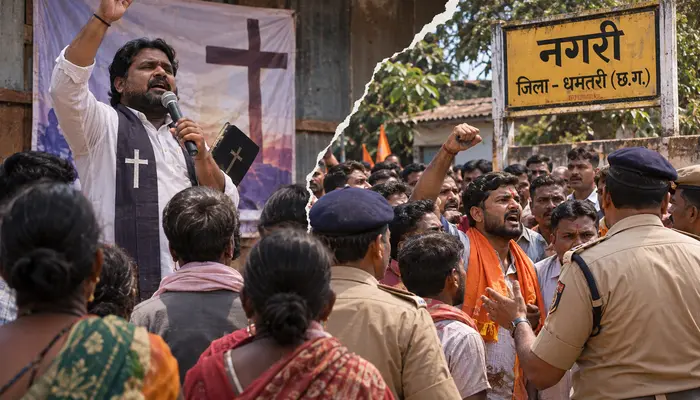
Case Summary
In Nagari, Dhamtari, Chhattisgarh, Hindu tribals were targeted for religious conversion by Christian pastor Dinesh Sahu under the guise of a prayer meeting. On Sunday, 22 November 2026, a prayer and healing meeting was held inside a house-like building in Ward No. 12 of Nagari town. The incident came to light after members of Hindu organisations, including the Hindu Jagran Manch and Sakal Hindu Samaj, reached the location, triggering protests. The organisations revealed that prayer and healing gatherings were used as a pretext to lure Hindu tribals into religious conversion. Members of the organisations stated that they had received repeated complaints about such gatherings being held regularly at a building situated in an isolated area behind the Nagari police station. According to Chitresh Sahu and Dakeshwar Sahu of the Hindu Jagran Manch, the gathering was attended by members of the Hindu community, while no members of the Christian community were present. They stated that the meetings were being conducted without following the prescribed rules and that religious conversions were taking place in violation of the Chhattisgarh Religious Freedom Act. The Hindu organisations staged a demonstration and a sit-in protest outside the building, demanding that the gathering be stopped. They also accused those conducting the meetings of misleading and enticing innocent tribal people into religious conversion under the guise of prayer and healing. During the protest, a confrontation broke out between members of the Hindu organisations and the people present at the building. Members of the Hindu organisations also stated that Pastor Dinesh Sahu threatened them openly and used abusive language against the Hindu community. He also made objectionable remarks about Bhagwan Shri Ram. As the situation escalated, an altercation also broke out between the protesters and the police personnel who arrived at the scene. Following information about the disturbance, personnel from the Nagari police station, along with the SDM, SDOP, CSP Abhishek Chaturvedi, administrative officials and additional police personnel, reached the location. The police intervened, separated the two sides and brought the situation under control. Following the incident, the Sakal Hindu Samaj submitted a memorandum to SDOP Vipin Rangani, demanding strict enforcement of the Chhattisgarh Religious Freedom Act, an investigation into the healing gatherings being conducted in the area, legal action against those involved in stone-pelting, and action against individuals who had hurt religious sentiments. Members of the Hindu organisations also submitted a written complaint to the administration, demanding that the illegal healing gatherings be stopped and those responsible be prosecuted. They stated that they had previously brought the matter to the administration's attention, but no action had been taken. The Hindu Jagran Manch further announced that its protest would continue until action was taken. CSP Abhishek Chaturvedi confirmed that a prayer meeting had been taking place in Nagari, following which members of a Hindu organisation arrived and began protesting and raising slogans. SDOP Vipin Rangani stated that the police were examining the application submitted by the organisation. The authorities said that an investigation would be conducted, based on which further legal action would be taken.
Why it is Hate Crime ?
The primary category selected in this case is: Predatory Proselytisation. The subcategory selected is: Conversion/ attempts to convert by inducement. Predatory Proselytisation is not just limited to threat, harassment, force and violence, but it also has contours of stealth. In several cases, the Hindu victim is exploited to convert, with non-Hindus taking advantage of their poverty. In such cases, the Hindu victim who is suffering financially is offered monetary benefits, including lucrative offers for jobs, health treatment, education, etc, to induce the victim into changing his/her religion. In such cases, the religious identity of the victim and the aim to disenfranchise him from his faith form the heart of the crime. Also, taking advantage of and exploiting an individual’s economic vulnerabilities is widely acknowledged as exploitation, forms of which are often penalised by law. Such cases therefore are considered religiously motivated hate crimes since the victim’s religious identity forms the very heart of the crime itself. The other primary category selected here is - Hate speech against Hindus. Within it, the sub-category selected here is - Anti-Hindu slurs, mocking faith. Anti-Hindu slurs and the deliberate mocking of the Hindu faith owing to religious animosity involve the usage of derogatory terms, stereotypes, or offensive references to religious practices, symbols, or figures. One of the common anti-Hindu slurs used against Hindus is “cow-worshipper” and “cow piss drinker”. The intention of using this term is to demean and mock Hindus as a group and their religious beliefs since Hindus consider the cow holy. Additionally, some symbols and the slurs attached to them have a historical context that exacerbates the insult, hate, stereotyping, dehumanisation and oppression against Hindus. Cow worship has been used for centuries to denigrate Hindus, insult their faith and oppress Hindus specifically as a religious group. There has been overwhelming documentation about how cow slaughter has been used to persecute Hindus with cow meat being thrown in temples and places of worship. There has also been overwhelming documentation where cow meat (beef) has been force-fed to Hindus to either forcefully convert them to Islam or denigrate their faith. Apart from cow worship, the Swastika – which holds deep religious significance for the Hindus – has also been misinterpreted and distorted to use as a slur against Hindus. Similarly, the worship of the Shivling has been used by supremacist ideologies and religions to denigrate Hindus owing to religious animosity. Such slurs and denigration stem out of inherent animosity and hate towards Hindus and their faith, therefore, it is categorised as hate speech targeted at Hindus specifically owing to their religious identity. The incident involved the targeting of Hindu tribals through religious gatherings organised under the guise of prayer and healing by a Christian pastor. The Changai Sabha format, often described publicly as a faith healing gathering, is a well-recognised tool in organised Christian proselytisation networks. These meetings usually employ songs, testimonies and emotionally charged prayer sessions to influence and induce vulnerable individuals without openly declaring the underlying objective. The absence of transparency is itself central to the method. People attend believing they are seeking comfort, healing or spiritual support, only to be gradually drawn into teachings that undermine their own religious identity and introduce them to the Christian framework presented as the only path to relief. Furthermore, what was presented as a simple prayer gathering inside a house was in reality a covert attempt at religious conversion. These were not genuine community prayers but calculated efforts to exploit the trust of Hindus and manipulate them into abandoning their faith. The organisers deliberately held the meeting in secrecy and without permission from the administration, indicating a deliberate and deceptive strategy designed to avoid public attention and scrutiny. By conducting such gatherings covertly, the Christian missionaries sought to manipulate vulnerable Hindus, taking advantage of their emotional and social circumstances to push them towards conversion. The healing meetings served as a means of inducement to attract Hindu tribals and influence them towards religious conversion. Offering healing through religious gatherings to vulnerable Hindus, particularly those seeking relief from illness or personal difficulties, can exploit their need for assistance and hope to advance a conversion agenda. Such practices are not acts of charity when healing is used as an instrument to persuade people to abandon their ancestral faith. Instead, they constitute a calculated form of religious inducement that exploits vulnerability and compromises an individual's freedom to make an independent religious choice. Such instances are seen in many cases where members of Christian missionary groups target socially and economically vulnerable Hindus to further their agenda of religious conversions. This form of coercion strips people of their agency and dignity and results in coerced conversions. These are not random or isolated incidents, but rather cases deeply rooted in religious animosity towards Hindu victims. The pastor's derogatory remarks about Bhagwan Shri Ram, one of the most revered deities in Hinduism and a central figure of Hindu faith, constituted a direct attack on Hindu religious sentiments. Bhagwan Shri Ram holds immense religious and spiritual significance for Hindus, and insulting him amounted to denigrating a deeply cherished object of Hindu devotion. Such remarks went beyond religious disagreement or criticism and amounted to the deliberate disparagement of Hindu beliefs. By directing abusive language and derogatory remarks at the Hindu community and its revered deity, the pastor displayed contempt for Hindu religious sentiments and engaged in conduct that fostered religious hostility towards Hindus. The pastor's use of abusive language against the Hindu community and threats towards members of Hindu organisations who protested against the conversion activities further demonstrated religious hostility. Instead of addressing their objections, he resorted to verbal abuse and intimidation directed at Hindus asserting their right to protect their religious community from coercive proselytisation. Abusing and threatening members of the Hindu community for opposing activities they considered harmful to their faith demonstrated contempt for their religious identity and an attempt to intimidate those who stood against the conversion efforts. The Christian faith, by its very theological foundations, places a strong emphasis on proselytisation. In pursuit of conversion objectives, Christian evangelists often employ unethical means, ranging from psychological pressure and misinformation to inducements such as money or jobs. In such cases, Christian missionary groups often target and brainwash socially and economically vulnerable Hindus to further their agenda of religious conversions. This form of coercion strips Hindus of their agency and dignity and enforces forced conversions. These are not random or isolated incidents, but rather premeditated efforts to undermine the Hindu faith, persuade Hindus to discard their own faith, and convert to Christianity. Such acts were deeply rooted in religious animosity towards Hindu victims, and thus, this case was added to the tracker. Disclaimer: Since one perpetrator, identified as pastor Dinesh Sahu, was explicitly named in the reports, the perpetrator count has been recorded as 1. The involvement of any additional perpetrators has not been established.


Case Status
Complaint filed


Perpetrators Details
Perpetrators
Christian Extremists
Perpetrators Range
One Person
Perpetrators Gender
male
 Sources