Hindu temple premises vandalised, bhajans forcibly stopped, and priest assaulted; perpetrator had previously threatened to demolish the temple
 Jamshedpur, Jharkhand, India
 20 November, 2026
Case Summary
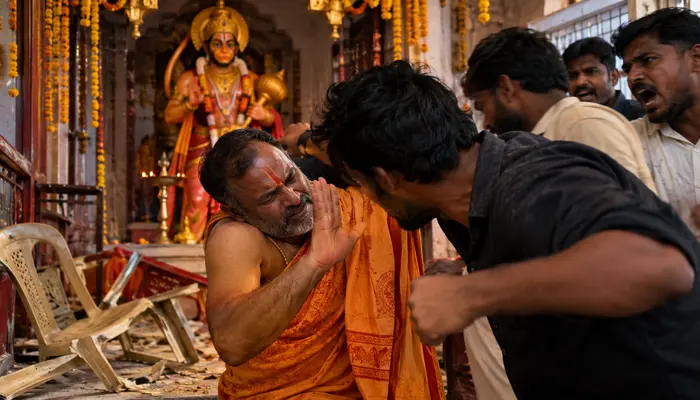
In Jamshedpur, Jharkhand, a Hindu temple dedicated to Lord Hanuman was targeted in an act of desecration by a miscreant. The perpetrator vandalised the temple premises, breaking chairs kept inside, and disrupted religious worship by forcibly stopping bhajans being played at the temple. He also physically assaulted the temple priest and subjected him to abusive behaviour. The incident followed repeated disturbances at the temple, during which the perpetrator had previously threatened to demolish it. The incident took place on 21 November 2026, between approximately 6:00 pm and 7:00 pm. According to Bharatiya Janata Party (BJP) Birsanagar Mandal president Bapan Banerjee, the accused, identified as Bapi Sardar, frequently visited the temple while intoxicated, created disturbances, and threatened to demolish the temple while raising allegations of encroachment. Local residents had previously intervened, attempted to reason with him, and sent him home. During the incident, Bapi Sardar engaged in verbal altercations with several residents of the settlement, stopped the bhajans playing inside the Bajrangbali temple, physically assaulted the priest and subjected him to abusive behaviour, and broke chairs kept within the temple premises. Upon receiving information about the incident, Bapan Banerjee left his meeting and rushed to the spot. He attempted to intervene and reason with the accused, urging him to stop his actions, but Bapi Sardar refused to heed his intervention. Bapan Banerjee, who had constructed the Bajrangbali temple in his residential locality with the assistance of local residents, also raised concerns over the closed-circuit television (CCTV) footage of the incident. Resident Manik Dutta provided footage showing only the altercation between Bapan Banerjee and Bapi Sardar, while recordings covering the verbal altercations involving other residents between 6:00 pm and 7:00 pm were not made available. Questioning the selective disclosure of the footage, Banerjee demanded that the police examine the complete CCTV recordings to establish the sequence of events and investigate the involvement of all those concerned. Banerjee also highlighted the encroachment upon a government drain situated in front of the temple. He stated that the drain had been encroached upon to facilitate a construction-material business involving stone chips (gitti), sand (balu) and bricks (eent). He further stated that after he objected to the encroachment and the business activities, old video recordings were being used to create a misleading narrative and portray him in a negative light. Demanding an impartial investigation, Bapan Banerjee called upon the police administration to examine the complete CCTV footage and ascertain the roles of everyone involved, specifically naming Bapi Sardar, Manik Dutta and Sandeep Samant. He warned that if the police failed to take appropriate action, he would stage a sit-in protest (dharna), followed by surrounding and blockading the police station alongside workers of the Bharatiya Janata Party Birsanagar Mandal. He also stated that CCTV footage was available with him and expressed his willingness to extend full cooperation to the police in the investigation.
Why it is Hate Crime ?
The primary category selected in this case is: Attack on Hindu religious representations. Within this, the subcategory selected is: Attack on Temples. In Hinduism, a temple is the abode of the Deity. The Deity in the Temple is consecrated, thereby, making it a real, breathing entity. Hindus believe that not just the Deity but the temple premises itself are sacred to Hindus since Hindus hold the faith that the entire Temple space is an amalgamation of the divine energy of the deity. Given the central significance of Temples in Hindu Dharma, any attack against a Hindu Temple or its peripheral premises is an attack on the faith itself and is born out of animosity towards the faith, of which, the Temple is a central tenet. Any manner of attack against a Temple and/or its premises would therefore be considered a religiously motivated hate crime. The other sub-category selected is: Breaking rules of place of worship. Sanatan Dharma is not a religion of one book, which is to say that while it has religious scriptures that form the central tenets of the faith, there are several traditions followed through thousands of years, mostly passed from generation to generation orally. One of these oral traditions or written traditions is the rules of specific temples. Certain temples have rules which are traditional rules, dependent on the worship of the presiding deities. These rules and traditions have been followed for thousands of years whether they find scriptural mention or not. Such traditions are based on the nature and rules of worship of the presiding deity of that temple. Any non-compliance of these traditions owing to animosity towards the faith or for the sake of activism stems not only from the lack of faith in the presiding deity but also disregard for the faith of the devotees of that deity/temple and implicit bias against the faith, the tradition and the deity itself. Since these specific traditions are central to the faith of the devotees of that specific temple and presiding deity, any non-compliance with these traditional rules would be considered a religiously motivated hate crime. The other subcategory selected is: Defiling religious customs. Sanatan Dharma is not a religion of one book, which is to say that while it has religious scriptures that form the central tenets of the faith, there are several traditions followed through thousands of years, mostly passed from generation to generation orally. There are several such customs and traditions that are followed by various Hindus and Hindu sects. Defiling of these traditions and customs is a breach of an individual or group’s religious practices. Such practices can range from dietary restrictions like not eating non-vegetarian food for a certain period of the year, not eating non-vegetarian food at all, not eating beef since the cow is considered holy in Hinduism, the sanctity of religious customs followed in the house (like many ISCKON devotees), etc. Any malicious action leading to the breach of such traditions or defilement of these traditions owing to animosity towards the faith or for the sake of activism stems not only from the lack of faith in the religion itself but also from disregard for the faith of the devotees who follow the customs/traditions and implicit bias against the faith, the tradition itself. Since these specific traditions are central to the faith of the devotees of that specific sect of Hindus, any non-compliance with these traditional rules would be considered a religiously motivated hate crime. This incident was a clear example of a religiously driven hate crime, as the perpetrator vandalised the temple premises, disrupted and forcibly stopped sacred bhajans being played inside the temple, assaulted the temple priest and subjected him to abusive behaviour, and had previously threatened to demolish the temple. He also repeatedly entered the temple in an intoxicated state and created disturbances. This pattern of repeated interference with Hindu religious worship, threats against the temple, and acts of violence and vandalism demonstrated deep-seated hostility towards Hinduism, Hindu religious practices and the Hindu community. Hindu temples hold immense religious significance for devotees and are considered sacred places of worship, where Hindus believe the divine resides. They serve as spiritual centres for prayer, devotion, religious rituals, festivals and the worship of deities, while also preserving Hindu traditions and providing devotees with a sacred space to connect with the divine. The sanctity of Hindu temples is traditionally maintained through religious discipline, purity and adherence to customs governing temple worship. Practices include keeping impure substances such as alcohol, meat and other prohibited items away from temple premises, as they are considered incompatible with the sacred environment of worship. The perpetrator repeatedly entered the temple in an intoxicated state, disregarded its religious customs, disrupted its sanctity and damaged temple property. His conduct demonstrated a blatant disregard for Hindu religious sentiments and the sacred customs observed by devotees. Deliberately violating the sanctity of a Hindu place of worship, creating disturbances and vandalising its premises reflected hostility towards Hinduism and amounted to an attack on the faith and religious sentiments of the Hindu community. The perpetrator also forcibly stopped bhajans being played inside the temple. Bhajans are devotional songs dedicated to Hindu deities and form an important part of Hindu worship. They are sung or played in temples to express devotion, invoke the divine, create a spiritually uplifting atmosphere and facilitate collective worship. Deliberately interrupting and forcibly stopping devotional bhajans inside a Hindu temple was an act of desecration of its religious practices. By disrupting devotional worship and preventing bhajans from being played, the perpetrator interfered with an integral part of the temple's religious atmosphere and demonstrated hostility towards Hindu religious observances and the faith of devotees. The perpetrator also physically assaulted the temple priest and subjected him to abusive behaviour. Hindu temple priests hold an important religious position as custodians of the temple, performing rituals, conducting worship, offering prayers to the deities and facilitating devotees' religious observances. Assaulting and humiliating a priest inside the temple, amid the disruption of worship and vandalism of the premises, further reflected contempt for Hindu religious institutions and those responsible for maintaining their sanctity. The attack on the priest in the context of the broader incident demonstrated hostility towards the temple's religious functioning and the Hindu community's religious sentiments. The perpetrator had also repeatedly threatened to demolish the temple in the past. Hindu temples are sacred religious institutions, and threatening to destroy one constitutes a threat against a place of worship central to the faith and religious identity of its devotees. His threats to demolish the temple demonstrated hostility towards the Hindu place of worship and the religious community associated with it. Furthermore, the fact that he had previously threatened to demolish the temple before subsequently creating disturbances, vandalising its premises, forcibly stopping bhajans and assaulting the priest indicated that his earlier threats were not isolated verbal incidents but were followed by acts of aggression directed at the temple and its religious functioning. The perpetrator repeatedly raised allegations of encroachment concerning the temple. If he genuinely believed that an encroachment had taken place, he could have approached the relevant local authorities and pursued the matter through lawful channels. Instead, he repeatedly created disturbances at the temple, threatened to demolish it, disrupted religious worship and vandalised its premises. His conduct demonstrated that the encroachment dispute was used as a pretext to target the Hindu temple, its religious activities and those associated with it, reflecting hostility towards the Hindu place of worship and the religious sentiments of the Hindu community. Overall, since this incident meets the parameters of a religiously driven crime, it is being added to the hate crime database of the Hinduphobia Tracker.
Victim Details
Total Victim
1
Deceased
0
Gender
- Male 1
- Female 0
- Third Gender 0
- Unknown 0
Caste
- SC/ST 0
- OBC 0
- General 0
- Unknown 1
Age Group
- Minor 0
- Adult 1
- Senior Citizen 0
- Unknown 0


Case Status
Complaint filed


Perpetrators Details
Perpetrators
Others
Perpetrators Range
One Person
Perpetrators Gender
male
 Sources





