Hindu man attacked by Muslim man and associates over consensual relationship with his sister in Agra, Uttar Pradesh
 Agra, Uttar Pradesh, India
 11 November, 2026

Case Summary
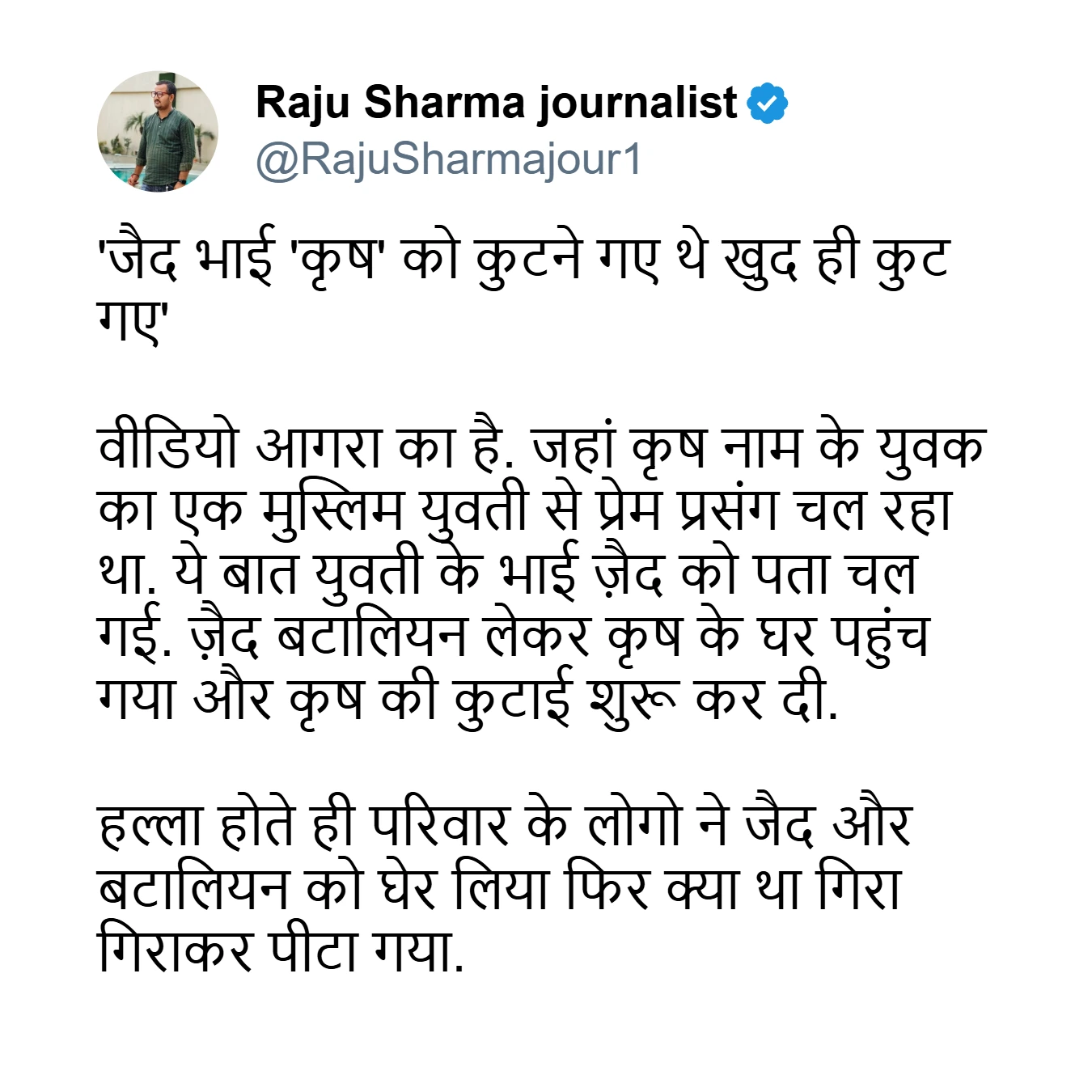
In Agra, Uttar Pradesh, a Hindu man identified as Krish was attacked at his residence by a group of Muslim men for being in a relationship with a Muslim woman. According to media reports, Krish was in a consensual relationship with the sister of a Muslim man named Zaid. Upon learning about the relationship, Zaid opposed it and arrived at Krish’s residence with several Muslim associates to confront and assault him. Zaid and his associates began assaulting Krish, following which Krish’s family members intervened. They confronted and surrounded Zaid and the Muslim men accompanying him, triggering a physical altercation. Zaid and his associates were overpowered and beaten by Krish’s family members during the clash. A video of the incident went viral on social media, showing the Muslim perpetrators pleading for forgiveness as the confrontation escalated. At the time of writing, details regarding any police action remained unknown.
Case Images
Why it is Hate Crime ?
The primary category selected for this case is: Men attacked for being associated with non-Hindu women. The subcategory selected is: Attacked by a non-Hindu partner/or her family. When Hindu men are in a relationship with non-Hindu women, there are cases where the man is forced to convert his religion and upon his refusal to do so, the partner or/and her family attacks the victim. Such relationships may be consensual with the religious identity of the non-Hindu woman known to the victim. Somewhere along the relationship, the non-Hindu woman or her family starts forcing/pressurizing the Hindu man to convert. In some of these cases, the association could be non-consensual as well or, the religious identity of the non-Hindu woman could be previously unknown to the Hindu victim. In such cases, the Hindu man is first forced/pressurized to change his religion by the non-Hindu woman or her family. The force/pressure could involve threats. The trigger for directing violence against the Hindu man is in these cases his refusal to comply and change his religion under threat and/or force. In other cases that have been documented, it is also seen that the Hindu partner is assaulted by the non-Hindu woman or her family simply for his relationship with the non-Hindu woman and by virtue of him following the Hindu faith and not the religion of the non-Hindu woman. In such cases, the relationship is consensual in most cases and the religion of both partners is known to the other. Often, in such cases, there is no direct force/pressure to convert either, however, the attack is a result of the Hindu man being in a relationship with the non-Hindu partner and not following her religion/following Hinduism specifically. Such cases are driven by specific religious motivations and against the religious identity of the victim and are therefore qualified as hate crimes. In this case, a Hindu man was attacked by a group of Muslim men over his consensual relationship with a Muslim woman. While the immediate motive for the confrontation was the relationship, it could be argued that the incident was a personal dispute and, as such, should not be included in the hate crime tracker. Therefore, it becomes essential to understand why this case has been included in the hate crime database. In this incident, the primary factor establishing its relevance for documentation is the nature of the attack. The Hindu victim was in a consensual relationship with a Muslim woman, and her brother, Zaid, upon learning about the relationship, arrived at the victim’s residence with several Muslim associates to confront and assault him. The victim was attacked over his relationship with Zaid’s sister, and the involvement of multiple Muslim men in the confrontation further highlights the circumstances surrounding the incident. In several cases where a Hindu man is in a relationship with a Muslim woman, the family of the Muslim woman ends up assaulting or murdering the man because of their disapproval of the relationship. In such cases, the relationship is consensual, and the Hindu man and Muslim woman are with each other, knowing each other’s identity fully well. Such cases are often called ‘honour killings’ and are seen in associations across religions, castes, economic strata, etc. In several such cases, the motivations for the violence or murder are stated and clear. For example, in some cases, the perpetrators would clearly mention what their main motivation to commit the crime was, whether it was because the partner was economically weaker, from a different caste or religion. In some cases, however, the motives are not stated and/or reported. To determine whether such cases are religiously motivated hate crimes, in the absence of a clearly stated motive, one has to understand what could possibly be the main factor which the perpetrator's family would believe diminishes the family’s ‘honour’, leading to the crime. For the purpose of this tracker, we would only be looking at cases where one of the determining factors of the crime is religion, which is to say that the man belongs to the Hindu faith and the woman to a non-Hindu faith. In such cases, even if the motivation is not stated, it can be said that the determining factor or at least one of the main considerations, leading to the crime would be the religious identity of the Hindu man, especially if the woman in the relationship is a Muslim. In the Islamic faith, a marriage is deemed illegitimate if the non-Muslim partner does not convert to Islam. For those who practice the faith, when the Muslim woman in their family marries or is in a relationship with a Hindu man without the man converting to Islam, the difference in religions followed becomes the main point of disapproval for the family of the Muslim woman. Because of the ingrained element of religious supremacy in Islam, even if the motivations are not explicit, it can reasonably be concluded as one of the determining factors of the assault or murder committed by the Muslim family against the Hindu man. Considering the same parameters, even in this incident involving the attack on Krish, one of the motivating factors behind Zaid’s opposition to the relationship was Krish’s Hindu religious identity. Krish was in a consensual relationship with Zaid’s Muslim sister, but Zaid viewed the relationship as a religious transgression, rooted in Islamic theology, which prohibits Muslim women from marrying or being in relationship with non-Muslim men unless they convert to Islam. His decision to arrive at Krish’s residence with several Muslim associates and assault him over the relationship reflects hostility towards a Hindu man for being involved with a Muslim woman. The use of violence against Krish for his religious identity and his choice of partner demonstrates how religious doctrines and the perception of interfaith relationships as transgressions can translate into hostility and aggression against Hindus. Targeting a Hindu man for entering into a consensual relationship with a Muslim woman, and using violence to intimidate him over that relationship, showcases religious intolerance and animosity directed towards him on account of his faith. Such incidents, where Hindu men are attacked by members of a Muslim woman's family over consensual relationships, demonstrates hostility and religious disapproval directed towards Hindu men because of their religious identity and their choice of partner. Therefore, this case warrants inclusion in the hate crime database of the tracker. Disclaimer: Although multiple perpetrators were involved in the attack, the total number of assailants was not specified. Only Zaid was explicitly identified by name. Hence, the perpetrator count has been recorded as one for documentation purposes. Hinduphobia Tracker records incident dates based on when the crime occurred, rather than when it was reported in the media. In this case, media reports did not specify the exact date of the incident. The earliest date on which the incident came to light on social media was 12 November 2026. Hence, this date has been recorded as the indicative incident date for documentation purposes only.
Victim Details
Total Victim
1
Deceased
0
Gender
- Male 1
- Female 0
- Third Gender 0
- Unknown 0
Caste
- SC/ST 0
- OBC 0
- General 0
- Unknown 1
Age Group
- Minor 0
- Adult 1
- Senior Citizen 0
- Unknown 0


Case Status
Unknown


Perpetrators Details
Perpetrators
Muslim Extremists
Perpetrators Range
One Person
Perpetrators Gender
male
 Sources





