Hindu woman sexually exploited and pressured to convert to Islam by Muslim man posing as Hindu; threatened with death upon refusal
 Meerut, Uttar Pradesh, India
 20 May, 2025
Case Summary
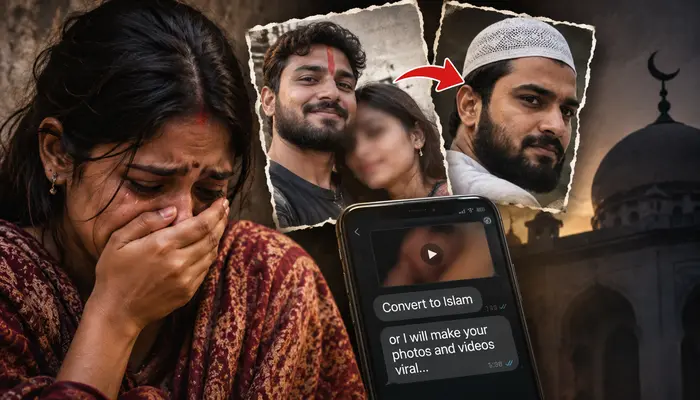
A Hindu woman was deceived into a relationship and sexually exploited by a Muslim man named Faisal who concealed his religious identity and posed as a Hindu. Furthermore, he also pressured her to convert to Islam and, upon her refusal, he assaulted her and threatened her with death and the circulation of her photographs and videos on social media. On 21 November 2026, the 24-year-old Hindu woman from the Nauchandi police station area of Meerut, Uttar Pradesh, approached the Senior Superintendent of Police (SSP) office and submitted a written complaint against the Muslim accused, a resident of the Mundali police station area. According to the complaint, the victim became acquainted with the accused through social media, approximately one and a half years earlier, where he introduced himself as Deepak and concealed his actual religious identity. He gradually developed a friendship with her, which eventually turned into a romantic relationship. The victim stated that, relying on his promise of marriage, she entered into a relationship with him, during which he established physical relations with her and sexually exploited her over the course of approximately one year. She subsequently discovered that the accused, whom she had known as Deepak, was actually named Faisal. When she confronted him about concealing his identity and asked him to marry her, he refused and subjected her to abusive behaviour. He subsequently pressured her to abandon Hinduism and embrace Islam as a condition for marrying him. However, the victim refused to convert. Following her refusal, Faisal threatened to kill her over the phone. He also threatened to circulate her photographs and videos on social media after she resisted his actions. Furthermore, he also assaulted her and threatened to kill her parents. Fearing for her safety, the victim approached the SSP office on Saturday, 21 November 2026, and sought action against Faisal and another individual whom she named in her complaint. SSP officials directed the Nauchandi police to investigate the matter and take appropriate action. SP City Vinayak Gopal Bhosale confirmed that the police were examining the statements contained in the woman's written complaint. Separately, Nauchandi police station in-charge Arun Bhati stated that a case had already been registered against the Muslim man and that the case was being investigated, with further action to be taken based on the findings of the investigation.
Why it is Hate Crime ?
This case has been added to the tracker under the primary category of - Crimes against women in relationships and other sexual crimes. Within this, the subcategory selected is: Man pretends to be Hindu, with the tertiary category being - Name changed. When a non-Hindu man pretends to be a Hindu to deceive a Hindu woman into a relationship, the act is seen as triggered by malicious intentions. In some cases, the woman eventually accepts the man’s original religious identity and converts after the man’s identity is revealed. These cases could be argued as cases of religious brainwashing and a result of the pressure a woman feels after getting into a relationship with a man. The woman, it can be argued, also changed her religious identity because of the stigma she believes she might face if she chooses to walk out of a deceptive relationship. However, for the purpose of documenting hate crimes, the cases in this subcategory are limited to those where there is explicit violence aimed at religious conversion against the wishes of the victim (force-feeding beef, blackmailing with intimate videos, rape on refusal to convert, etc., or if the woman herself complains of the man’s religious deception. In such cases, it is established that the deception of the non-Hindu man had a specific aim of religious conversion or targeting of the victim due to her Hindu religious identity, therefore, making it a religiously motivated hate crime. The other subcategory selected in this case is - Forced conversion before marriage. In such cases, a non-Hindu man is in a relationship with a Hindu woman when the pressure to convert her religion begins to manifest. In such cases, typically, two patterns emerge. First, when the relationship is consensual, and the religious identity of the perpetrator is known to the Hindu woman in the relationship, however, at some point during the relationship, the non-Hindu man starts to force the victim to convert her religion and give up her Hindu religious identity. The second is when the woman gets into a marriage with the man, pretending to share her faith. Later, when the truth is revealed, the man starts pressuring the woman to convert to his religion and give up her religious identity. In both situations, the methods used to force the victim to convert her religion often revolve around force-feeding beef, forcing her to wear a hijab, forcing her to read the Kalima, or even pressuring the victim to do ‘Nikah’, which is marriage under Islamic law, with a prerequisite being conversion to Islam. Cases where a Hindu woman consensually converts to Islam in a relationship will be left out of the hate crime database, even though it could be argued in several cases that the conversion was a result of religious brainwashing. The other sub-category selected here is - Assault or threat upon refusal to convert. When Hindu women are in a relationship with non-Hindu men, there are cases where the woman faces threats or assault after she refuses to convert and change her religious identity owing to pressure/force by the non-Hindu man. Such relationships may be consensual with the religious identity of the non-Hindu man known to the victim. Somewhere along the relationship, the non-Hindu man starts pressurizing the Hindu woman to convert to Islam and upon her refusal, assaults or threatens the victim. Such cases are driven by specific religious motivations and against the religious identity of the victim and are therefore qualified as hate crimes. Cases where the Hindu woman converts to Islam and does not file a complaint about the force or threat, are not considered a part of the hate tracker, even though, it may be argued that the woman was brainwashed or threatened to convert to Islam. The religious dimension of this case was established by the deliberate concealment of the accused's Muslim identity and his subsequent demand that the Hindu woman abandon her faith as a condition for marriage. The use of a false Hindu identity was a significant aspect of the religious targeting. The accused deliberately concealed his religious identity to initiate and sustain a relationship with a Hindu woman. This itself is a clear manifestation of bias and malicious intent towards the victim's religion. By concealing his true identity, he exploited her trust, targeting her under false pretences. This indicates a premeditated intent to manipulate her based on her religious background. In cases like these, the tactic of adopting a false Hindu identity to manipulate and "ensnare" a Hindu individual is not just an act of personal betrayal but can also be interpreted as an expression of disdain or disregard for Hinduism and its customs that reflects a deeper animosity towards Hindus and their beliefs. In such instances, identity concealment is not just a deceptive tactic for personal reasons but a calculated strategy rooted in religious profiling and targeting. The perpetrator was aware that the victims, being Hindu, would likely refuse his advances if they knew his real identity, and he circumvented this by lying, which directly pointed to a religiously driven intent. This deception reflected a larger pattern where Hindu women are specifically singled out using false identities by Muslim men, often with coercion or conversion in mind. Such targeted victimisation based on religion not only demonstrated a fundamental disregard for Hinduism but also exposed a deeper animosity toward Hindus and their beliefs. The demand for conversion was not an incidental aspect of the relationship. It placed the abandonment of Hinduism as a condition for marriage and effectively made the woman's religious identity an obstacle that she was expected to overcome. By insisting that she embrace Islam, the perpetrator sought to make her religious submission a prerequisite for continuing the relationship. This constituted direct pressure on her freedom to retain and practise her Hindu faith. Pressuring a Hindu individual to discard her religious faith and embrace another was a direct attack on her religious identity and dignity. It was not a matter of personal choice; it was coercion rooted in hostility towards the victim's Hindu identity. Such an attempt reflects religious animosity because the act was not simply about personal differences but about erasing the victim’s Hindu faith, making it a religiously motivated crime. The threats were particularly significant because they followed her refusal to abandon Hinduism. Instead of accepting her decision, the accused resorted to threats of physical harm and reputational damage to intimidate her into submission. This transformed the religious coercion into a pattern of intimidation directed at a Hindu woman who had refused to surrender her religious identity. The violence was used to punish her refusal to relinquish her faith and compel her towards religious compliance. Resorting to physical force because a Hindu victim chose to retain her religion demonstrated that her Hindu identity was being treated as an obstacle that had to be overcome through violence. The assault therefore reflected hostility towards her Hindu faith and demonstrated the extreme coercive measures employed to force her religious abandonment. Often in such cases, sexual exploitation, threats or violence serves a dual purpose: physical subjugation and religious humiliation. The intention was to break the victim down, emotionally, physically, and spiritually, so that she could be converted. This was not random violence; it was systematic, targeted, and rooted in religious animosity Such acts are carried out by Muslim perpetrators due to indoctrination by Islamic theology, which advocates that all non-Muslims (referred to as kafirs) are inferior and subject to subjugation unless they convert to Islam or live under Islamic rule (dhimmitude). These ideas are not mere abstractions; they manifest in actions where non-Muslims, especially Hindus in India, are seen as targets for religious domination, coercion, or humiliation. This theological framework fosters an "us versus them" mindset, in which any assertion of Hindu identity or religious freedom is seen not only as undesirable but as a threat to Islamic supremacy. As a result, perpetrators who are shaped by such teachings feel justified, even morally obligated, to harass, suppress, or violently attack Hindus, particularly when Hindus assert their religious rights or resist conversion. As a result, Muslim perpetrators invoke such doctrines to justify coercive attempts to convert non-Muslims, particularly Hindus, portraying conversion as a means of abandoning Kufr (a state of disbelief in Islam or disbelief in Islam) and attaining salvation. Such acts, therefore, are not isolated but driven by a broader ideological hostility towards Hindus as non-believers and reflect an attempt to impose religious dominance. Since this case was also not a random, isolated incident of deception of Hindu women but a premeditated attack motivated by bias and hatred against the Hindu community, which is a defining feature of hate crimes, this has been added to the tracker. Disclaimer: It is important to clarify that the media reports covering this case have not specified the exact date when Faisal, posing as Deepak, first approached the Hindu woman or when the sexual exploitation began. However, the reports stated that the victim came into contact with the accused approximately one year before approaching the SSP office on 21 November 2026. Accordingly, the Hinduphobia Tracker records the indicative date of 21 May 2025, approximately one and a half years before the complaint, as the date of the incident. This date is used as a placeholder to indicate the approximate commencement of the relationship and does not represent the exact date of the first incident.
Victim Details
Total Victim
1
Deceased
0
Gender
- Male 0
- Female 1
- Third Gender 0
- Unknown 0
Caste
- SC/ST 0
- OBC 0
- General 0
- Unknown 1
Age Group
- Minor 0
- Adult 1
- Senior Citizen 0
- Unknown 0


Case Status
Complaint registered


Perpetrators Details
Perpetrators
Muslim Extremists
Perpetrators Range
One Person
Perpetrators Gender
male
 Sources



