Hindu deities Lord Shiva and Lord Vishnu subjected to derogatory remarks by Birha singer in Facebook video
 Pratapgarh, Uttar Pradesh, India
 17 November, 2026
Case Summary
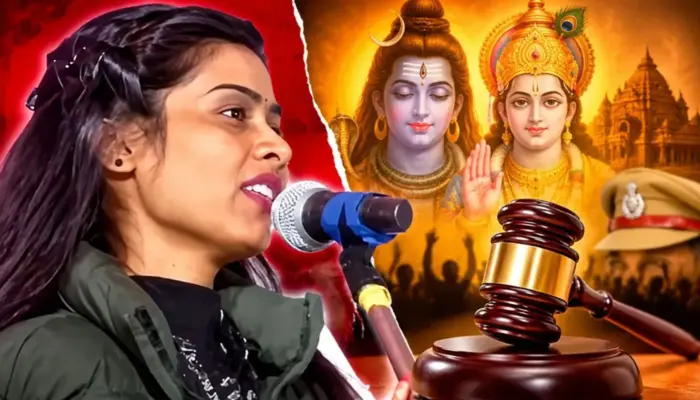
Hindu deities Lord Shiva and Lord Vishnu were subjected to abusive and derogatory remarks by Birha folk singer Ruchi Yadav in a video circulated on Facebook. On 18 November 2026, Kamalendra Mishra, also known as Pawan Mishra, the state president of the Savarna Army, approached Maheshganj Police Station in Pratapgarh district, Uttar Pradesh, and submitted a written complaint against Birha folk singer Ruchi Yadav and a man identified as Chhedi over a Facebook video containing derogatory and objectionable remarks about Hindu deities. According to the complaint, Mishra had been browsing Facebook when he came across a video uploaded to the Facebook page ‘Singer Ruchi Yadav’, which belonged to Ruchi Yadav, a resident of Khargipur Lauli village under the Kohdaur police station area. The video featured Ruchi Yadav singing and using abusive and objectionable language against Hindu deities, specifically Lord Shiva and Lord Vishnu. The video also mentioned a man identified as Chhedi, who was subsequently named alongside Ruchi Yadav in the police complaint. Mishra objected to the derogatory portrayal of the Hindu deities and demanded that the police investigate the video and take strict legal action against both individuals. The incident generated resentment among members of the Hindu community, while the Savarna Army state president publicly condemned the content and called for action against those responsible for making objectionable remarks about Hindu religious figures on social media. Following the complaint, Maheshganj Police registered a case against Ruchi Yadav and Chhedi under Sections 299, 302 and 3(5) of the Bharatiya Nyaya Sanhita (BNS), along with Section 67 of the Information Technology Act, 2000, as amended in 2008. Maheshganj Station House Officer Bhupesh Nath confirmed that the complaint had been received, an FIR had been registered, and legal proceedings were underway. The police subsequently began examining the Facebook video mentioned in the complaint to determine the next course of action.
Why it is Hate Crime ?
This case has been added to the tracker under the primary category of - Hate speech against Hindus. Within it, the sub-category selected here is - Anti-Hindu slurs, mocking faith. Anti-Hindu slurs and the deliberate mocking of the Hindu faith owing to religious animosity involve the usage of derogatory terms, stereotypes, or offensive references to religious practices, symbols, or figures. One of the common anti-Hindu slurs used against Hindus is “cow-worshipper” and “cow piss drinker”. The intention of using this term is to demean and mock Hindus as a group and their religious beliefs since Hindus consider the cow holy. Additionally, some symbols and the slurs attached to them have a historical context that exacerbates the insult, hate, stereotyping, dehumanisation and oppression against Hindus. Cow worship has been used for centuries to denigrate Hindus, insult their faith and oppress Hindus specifically as a religious group. There has been overwhelming documentation about how cow slaughter has been used to persecute Hindus with cow meat being thrown in temples and places of worship. There has also been overwhelming documentation where cow meat (beef) has been force-fed to Hindus to either forcefully convert them to Islam or denigrate their faith. Apart from cow worship, the Swastika – which holds deep religious significance for the Hindus – has also been misinterpreted and distorted to use as a slur against Hindus. Similarly, the worship of the Shivling has been used by supremacist ideologies and religions to denigrate Hindus owing to religious animosity. Such slurs and denigration stem out of inherent animosity and hate towards Hindus and their faith, therefore, it is categorised as hate speech targeted at Hindus specifically owing to their religious identity. The incident constituted a case of religiously targeted hostility because the derogatory content was directed specifically at Hindu deities. Lord Shiva and Lord Vishnu occupy a central position in Hindu religious belief and worship, and are revered by millions of Hindus as divine figures. Lord Shiva is revered as Mahadev, the supreme deity associated with creation, preservation and destruction, and is worshipped across India in numerous forms, including the Shiva Lingam. Lord Vishnu is worshipped as the preserver and protector of the universe, with his various avatars, including Lord Rama and Lord Krishna, occupying a central place in Hindu scriptures, traditions and devotional practices. Both deities are among the most revered figures in Hinduism, with millions of devotees offering prayers, observing religious rituals and celebrating festivals dedicated to them. Their significance extends beyond individual worship, forming an integral part of Hindu civilisation, spiritual traditions and collective religious identity. Consequently, the use of abusive and derogatory language against these deities amounted to an attack on figures held sacred by the Hindu community and struck at the religious sentiments of millions of their devotees. The religious character of the incident was particularly significant because the objectionable content was not directed at an individual Hindu devotee or a particular religious organisation, but at the deities themselves. Hindu religious beliefs, practices and collective identity are intrinsically connected to the worship and reverence of these divine figures. Deliberately subjecting them to abusive or degrading expressions consequently amounted to an attack on objects of Hindu faith and religious reverence. Such conduct normalises contempt towards Hindu religious beliefs and undermines the dignity accorded to their sacred figures. The fact that the remarks were disseminated through a Facebook video further extended the reach of the derogatory content beyond a private exchange, making it accessible to a wider audience and exposing Hindu religious sentiments to public denigration. The distinction between legitimate expression and religious hostility is important in assessing this incident. Criticism of religious institutions, practices or beliefs does not automatically constitute a hate crime. However, the use of abusive and objectionable language specifically against Hindu deities presented a different dimension, as it involved the disparagement of figures central to Hindu worship and faith. The targeting of Lord Shiva and Lord Vishnu gave the content a distinctly anti-Hindu religious character. In recent times, social media has increasingly become a platform for anti-Hindu hate, with derogatory memes, videos, and messages targeting Hindu religious symbols, practices, and deities. Such content is recognised as part of a broader pattern of Hinduphobia and religious hate crimes online. This deliberate targeting of revered religious icons firmly establishes this act as a religiously motivated hate crime; therefore, it is being categorised under the hate crime database.


Case Status
Complaint registered


Perpetrators Details
Perpetrators
Others
Perpetrators Range
From 2 To 5
Perpetrators Gender
both
 Sources



