Hindu deities targeted, Hindu women wearing bindi and sindoor branded “prostitutes” by Muslim cleric in Bangladesh
 Bangladesh
 6 November, 2026
Case Summary
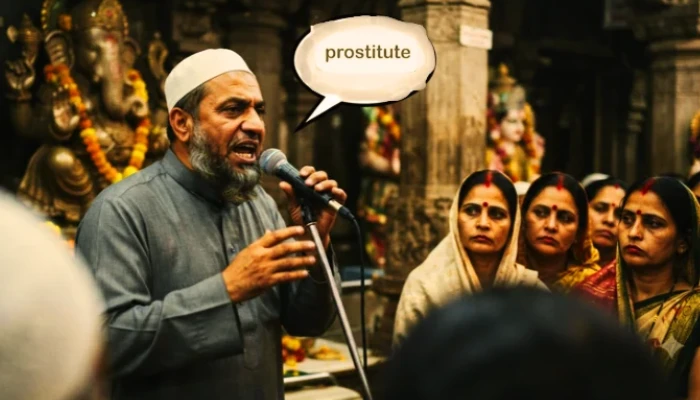
In Bangladesh, Hindu women were subjected to sexually degrading insults by an Islamic cleric, who particularly targeted those who wore a red bindi and applied sindoor. The accused branded Hindu women as prostitutes solely because of their religious and cultural practices and further denigrated Hinduism by making obscene remarks about the faith and its traditions. An undated video of the accused making these remarks went viral on social media after Sanatan TV shared it. In the video, the accused stated that Hindu women who applied sindoor or wore a red bindi were prostitutes. He further claimed that these practices were exclusive to Hindu women and that Hindu women worshipped prostitutes as part of their religion. He also said that Muslim women should not apply sindoor or wear a red bindi, associating these Hindu symbols with prostitution. The accused further attempted to justify his derogatory remarks by stating, "It is not your fault, it is simply the fault of your birth." His statements explicitly targeted Hindu women on the basis of their religious identity and subjected their traditional symbols of faith and marital identity to sexually degrading abuse. The video triggered outrage among social media users, who condemned the cleric for insulting Hindu women and denigrating Hindu religious and cultural practices.
Why it is Hate Crime ?
This case has been added to the tracker under the primary category of Hate speech against Hindus. Within it, the sub-category selected here is Anti-Hindu slurs, mocking the faith. Anti-Hindu slurs and the deliberate mocking of the Hindu faith owing to religious animosity involve the use of derogatory terms, stereotypes, or offensive references to religious practices, symbols, or figures. One of the common anti-Hindu slurs used against Hindus is “cow-worshipper” and “cow piss drinker”. The intention of using these terms is to demean and mock Hindus as a group and their religious beliefs, since Hindus consider the cow holy. Additionally, some symbols and the slurs attached to them have a historical context that exacerbates the insult, hate, stereotyping, dehumanization,n and oppression against Hindus. Cow worship has been used for centuries to denigrate Hindus, insult their faith,th and oppress Hindus specifically as a religious group. There has been overwhelming documentation about how cow slaughter has been used to persecute Hindus,dus with cow meat being thrown in temples and places of worship. There has also been overwhelming documentation that cow meat (beef) has been force-fed to Hindus to either forcefully convert them to Islam or denigrate their faith. Apart from cow worship, the Swastika – which holds deep religious significance for the Hindus – has also been misinterpreted and distorted and used as a slur against Hindus. Similarly, the worship of the Shivling has been used by supremacist ideologies and religions to denigrate Hindus owing to religious animosity. Such slurs and denigration stem from inherent animosity and hate towards Hindus and their faith; therefore, it is categorised as hate speech targeted at Hindus specifically owing to their religious identity. This incident constituted an instance of the denigration of Hinduism, as Hindu women were targeted for observing their religious and cultural traditions, while Hindu deities were subjected to sexually degrading insults, reflecting contempt for Hindu faith and its sacred symbols. The targeting of women who wore a bindi and applied sindoor was particularly significant because these are not merely decorative elements or personal fashion choices. The bindi and sindoor are not merely decorative elements or arbitrary customs. The bindi is traditionally applied to the forehead, at the point associated with the Ajna Chakra in Hindu spiritual traditions, which is symbolically connected with awareness, concentration, and inner perception. Sindoor is deeply embedded in Hindu marital and religious traditions. Traditionally applied along the hair parting by married Hindu women, it symbolises marital auspiciousness, devotion and prayers for the longevity and well-being of their husbands. Its traditional preparation also reflects knowledge of natural materials, with turmeric being treated with alkaline substances such as slaked lime to produce its characteristic red colour. Thus, sindoor carries religious, cultural and traditional significance and cannot be reduced to a mere cosmetic choice. Ridiculing Hindu women for wearing it amounts to disparaging a deeply rooted expression of their religious and cultural identity. The use of sexually degrading terminology to describe Hindu women was particularly contemptuous. Instead of merely expressing disagreement with a religious custom, the cleric attached sexual stigma to women for observing their own traditions. By portraying Hindu women as sexually immoral on account of wearing a bindi or sindoor, he attempted to strip these symbols of their religious and cultural significance and replace them with a degrading sexual association. Such language was not an ordinary religious disagreement; it was a deliberate form of humiliation directed at Hindu women for visibly practising and expressing their faith. The extension of obscene insults to Hindu deities further aggravated the disparagement. Hindu Gods and Goddesses are sacred objects of devotion, worship and reverence for Hindus. Using sexually degrading language against them demonstrated contempt not merely for individual devotees but for the sacred figures and beliefs at the heart of Hindu religious life. The accused's remark, "It is not your fault, it is simply the fault of your birth," carried an additional and deeply disparaging implication. By suggesting that Hindus were not responsible for being born into Hinduism, he implicitly framed their religious identity as an unfortunate circumstance rather than a faith they could rightfully continue to practise with dignity. The statement went beyond insulting Hindu customs; it conveyed the expectation that Hindus should recognise their supposed religious inferiority and abandon their faith in favour of Islam. This presented conversion as a means of escaping an identity that the accused had portrayed as undesirable. Such rhetoric reinforced a religious hierarchy in which Islam was implicitly placed above Hinduism, while Hindu religious identity was treated as something from which its followers ought to distance themselves. It sent a deeply contemptuous message to Hindu devotees that their faith, traditions, and continued adherence to Hinduism did not deserve equal dignity or respect. The remarks also reflected an exclusionary religious outlook in which Hindu customs and symbols were treated as inferior, while Islamic religious identity was presented as the standard against which they were judged. The suggestion that Muslim women should not adopt Hindu symbols, coupled with the sexually degrading portrayal of Hindu women who observed these customs, revealed a supremacist outlook. These remarks implicitly positioned Muslim women as superior to Hindu women. In contrast, Hindu women and their religious practices were subjected to sexual humiliation and contempt, reinforcing the notion that Hindus were inferior and deserved to be looked down upon. This reflected a supremacist understanding of religious identity in which one's own faith was treated as superior, and the traditions of another community were subjected to ridicule and degradation. By making the disparaging remarks, the Muslim cleric revealed his disdain for Hinduism. His words are not just casual insults but indicate a deeper hostility, fueled by a desire to demean and belittle Hindu beliefs and customs. As such, this incident is being categorised as a religiously motivated hate crime against Hindus. Disclaimer: The Hinduphobia Tracker records incidents based on when an event occurred or when the victim's ordeal began. The report does not specify the exact date the accused delivered the offensive content. Therefore, for documentation purposes, we used 07 November 2026, the date the video circulated in the media, as the incident date.


Case Status
Unknown


Perpetrators Details
Perpetrators
Muslim Extremists
Perpetrators Range
One Person
Perpetrators Gender
male
 Sources



