Hindu employee denied entry at TCS office by Muslim senior for observing Ayyappa Deeksha
 Rangareddi, Telangana, India
 18 November, 2026
Case Summary
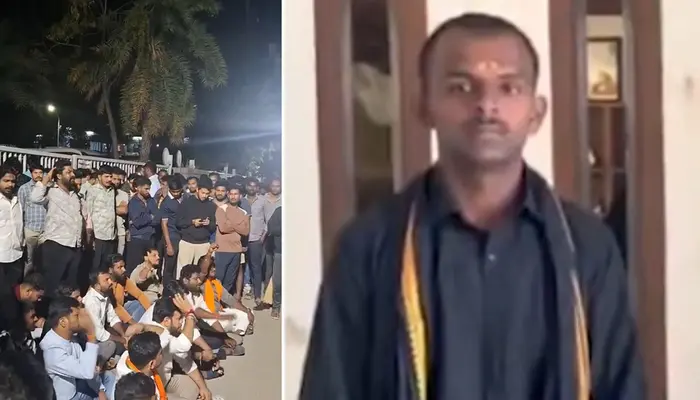
At the Tata Consultancy Services (TCS) office in Adibatla, Rangareddy district, Telangana, a Hindu employee named Manish was stopped from entering the workplace on instructions of a Muslim employee, Sikendar Shah, for observing Ayyappa Deeksha and wearing traditional attire associated with the religious observance. According to reports, Manish, who had been working at the company for approximately two years, stated that he had informed the management of his decision to undertake Ayyappa Deeksha around two months before the incident. Despite having given prior notice, he was stopped at the office entrance on 19 November 2026 by security personnel, who cited the company's dress code as the reason for denying him entry. Manish questioned the selective enforcement of the dress code, pointing out that other employees were permitted to enter the premises without adhering to the prescribed dress requirements, whereas he was specifically stopped because of his traditional attire. He also identified his senior, Sikender Shah, as being responsible for the discriminatory treatment. The incident prompted Ayyappa devotees and members of Hindu organisations to gather outside the TCS office and stage a protest against the management. The protesters raised slogans and demanded that Manish be allowed to perform his professional duties without being restricted on account of his religious observance. They also called for respect for his religious beliefs and the traditions associated with Ayyappa Deeksha. The incident drew the attention of the Adibatla Police, who reached the premises and intervened to bring the situation under control. A senior police officer claimed that the matter had stemmed from a misunderstanding rather than communal hostility. According to the officer, Manish had arrived at the workplace wearing a traditional mundu (dhoti), following which the HR department had asked him to change into trousers. The officer claimed that the HR department had cited the presence of foreign clients who might not understand the cultural significance of the attire and could express disapproval of it. At the same time, an Adibatla police officer said that the police had not received any formal written complaint from Manish at the time and were examining the circumstances surrounding the incident. The police subsequently stated that the protest had ended peacefully, with no further disturbance reported.
Why it is Hate Crime ?
This case has been added to the tracker under the primary category of - Restriction/ban on Hindu practices. Within it, the sub-category selected here is - Restriction on expression of Hindu identity. An example of the state-affected prejudicial and targeted orders against the Hindu community would be a government denying the right of a Hindu or a group of Hindus to hold a religious procession owing to the animosity of non-Hindu groups. Denial of the religious right of the Hindus to assuage the non-Hindu group which harbours animosity to a point where it could lead to violence against Hindus is not only a failure of law and order but is a prejudicial order against Hindus, denying them their fundamental rights to express their religious identity. An example of a hate crime against Hindus by a non-Hindu would be a non-Hindu institution forcing its Hindu employees to abandon religious symbols that a Hindu would wear as an expression of faith owing to inherent prejudice against the faith professed by the victim or a non-Hindu group of people restricting a Hindu group from constructing a place of worship simply because the demography of the area in which the temple is being built is dominated by non-Hindus. Such actions are driven by religious animosity and/or prejudice against Hindus and their faith and would therefore be categorized as a hate crime. The incident at the TCS Adibatla office constituted religious discrimination against a Hindu employee for practising his faith by a Muslim man. Manish was prevented from entering the workplace while observing Ayyappa Deeksha, a Hindu religious commitment, and wearing the traditional attire associated with it. The discriminatory nature of the incident stemmed from the fact that his religious observance became the specific reason for restricting his access to the workplace. Ayyappa Deeksha involves a period of religious discipline, devotion and personal austerity undertaken by devotees in preparation for the pilgrimage to the Sabarimala temple. During this period, devotees follow specific practices concerning clothing, food, conduct and daily routine. The traditional mundu or dhoti and other prescribed attire form part of this religious observance. Consequently, forcing a devotee to abandon or alter this attire constitutes interference with an established Hindu religious practice. Manish was effectively placed in a position where he had to compromise his religious observance to gain access to his workplace. Such treatment made the expression of his Hindu identity conditional upon compliance with demands that disregarded the religious significance of his attire. If TCS had genuine concerns about its workplace dress code or considered traditional mundu inappropriate for its professional environment, the management had ample opportunity to communicate these requirements to Manish when he first informed them, approximately two months earlier, about his intention to undertake Ayyappa Deeksha. The company could have clarified its dress-code expectations well in advance and discussed a reasonable arrangement that respected both its workplace requirements and the employee's religious observance. Instead, no such objection was raised at the time, and Manish was stopped from entering the workplace only when he arrived wearing the prescribed religious attire. This raised a pertinent question: if the attire genuinely violated company policy, why was this not communicated when the employee first notified management of his religious observance? The sudden enforcement of the dress code at the workplace, rather than any prior clarification, reflected that the restriction was not handled as a routine administrative matter but was imposed in a manner that directly interfered with his religious practice. The justification that foreign clients might not understand the cultural significance of traditional Indian attire and could express disapproval of it further exposed the discriminatory nature of the restriction. The unfamiliarity of foreign clients with Hindu customs could not justify treating Hindu religious practices as incompatible with professional standards. Rather than respecting an employee's religious observance, the reasoning placed the presumed preferences of foreign clients above his right to practise his faith. It effectively communicated that Hindu religious customs were acceptable only when they remained invisible or did not make people unfamiliar with them uncomfortable. This expectation placed the burden of cultural accommodation entirely on the Hindu employee and treated his religious identity as an inconvenience that needed to be concealed in a corporate environment. The selective enforcement of the dress code further established the discriminatory dimension of the incident. Manish specifically questioned why employees who did not follow the prescribed dress requirements were permitted to enter the premises while he was stopped for wearing attire associated with Ayyappa Deeksha. A workplace dress code could constitute a legitimate organisational requirement, but its selective application against an employee observing a Hindu religious tradition amounted to unequal treatment. The issue was not simply the enforcement of corporate clothing standards but the use of those standards to restrict a Hindu employee's religious expression. Such differential treatment singled out his religious observance for restriction while apparently allowing flexibility in the case of other employees. The involvement of Manish's Muslim senior, Sikender Shah, was particularly significant in establishing the religious dimension of the incident. Manish specifically identified Shah as the person responsible for the discriminatory treatment and attributed the restriction on his entry to him. This demonstrated religious animosity towards Hindus and their religious practices, as a Hindu employee was singled out and restricted from entering his workplace while observing an established Hindu religious tradition. The treatment also placed Manish in a humiliating position, forcing him to face embarrassment and indignity at his workplace because he chose to observe his faith. Rather than being allowed to fulfil his professional responsibilities while adhering to his religious commitments, he was made to feel that openly practising his Hindu faith was incompatible with his place of employment. Such conduct by Manish's Muslim senior, Sikender Shah, was rooted in religious animosity towards Hindus and their religious practices. By singling out Manish and restricting his entry into the workplace while he was observing Ayyappa Deeksha, Shah subjected him to discriminatory and humiliating treatment on account of his Hindu faith. The incident therefore constituted religiously motivated discrimination against a Hindu employee and has been included in the Hate Crime database of the Hinduphobia Tracker.
Victim Details
Total Victim
1
Deceased
0
Gender
- Male 1
- Female 0
- Third Gender 0
- Unknown 0
Caste
- SC/ST 0
- OBC 0
- General 0
- Unknown 1
Age Group
- Minor 0
- Adult 1
- Senior Citizen 0
- Unknown 0


Case Status
Complaint filed


Perpetrators Details
Perpetrators
Muslim Extremists
Perpetrators Range
One Person
Perpetrators Gender
male
 Sources



